

112
7 Fluctuations of the Proton Electromotive Force Across Inner Mitochondrial. . .
occur at that location [2] and superposition with electrical potential difference can
lead to P MF s attaining the 200 mV mark.
Since the intermembrane space in most of its traject has a width of only
about 10–20 nanometers this dimension limits a region of molecular proportions
where fluctuations in thermodynamic parameters may become an important part
of the forces acting upon the molecular machines inserted alongside the inner
mitochondrial membrane.
This paper analyses some consequences of the particular geometry of the intermembrane space (I MS) in mitochondria, which may result in relatively important
fluctuations of proton-motive force across the I MM.
7.2 Theory
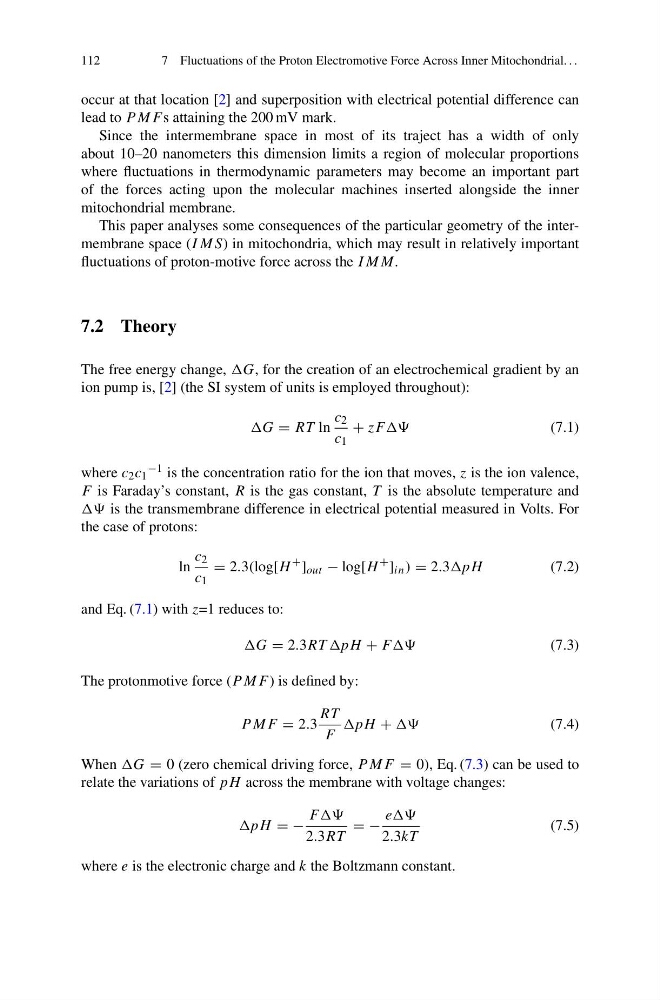
The free energy change, G, for the creation of an electrochemical gradient by an
ion pump is, [2] (the SI system of units is employed throughout):
G = RT ln
c 2
c 1
+ zFFF
(7.1)
where c 2 c 1
−1 is the concentration ratio for the ion that moves, z is the ion valence,
F is Faraday’s constant, R is the gas constant, T is the absolute temperature and
is the transmembrane difference in electrical potential measured in Volts. For
the case of protons:
ln
c 2
c 1
= 2.3(log[H
+
] out − log[H
+
] in ) = 2.3pH
(7.2)
and Eq. (7.1) with z=1 reduces to:
G = 2.3RT TpH + FFF
(7.3)
The protonmotive force (P MF ) is defined by:
P MF = 2.3
RT
F
+
(7.4)
When G = 0 (zero chemical driving force, P MF = 0), Eq. (7.3) can be used to
relate the variations of pH across the membrane with voltage changes:
pH = −
FFF
2.3RT
= −
eee
2.3kT
(7.5)
where e is the electronic charge and k the Boltzmann constant.
7 Fluctuations of the Proton Electromotive Force Across Inner Mitochondrial. . .
occur at that location [2] and superposition with electrical potential difference can
lead to P MF s attaining the 200 mV mark.
Since the intermembrane space in most of its traject has a width of only
about 10–20 nanometers this dimension limits a region of molecular proportions
where fluctuations in thermodynamic parameters may become an important part
of the forces acting upon the molecular machines inserted alongside the inner
mitochondrial membrane.
This paper analyses some consequences of the particular geometry of the intermembrane space (I MS) in mitochondria, which may result in relatively important
fluctuations of proton-motive force across the I MM.
7.2 Theory
The free energy change, G, for the creation of an electrochemical gradient by an
ion pump is, [2] (the SI system of units is employed throughout):
G = RT ln
c 2
c 1
+ zFFF
(7.1)
where c 2 c 1
−1 is the concentration ratio for the ion that moves, z is the ion valence,
F is Faraday’s constant, R is the gas constant, T is the absolute temperature and
is the transmembrane difference in electrical potential measured in Volts. For
the case of protons:
ln
c 2
c 1
= 2.3(log[H
+
] out − log[H
+
] in ) = 2.3pH
(7.2)
and Eq. (7.1) with z=1 reduces to:
G = 2.3RT TpH + FFF
(7.3)
The protonmotive force (P MF ) is defined by:
P MF = 2.3
RT
F
+
(7.4)
When G = 0 (zero chemical driving force, P MF = 0), Eq. (7.3) can be used to
relate the variations of pH across the membrane with voltage changes:
pH = −
FFF
2.3RT
= −
eee
2.3kT
(7.5)
where e is the electronic charge and k the Boltzmann constant.