

77
complexity of the problem. In such cases, AS (through the processes of primary
succession) increase species richness and taxonomic diversity in a given area and
increase and strengthen functional diversity and/or provide new services and goods
(Bonsdorff 2006 ; Kotta et al. 2006 ).
It must be emphasised that the Baltic Sea is ‘a sea of aliens’ (Leppäkoski et al.
2002 ), since almost all marine organisms present today invaded the area sometime
over the last 10,000 years. However, as it was mentioned previously, the invasion
rate has accelerated enormously since the 1950s mainly due to human activities
(such as maritime transportation and habitat change). Moreover, synergistic effects
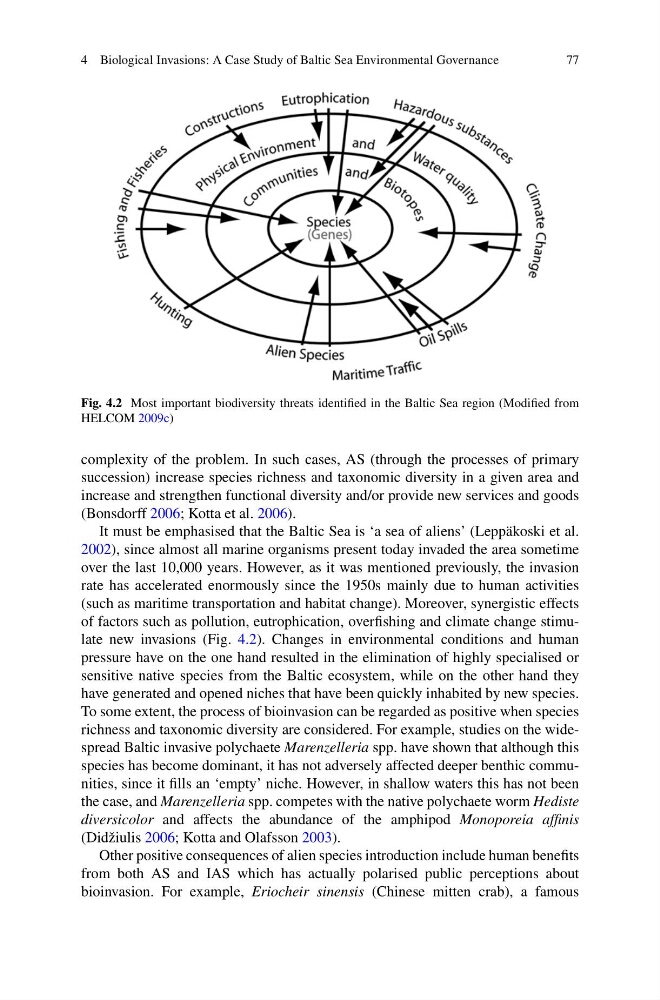
of factors such as pollution , eutrophication, overfi shing and climate change stimulate new invasions (Fig. 4.2 ). Changes in environmental conditions and human
pressure have on the one hand resulted in the elimination of highly specialised or
sensitive native species from the Baltic ecosystem, while on the other hand they
have generated and opened niches that have been quickly inhabited by new species.
To some extent, the process of bioinvasion can be regarded as positive when species
richness and taxonomic diversity are considered. For example, studies on the widespread Baltic invasive polychaete Marenzelleria spp. have shown that although this
species has become dominant, it has not adversely affected deeper benthic communities, since it fi lls an ‘empty’ niche. However, in shallow waters this has not been
the case, and Marenzelleria spp. competes with the native polychaete worm Hediste
diversicolor and affects the abundance of the amphipod Monoporeia affi nis
(Didžiulis 2006 ; Kotta and Olafsson 2003 ).
Other positive consequences of alien species introduction include human benefi ts
from both AS and IAS which has actually polarised public perceptions about
bioinvasion. For example, Eriocheir sinensis (Chinese mitten crab), a famous
Fig. 4.2 Most important biodiversity threats identifi ed in the Baltic Sea region (Modifi ed from
HELCOM 2009c )
4 Biological Invasions: A Case Study of Baltic Sea Environmental Governance
complexity of the problem. In such cases, AS (through the processes of primary
succession) increase species richness and taxonomic diversity in a given area and
increase and strengthen functional diversity and/or provide new services and goods
(Bonsdorff 2006 ; Kotta et al. 2006 ).
It must be emphasised that the Baltic Sea is ‘a sea of aliens’ (Leppäkoski et al.
2002 ), since almost all marine organisms present today invaded the area sometime
over the last 10,000 years. However, as it was mentioned previously, the invasion
rate has accelerated enormously since the 1950s mainly due to human activities
(such as maritime transportation and habitat change). Moreover, synergistic effects
of factors such as pollution , eutrophication, overfi shing and climate change stimulate new invasions (Fig. 4.2 ). Changes in environmental conditions and human
pressure have on the one hand resulted in the elimination of highly specialised or
sensitive native species from the Baltic ecosystem, while on the other hand they
have generated and opened niches that have been quickly inhabited by new species.
To some extent, the process of bioinvasion can be regarded as positive when species
richness and taxonomic diversity are considered. For example, studies on the widespread Baltic invasive polychaete Marenzelleria spp. have shown that although this
species has become dominant, it has not adversely affected deeper benthic communities, since it fi lls an ‘empty’ niche. However, in shallow waters this has not been
the case, and Marenzelleria spp. competes with the native polychaete worm Hediste
diversicolor and affects the abundance of the amphipod Monoporeia affi nis
(Didžiulis 2006 ; Kotta and Olafsson 2003 ).
Other positive consequences of alien species introduction include human benefi ts
from both AS and IAS which has actually polarised public perceptions about
bioinvasion. For example, Eriocheir sinensis (Chinese mitten crab), a famous
Fig. 4.2 Most important biodiversity threats identifi ed in the Baltic Sea region (Modifi ed from
HELCOM 2009c )
4 Biological Invasions: A Case Study of Baltic Sea Environmental Governance