

175
8.2 Theoretical Context
8.2.1 Science-Policy Theory and the Ecosystem Approach
to Management
Science-based advice is universally regarded and used as a primary trustworthy
basis for environmental management and decision-making. However, at the same
time, in many areas, there is an ambiguity and increasing concern about the sole
dependence on expertise from the (natural) sciences, which often acts to the
detriment of suffi cient consideration of other knowledge claims, stakeholder
perspectives and values held by actors such as NGOs, citizens or business people.
Bijker et al. ( 2009 : 1) have called this phenomenon the paradox of scientifi c
authority and asked the question of ‘how can scientifi c advice be effective and
infl uential in an age in which the status of science and/or scientists seems to be as
low as it has ever been?’ One reason for this paradox lies in the fact that science
becomes politicised whenever it is called into a political context (Weingart 1999 )
and is hence subject to constraints, i.e. rules, norms and evaluation criteria, other
than those set by the scientifi c community. A basic challenge is that the demarcation
that exists between the spheres of science and politics falls apart in such contexts,
which consequently leads to concerns and potential confl icts about the legitimate
role of science and its relation to policy. Both the role of science- based advice and
the political decisions based on it may therefore become contested with respect to
credibility , legitimacy and accountability (cf. Cash et al. 2003 ).
In management practice, a distinction is often made between a science system
(representing factual knowledge claims) and a social system (representing political,
business and other concerns of public life) – a division that is inscribed in the
institutional design of most policy systems in modern societies. Science is responsible for providing the best available knowledge in terms of a presumed value-free
and objective input to political decision-making, which is accordingly seen as most
rational and democratically legitimated (Funtowicz and Strand 2007 ; Wilson 2009 ).
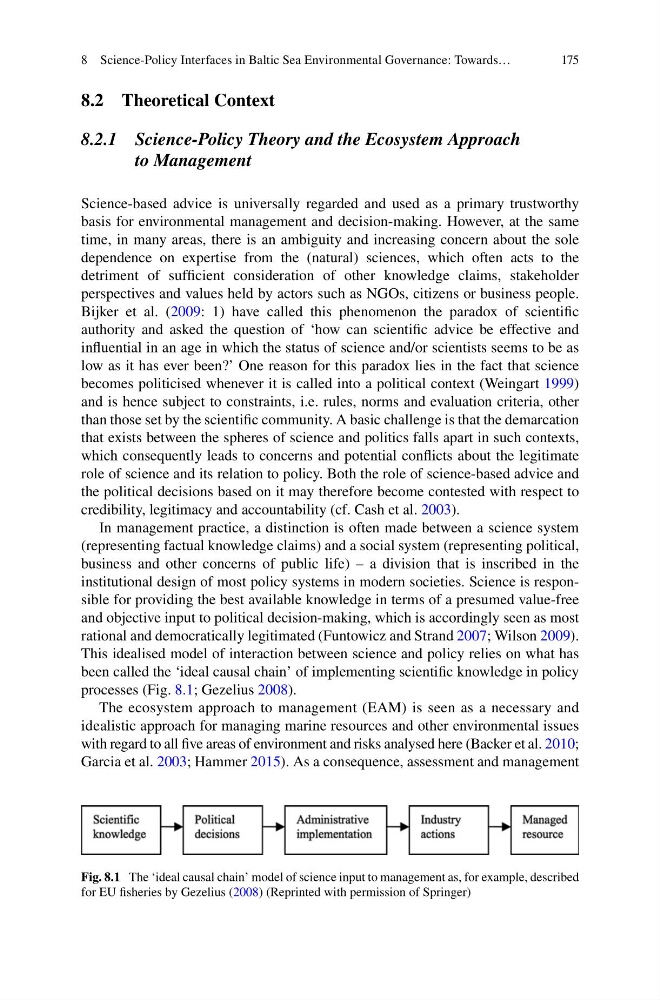
This idealised model of interaction between science and policy relies on what has
been called the ‘ideal causal chain’ of implementing scientifi c knowledge in policy
processes (Fig. 8.1 ; Gezelius 2008 ).
The ecosystem approach to management (EAM) is seen as a necessary and
idealistic approach for managing marine resources and other environmental issues
with regard to all fi ve areas of environment and risks analysed here (Backer et al. 2010 ;
Garcia et al. 2003 ; Hammer 2015 ). As a consequence, assessment and management
Fig. 8.1 The ‘ideal causal chain’ model of science input to management as, for example, described
for EU fi sheries by Gezelius ( 2008 ) (Reprinted with permission of Springer)
8 Science-Policy Interfaces in Baltic Sea Environmental Governance: Towards…
8.2 Theoretical Context
8.2.1 Science-Policy Theory and the Ecosystem Approach
to Management
Science-based advice is universally regarded and used as a primary trustworthy
basis for environmental management and decision-making. However, at the same
time, in many areas, there is an ambiguity and increasing concern about the sole
dependence on expertise from the (natural) sciences, which often acts to the
detriment of suffi cient consideration of other knowledge claims, stakeholder
perspectives and values held by actors such as NGOs, citizens or business people.
Bijker et al. ( 2009 : 1) have called this phenomenon the paradox of scientifi c
authority and asked the question of ‘how can scientifi c advice be effective and
infl uential in an age in which the status of science and/or scientists seems to be as
low as it has ever been?’ One reason for this paradox lies in the fact that science
becomes politicised whenever it is called into a political context (Weingart 1999 )
and is hence subject to constraints, i.e. rules, norms and evaluation criteria, other
than those set by the scientifi c community. A basic challenge is that the demarcation
that exists between the spheres of science and politics falls apart in such contexts,
which consequently leads to concerns and potential confl icts about the legitimate
role of science and its relation to policy. Both the role of science- based advice and
the political decisions based on it may therefore become contested with respect to
credibility , legitimacy and accountability (cf. Cash et al. 2003 ).
In management practice, a distinction is often made between a science system
(representing factual knowledge claims) and a social system (representing political,
business and other concerns of public life) – a division that is inscribed in the
institutional design of most policy systems in modern societies. Science is responsible for providing the best available knowledge in terms of a presumed value-free
and objective input to political decision-making, which is accordingly seen as most
rational and democratically legitimated (Funtowicz and Strand 2007 ; Wilson 2009 ).
This idealised model of interaction between science and policy relies on what has
been called the ‘ideal causal chain’ of implementing scientifi c knowledge in policy
processes (Fig. 8.1 ; Gezelius 2008 ).
The ecosystem approach to management (EAM) is seen as a necessary and
idealistic approach for managing marine resources and other environmental issues
with regard to all fi ve areas of environment and risks analysed here (Backer et al. 2010 ;
Garcia et al. 2003 ; Hammer 2015 ). As a consequence, assessment and management
Fig. 8.1 The ‘ideal causal chain’ model of science input to management as, for example, described
for EU fi sheries by Gezelius ( 2008 ) (Reprinted with permission of Springer)
8 Science-Policy Interfaces in Baltic Sea Environmental Governance: Towards…