

83
suggested that the EU Parliament should persuade all the coastal Member States to
endorse the Convention, or even that the EU Commission should consider legislative action in this fi eld. Since Member States differ in their perception of IAS, the
framework should be developed with the aim of establishing common objectives,
terminology and procedures to prevent bioinvasions in the marine environment, as
well as controlling measures for sustaining or restoring marine biodiversity .
In the Baltic Sea region, national legislations and policies relating to IAS risk
assessment and management are being developed. Risk analysis is one of the most
important activities that are necessary to plan appropriate, science-based and costeffective management options. Risk assessment is a logical process for assessing
the likelihood and consequences of specifi c events, such as the entry, establishment,
or spread of harmful aquatic organisms and pathogens. Risk assessment can be
qualitative or quantitative, and can be a valuable decision aid if completed in a
systemic and rigorous manner (MEPC. 162(56)).
13 Marine biosecurity risk assessments follow standardised risk procedures and in case of IAS have been previously
based on frameworks and concepts of general ecological risk assessment (Leppäkoski
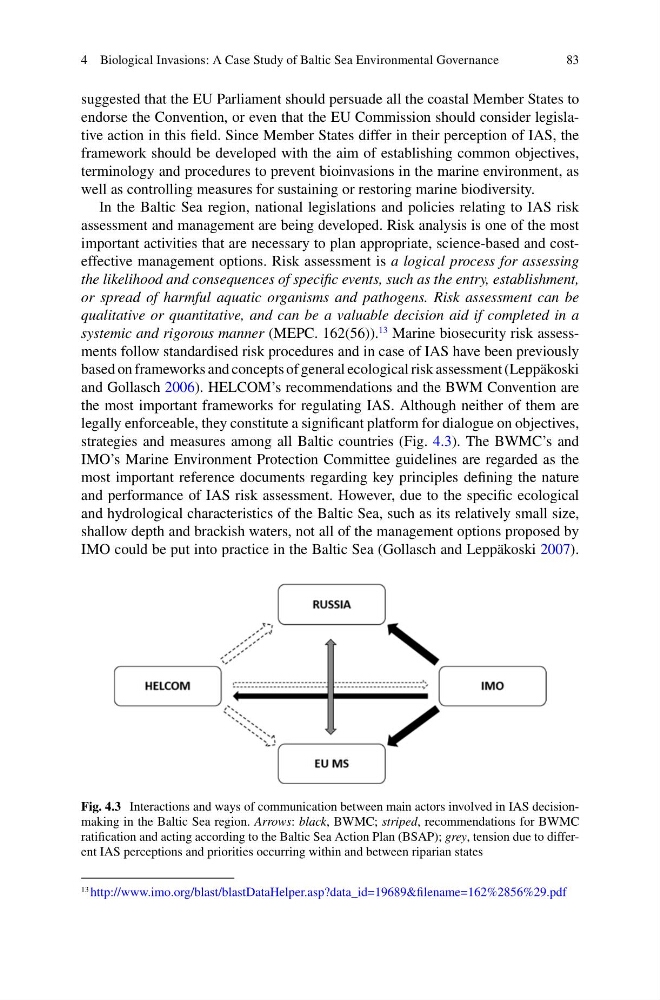
and Gollasch 2006 ). HELCOM’s recommendations and the BWM Convention are
the most important frameworks for regulating IAS. Although neither of them are
legally enforceable, they constitute a signifi cant platform for dialogue on objectives,
strategies and measures among all Baltic countries (Fig. 4.3 ). The BWMC’s and
IMO’s Marine Environment Protection Committee guidelines are regarded as the
most important reference documents regarding key principles defi ning the nature
and performance of IAS risk assessment. However, due to the specifi c ecological
and hydrological characteristics of the Baltic Sea, such as its relatively small size,
shallow depth and brackish waters, not all of the management options proposed by
IMO could be put into practice in the Baltic Sea (Gollasch and Leppäkoski 2007 ).
13 http://www.imo.org/blast/blastDataHelper.asp?data_id=19689&fi lename=162%2856%29.pdf
Fig. 4.3 Interactions and ways of communication between main actors involved in IAS decisionmaking in the Baltic Sea region. Arrows : black , BWMC; striped , recommendations for BWMC
ratifi cation and acting according to the Baltic Sea Action Plan (BSAP); grey , tension due to different IAS perceptions and priorities occurring within and between riparian states
4 Biological Invasions: A Case Study of Baltic Sea Environmental Governance
suggested that the EU Parliament should persuade all the coastal Member States to
endorse the Convention, or even that the EU Commission should consider legislative action in this fi eld. Since Member States differ in their perception of IAS, the
framework should be developed with the aim of establishing common objectives,
terminology and procedures to prevent bioinvasions in the marine environment, as
well as controlling measures for sustaining or restoring marine biodiversity .
In the Baltic Sea region, national legislations and policies relating to IAS risk
assessment and management are being developed. Risk analysis is one of the most
important activities that are necessary to plan appropriate, science-based and costeffective management options. Risk assessment is a logical process for assessing
the likelihood and consequences of specifi c events, such as the entry, establishment,
or spread of harmful aquatic organisms and pathogens. Risk assessment can be
qualitative or quantitative, and can be a valuable decision aid if completed in a
systemic and rigorous manner (MEPC. 162(56)).
13 Marine biosecurity risk assessments follow standardised risk procedures and in case of IAS have been previously
based on frameworks and concepts of general ecological risk assessment (Leppäkoski
and Gollasch 2006 ). HELCOM’s recommendations and the BWM Convention are
the most important frameworks for regulating IAS. Although neither of them are
legally enforceable, they constitute a signifi cant platform for dialogue on objectives,
strategies and measures among all Baltic countries (Fig. 4.3 ). The BWMC’s and
IMO’s Marine Environment Protection Committee guidelines are regarded as the
most important reference documents regarding key principles defi ning the nature
and performance of IAS risk assessment. However, due to the specifi c ecological
and hydrological characteristics of the Baltic Sea, such as its relatively small size,
shallow depth and brackish waters, not all of the management options proposed by
IMO could be put into practice in the Baltic Sea (Gollasch and Leppäkoski 2007 ).
13 http://www.imo.org/blast/blastDataHelper.asp?data_id=19689&fi lename=162%2856%29.pdf
Fig. 4.3 Interactions and ways of communication between main actors involved in IAS decisionmaking in the Baltic Sea region. Arrows : black , BWMC; striped , recommendations for BWMC
ratifi cation and acting according to the Baltic Sea Action Plan (BSAP); grey , tension due to different IAS perceptions and priorities occurring within and between riparian states
4 Biological Invasions: A Case Study of Baltic Sea Environmental Governance