

PART TWO
THERMODYNAMICS
AND MOLECULAR PHYSICS
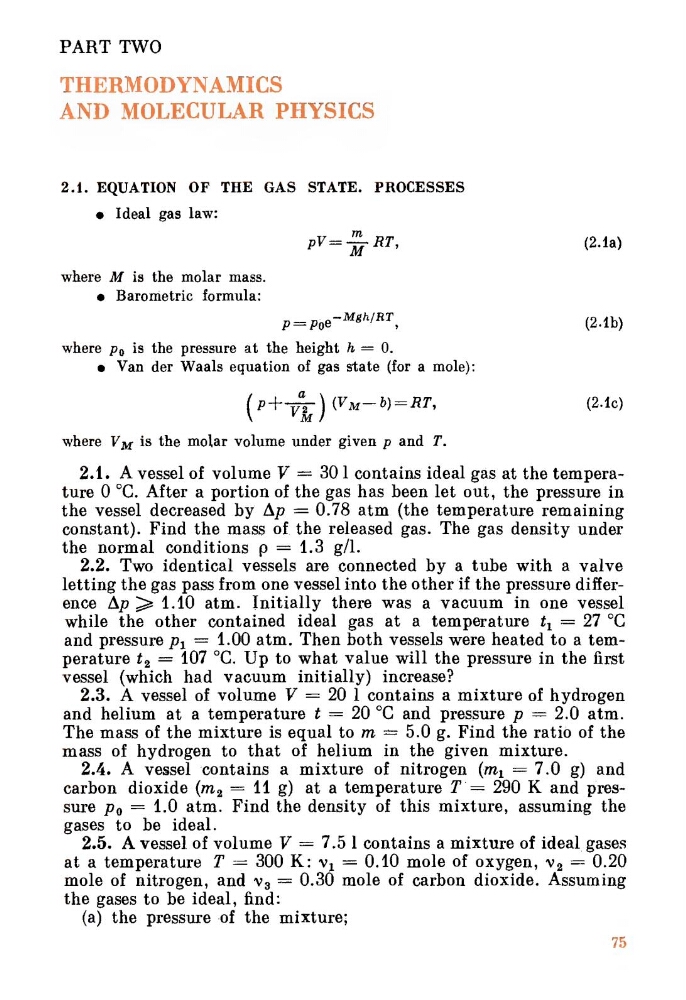
2.1. EQUATION OF THE GAS STATE. PROCESSES
• Ideal gas law:
pV = M RT,
where M is the molar mass.
• Barometric formula:
Poe
MghIRT
where Po is the pressure at the height h = 0.
• Van der Weals equation of gas state (for a mole):
a
(p -H TI- 1 ) (V m—b)-=RT,
where VM is the molar volume under given p and T.
2.1. A vessel of volume V = 30 1 contains ideal gas at the temperature 0 °C. After a portion of the gas has been let out, the pressure in
the vessel decreased by Op = 0.78 atm (the temperature remaining
constant). Find the mass of the released gas. The gas density under
the normal conditions p = 1.3 WI.
2.2. Two identical vessels are connected by a tube with a valve
letting the gas pass from one vessel into the other if the pressure difference Op 1.10 atm. Initially there was a vacuum in one vessel
while the other contained ideal gas at a temperature t1 = 27 °C
and pressure pi = 1.00 atm. Then both vessels were heated to a temperature t 2 = 107 °C. Up to what value will the pressure in the first
vessel (which had vacuum initially) increase?
2.3. A vessel of volume V = 20 1 contains a mixture of hydrogen
and helium at a temperature t = 20 °C and pressure p = 2.0 atm.
The mass of the mixture is equal to m ---- 5.0 g. Find the ratio of the
mass of hydrogen to that of helium in the given mixture.
2.4. A vessel contains a mixture of nitrogen (m1 = 7.0 g) and
carbon dioxide (m2 = 11 g) at a temperature T = 290 K and pressure pc, = 1.0 atm. Find the density of this mixture, assuming the
gases to be ideal.
2.5. A vessel of volume V = 7.5 1 contains a mixture of ideal gases
at a temperature T = 300 K: v1 = 0.10 mole of oxygen, v2 = 0.20
mole of nitrogen, and v3 = 0.30 mole of carbon dioxide. Assuming
the gases to be ideal, find:
(a) the pressure of the mixture;
(2.1a)
(2.1b)
(2.1c)
75
THERMODYNAMICS
AND MOLECULAR PHYSICS
2.1. EQUATION OF THE GAS STATE. PROCESSES
• Ideal gas law:
pV = M RT,
where M is the molar mass.
• Barometric formula:
Poe
MghIRT
where Po is the pressure at the height h = 0.
• Van der Weals equation of gas state (for a mole):
a
(p -H TI- 1 ) (V m—b)-=RT,
where VM is the molar volume under given p and T.
2.1. A vessel of volume V = 30 1 contains ideal gas at the temperature 0 °C. After a portion of the gas has been let out, the pressure in
the vessel decreased by Op = 0.78 atm (the temperature remaining
constant). Find the mass of the released gas. The gas density under
the normal conditions p = 1.3 WI.
2.2. Two identical vessels are connected by a tube with a valve
letting the gas pass from one vessel into the other if the pressure difference Op 1.10 atm. Initially there was a vacuum in one vessel
while the other contained ideal gas at a temperature t1 = 27 °C
and pressure pi = 1.00 atm. Then both vessels were heated to a temperature t 2 = 107 °C. Up to what value will the pressure in the first
vessel (which had vacuum initially) increase?
2.3. A vessel of volume V = 20 1 contains a mixture of hydrogen
and helium at a temperature t = 20 °C and pressure p = 2.0 atm.
The mass of the mixture is equal to m ---- 5.0 g. Find the ratio of the
mass of hydrogen to that of helium in the given mixture.
2.4. A vessel contains a mixture of nitrogen (m1 = 7.0 g) and
carbon dioxide (m2 = 11 g) at a temperature T = 290 K and pressure pc, = 1.0 atm. Find the density of this mixture, assuming the
gases to be ideal.
2.5. A vessel of volume V = 7.5 1 contains a mixture of ideal gases
at a temperature T = 300 K: v1 = 0.10 mole of oxygen, v2 = 0.20
mole of nitrogen, and v3 = 0.30 mole of carbon dioxide. Assuming
the gases to be ideal, find:
(a) the pressure of the mixture;
(2.1a)
(2.1b)
(2.1c)
75