

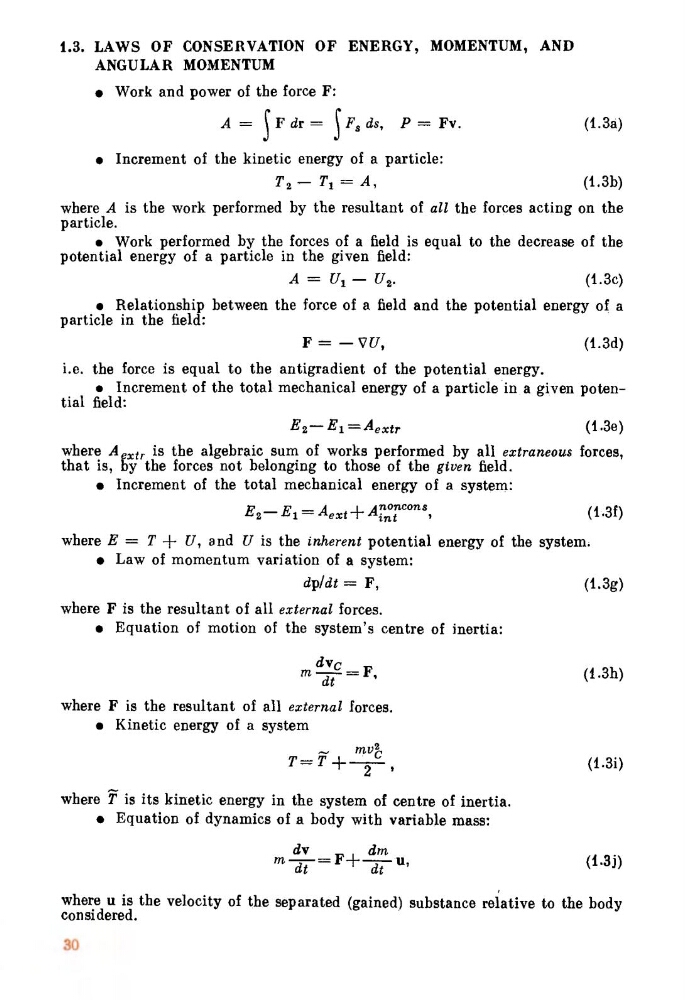
1.3. LAWS OF CONSERVATION OF ENERGY, MOMENTUM, AND
ANGULAR MOMENTUM
• Work and power of the force F:
A = F dr = Fs ds, P = Fv.
(1.3a)
• Increment of the kinetic energy of a particle:
T2 — T1 = A,
(1.3b)
where A is the work performed by the resultant of all the forces acting on the
particle.
• Work performed by the forces of a field is equal to the decrease of the
potential energy of a particle in the given field:
A = U1 — U2.
(1.3c)
• Relationship between the force of a field and the potential energy of a
particle in the field:
F = — VU,
(1.3d)
i.e. the force is equal to the antigradient of the potential energy.
• Increment of the total mechanical energy of a particle in a given potential field:
E2 — El = Aextr
(1.3e)
where A xtr is the algebraic sum of works performed by all extraneous forces,
that is, by the forces not belonging to those of the given field.
• Increment of the total mechanical energy of a system:
Ann ot
E 2 — E1 = Aext+
acons
(1.3f)
where E = T
U, and U is the inherent potential energy of the system.
• Law of momentum variation of a system:
dpIrlt = F,
(1.3g)
where F is the resultant of all external forces.
• Equation of motion of the system's centre of inertia:
dvc =r
m dt
where F is the resultant of all external forces.
• Kinetic energy of a system
T =
In 2'1
where i; is its kinetic energy in the system of centre of inertia.
• Equation of dynamics of a body with variable mass:
, dm
m
dv
—=r-r--dt
dt
(1.3h)
(1.3i)
(1.3j)
where u is the velocity of the separated (gained) substance relative to the body
considered.
ANGULAR MOMENTUM
• Work and power of the force F:
A = F dr = Fs ds, P = Fv.
(1.3a)
• Increment of the kinetic energy of a particle:
T2 — T1 = A,
(1.3b)
where A is the work performed by the resultant of all the forces acting on the
particle.
• Work performed by the forces of a field is equal to the decrease of the
potential energy of a particle in the given field:
A = U1 — U2.
(1.3c)
• Relationship between the force of a field and the potential energy of a
particle in the field:
F = — VU,
(1.3d)
i.e. the force is equal to the antigradient of the potential energy.
• Increment of the total mechanical energy of a particle in a given potential field:
E2 — El = Aextr
(1.3e)
where A xtr is the algebraic sum of works performed by all extraneous forces,
that is, by the forces not belonging to those of the given field.
• Increment of the total mechanical energy of a system:
Ann ot
E 2 — E1 = Aext+
acons
(1.3f)
where E = T
U, and U is the inherent potential energy of the system.
• Law of momentum variation of a system:
dpIrlt = F,
(1.3g)
where F is the resultant of all external forces.
• Equation of motion of the system's centre of inertia:
dvc =r
m dt
where F is the resultant of all external forces.
• Kinetic energy of a system
T =
In 2'1
where i; is its kinetic energy in the system of centre of inertia.
• Equation of dynamics of a body with variable mass:
, dm
m
dv
—=r-r--dt
dt
(1.3h)
(1.3i)
(1.3j)
where u is the velocity of the separated (gained) substance relative to the body
considered.