

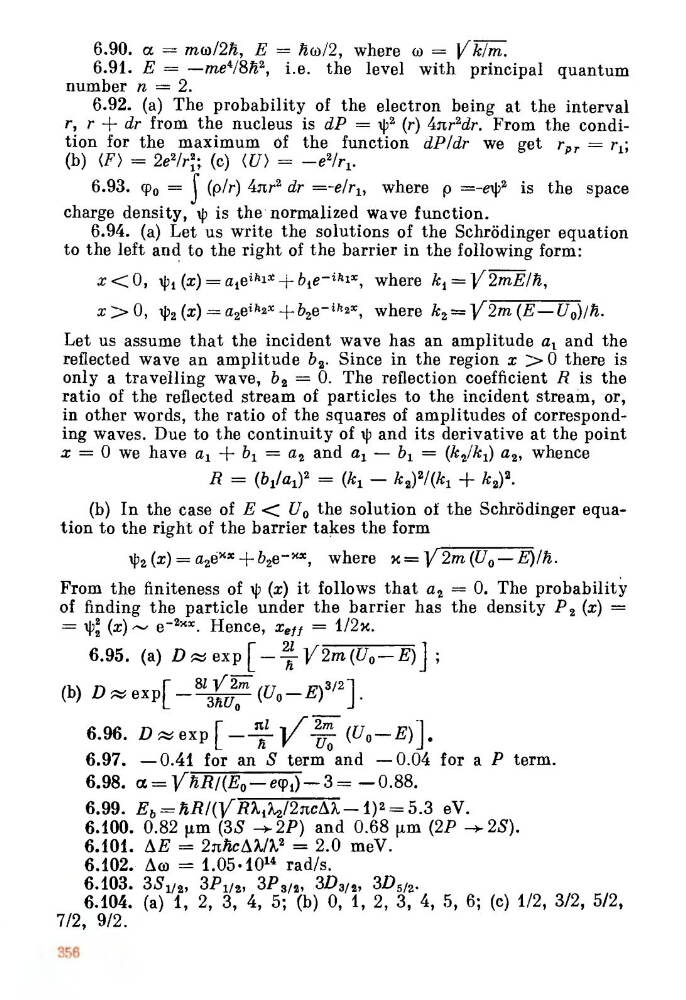
6.90. a = mw/2h, E = hco/2, where co = 1/kInt.
6.91. E = —me418h2, i.e. the level with principal quantum
number n = 2.
6.92. (a) The probability of the electron being at the interval
r, r + dr from the nucleus is dP = 2 (r)42-cr2dr. From the condition for the maximum of the function dP/dr we get rp,. =
(b) (F) = 2e2/ri 2; (c) (U) =
6.93. (p0 = (p/r) 4nr2 dr =-elri, where p =-42 is the space
charge density, ip is the normalized wave function.
6.94. (a) Let us write the solutions of the Schrodinger equation
to the left and to the right of the barrier in the following form:
x < 0, 14)i (x)=aieihiH- bie-ikix, where k1 = V- 2mElh,
x> 0, 2 (x) = a2eih2x b2e-ih2s, where k2 = - 1(2m (E —U0)1h.
Let us assume that the incident wave has an amplitude a1 and the
reflected wave an amplitude b2. Since in the region x >0 there is
only a travelling wave, b2 = 0. The reflection coefficient R is the
ratio of the reflected stream of particles to the incident stream, or,
in other words, the ratio of the squares of amplitudes of corresponding waves. Due to the continuity of* and its derivative at the point
= 0 we have a1
b1 = a2 and al — bi = (k21k1) a2, whence
R =(b1/a1)2 = (ki— k2)2/(k1 + k2)2.
(b) In the case of E < U0 the solution of the SchrOdinger equation to the right of the barrier takes the form
11,2 (x) = a2e" b2e--", where x =2m (U0 — E)1h.
From the finiteness of (x) it follows that a 2 = 0. The probability
of finding the particle under the barrier has the density P2 (x) =
114 (x)— e-2". Hence, xefi = 1/2x.
6.95. (a) D exp [—
(Uo — E)];
Ii2m
(b) D exp[ - 81 3uo (Uo —E)312 ].
6.96. D exp [ — 21 h1 -1/- 2 (
-4- 7- ' (U0 —E)].
6.97. —0.41 for an S term°and —0.04 for a P term.
6.98. cc = jihR/(E0 —eq)i)— 3= —0.88.
6.99. Eb=h111(11 Rki X,2122tc6,X— 1)2 = 5.3 eV.
6.100. 0.82 µm (3S —)-2P) and 0.68 p,m (2P
2S).
6.101. AE = 21chcA2s,/k2 = 2.0 meV.
6.102. Au) = 1.05.10" rad/s.
6.103. 3S112, 3P112, 3P312, 3D312, 3D512.
6.104. (a) 1, 2, 3, 4, 5; (b) 0, 1, 2, 3, 4, 5, 6; (c) 1/2, 3/2, 5/2,
7/2, 9/2.
6.91. E = —me418h2, i.e. the level with principal quantum
number n = 2.
6.92. (a) The probability of the electron being at the interval
r, r + dr from the nucleus is dP = 2 (r)42-cr2dr. From the condition for the maximum of the function dP/dr we get rp,. =
(b) (F) = 2e2/ri 2; (c) (U) =
6.93. (p0 = (p/r) 4nr2 dr =-elri, where p =-42 is the space
charge density, ip is the normalized wave function.
6.94. (a) Let us write the solutions of the Schrodinger equation
to the left and to the right of the barrier in the following form:
x < 0, 14)i (x)=aieihiH- bie-ikix, where k1 = V- 2mElh,
x> 0, 2 (x) = a2eih2x b2e-ih2s, where k2 = - 1(2m (E —U0)1h.
Let us assume that the incident wave has an amplitude a1 and the
reflected wave an amplitude b2. Since in the region x >0 there is
only a travelling wave, b2 = 0. The reflection coefficient R is the
ratio of the reflected stream of particles to the incident stream, or,
in other words, the ratio of the squares of amplitudes of corresponding waves. Due to the continuity of* and its derivative at the point
= 0 we have a1
b1 = a2 and al — bi = (k21k1) a2, whence
R =(b1/a1)2 = (ki— k2)2/(k1 + k2)2.
(b) In the case of E < U0 the solution of the SchrOdinger equation to the right of the barrier takes the form
11,2 (x) = a2e" b2e--", where x =2m (U0 — E)1h.
From the finiteness of (x) it follows that a 2 = 0. The probability
of finding the particle under the barrier has the density P2 (x) =
114 (x)— e-2". Hence, xefi = 1/2x.
6.95. (a) D exp [—
(Uo — E)];
Ii2m
(b) D exp[ - 81 3uo (Uo —E)312 ].
6.96. D exp [ — 21 h1 -1/- 2 (
-4- 7- ' (U0 —E)].
6.97. —0.41 for an S term°and —0.04 for a P term.
6.98. cc = jihR/(E0 —eq)i)— 3= —0.88.
6.99. Eb=h111(11 Rki X,2122tc6,X— 1)2 = 5.3 eV.
6.100. 0.82 µm (3S —)-2P) and 0.68 p,m (2P
2S).
6.101. AE = 21chcA2s,/k2 = 2.0 meV.
6.102. Au) = 1.05.10" rad/s.
6.103. 3S112, 3P112, 3P312, 3D312, 3D512.
6.104. (a) 1, 2, 3, 4, 5; (b) 0, 1, 2, 3, 4, 5, 6; (c) 1/2, 3/2, 5/2,
7/2, 9/2.