

Fig. 41.
5.122. (a) AO = arcsin (n sin 0) — 0 = 7.90; (b) from the condition b (sin 01 — n sin 0) = ±X we obtain AO = 0+1 — 0_1
7.3°.
5.123. X
(co —
dl2k = 0.6 um.
5.125. 55°.
5.126. d = 2.8 pm.
5.127. X = (d sin A0)/1/ 5 — 4 cos AO = 0.54 um.
5.128. (a) 45°; (b)-64°.
5.129. x = 2R/(n —1) y ((Ja)2 -1= 8 cm.
5.130. From the condition d En sin 0 — sin (0 + Oh)] = kX we
obtain 00 = —18.5°, 0+1 = 0° ; kmax = +6, 0+6 = +78.5°. See
Fig. 40.
5.131. hh = X (k — 1/2)/(n — 1),
where
k = 1, 2, . . .;
a sin 01 = X/2.
5.132. v = Xvf/Ax = 1.5 km/s.
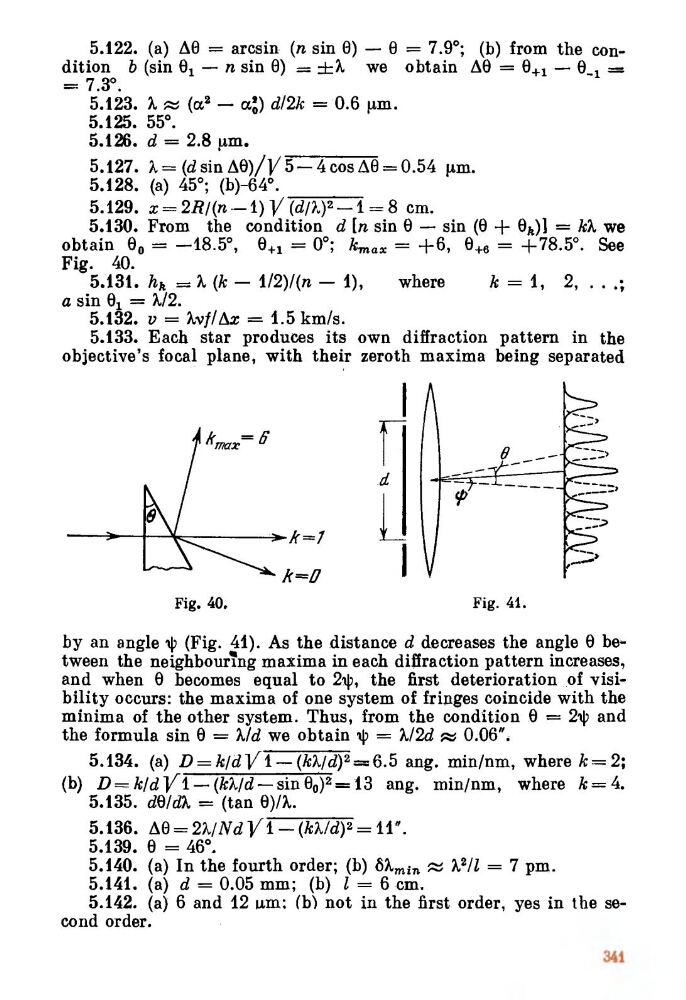
5.133. Each star produces its own diffraction pattern in the
objective's focal plane, with their zeroth maxima being separated
Fig. 40.
by an angle * (Fig. 41). As the distance d decreases the angle 0 between the neighbouring maxima in each diffraction pattern increases,
and when 0 becomes equal to 2*, the first deterioration of visibility occurs: the maxima of one system of fringes coincide with the
minima of the other system. Thus, from the condition 0 = 2p and
the formula sin 0 = Xld we obtain , = X/2d ge, 0.06".
5.134. (a) D=IcIdli 1— (kX1d)2= 6.5 ang. min/nm, where k= 2;
(b) D = kld V 1 —(kX1d— sin 002 = 13 ang. min/nm, where k= 4.
5.135. dOldX = (tan 0)/1.
5.136. AO-- 2X/Nd 1/1 — (kk/d)2 =11".
5.139. 0 = 46°.
5.140. (a) In the fourth order; (b) 6X„,in
X2Il = 7 pm.
5.141. (a) d = 0.05 mm; (b) 1 = 6 cm.
5.142. (a) 6 and 12 um: (b) not in the first order, yes in the second order.
5.122. (a) AO = arcsin (n sin 0) — 0 = 7.90; (b) from the condition b (sin 01 — n sin 0) = ±X we obtain AO = 0+1 — 0_1
7.3°.
5.123. X
(co —
dl2k = 0.6 um.
5.125. 55°.
5.126. d = 2.8 pm.
5.127. X = (d sin A0)/1/ 5 — 4 cos AO = 0.54 um.
5.128. (a) 45°; (b)-64°.
5.129. x = 2R/(n —1) y ((Ja)2 -1= 8 cm.
5.130. From the condition d En sin 0 — sin (0 + Oh)] = kX we
obtain 00 = —18.5°, 0+1 = 0° ; kmax = +6, 0+6 = +78.5°. See
Fig. 40.
5.131. hh = X (k — 1/2)/(n — 1),
where
k = 1, 2, . . .;
a sin 01 = X/2.
5.132. v = Xvf/Ax = 1.5 km/s.
5.133. Each star produces its own diffraction pattern in the
objective's focal plane, with their zeroth maxima being separated
Fig. 40.
by an angle * (Fig. 41). As the distance d decreases the angle 0 between the neighbouring maxima in each diffraction pattern increases,
and when 0 becomes equal to 2*, the first deterioration of visibility occurs: the maxima of one system of fringes coincide with the
minima of the other system. Thus, from the condition 0 = 2p and
the formula sin 0 = Xld we obtain , = X/2d ge, 0.06".
5.134. (a) D=IcIdli 1— (kX1d)2= 6.5 ang. min/nm, where k= 2;
(b) D = kld V 1 —(kX1d— sin 002 = 13 ang. min/nm, where k= 4.
5.135. dOldX = (tan 0)/1.
5.136. AO-- 2X/Nd 1/1 — (kk/d)2 =11".
5.139. 0 = 46°.
5.140. (a) In the fourth order; (b) 6X„,in
X2Il = 7 pm.
5.141. (a) d = 0.05 mm; (b) 1 = 6 cm.
5.142. (a) 6 and 12 um: (b) not in the first order, yes in the second order.