

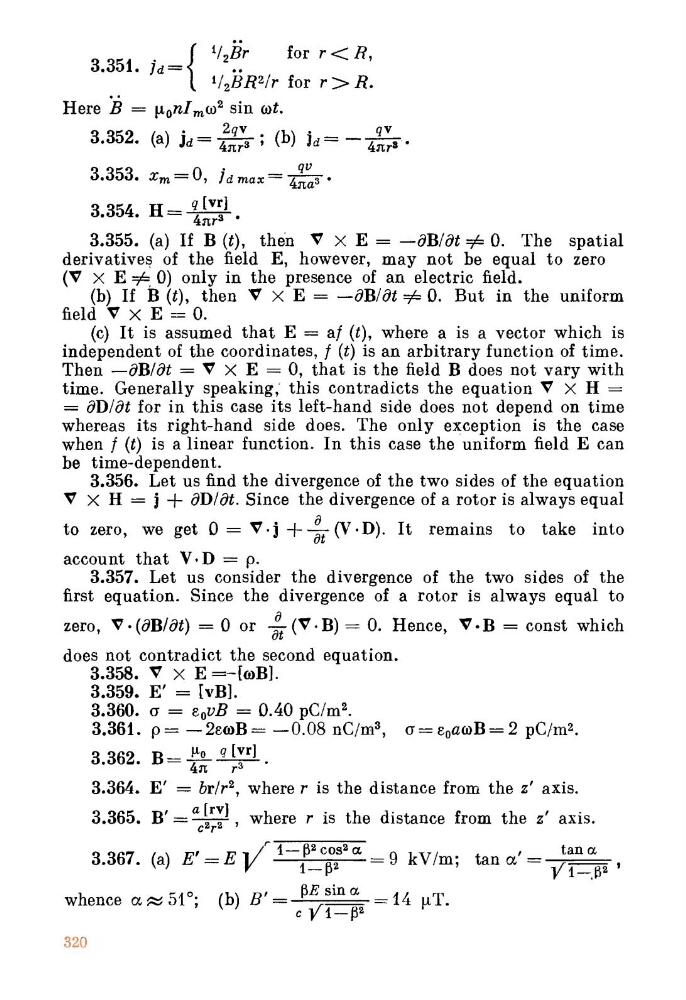
3.351. fd-={
1/2:Eir
for r < R,
112BR2 Ir for r > R.
Here h = p,on/mo)2 sin cot.
3.352. (a) jd = 42it qr v3 ; (b) jd
3.353. xn,=- . 0, id max — 4,, qv a 3 •
3.354. H— q Evri
4nr3 •
3.355. (a) If B (t), then V X E
—OBI&
0. The spatial
derivatives of the field E, however, may not be equal to zero
(V x E
0) only in the presence of an electric field.
(b) If B (t), then V X E =
0. But in the uniform
field V x E = 0.
(c) It is assumed that E = of (t), where a is a vector which is
independent of the coordinates, f (t) is an arbitrary function of time.
Then —awat = V X E = 0, that is the field B does not vary with
time. Generally speaking, this contradicts the equation V x H =
= apiat for in this case its left-hand side does not depend on time
whereas its right-hand side does. The only exception is the case
when f (t) is a linear function. In this case the uniform field E can
be time-dependent.
3.356. Let us find the divergence of the two sides of the equation
V X H = j
°plat. Since the divergence of a rotor is always equal
to zero, we get 0 = V•j + 4F (V •D). It remains to take into
account that V•D = p.
3.357. Let us consider the divergence of the two sides of the
first equation. Since the divergence of a rotor is always equal to
zero, V • (mat) = 0 or -- a-F a (V•B) = 0. Hence, V•B = const which
does not contradict the second equation.
3.358. V X E
3.359. E' =
3.360. a = eovB = 0.40 pC/m2.
3.361. p = —2eo)B= —0.08 nC/m3, a = eoczo)B= 2 pC/m2.
3.362. B=
[r]
[yr] r3 •
3.364. E' = br/r2, where r is the distance from the z' axis.
3.365. B' = c2r2
a [rv]
'
where r is the distance from the z' axis.
3.367. (a) E' = E V
132 c°82 a = 9 kV/m; tan a'
VO2
whence a 51'; (b) B' —
PE sin a -14 IA.
c171-132
qv
4nr3
tan a
V 1 —,P2
320
1/2:Eir
for r < R,
112BR2 Ir for r > R.
Here h = p,on/mo)2 sin cot.
3.352. (a) jd = 42it qr v3 ; (b) jd
3.353. xn,=- . 0, id max — 4,, qv a 3 •
3.354. H— q Evri
4nr3 •
3.355. (a) If B (t), then V X E
—OBI&
0. The spatial
derivatives of the field E, however, may not be equal to zero
(V x E
0) only in the presence of an electric field.
(b) If B (t), then V X E =
0. But in the uniform
field V x E = 0.
(c) It is assumed that E = of (t), where a is a vector which is
independent of the coordinates, f (t) is an arbitrary function of time.
Then —awat = V X E = 0, that is the field B does not vary with
time. Generally speaking, this contradicts the equation V x H =
= apiat for in this case its left-hand side does not depend on time
whereas its right-hand side does. The only exception is the case
when f (t) is a linear function. In this case the uniform field E can
be time-dependent.
3.356. Let us find the divergence of the two sides of the equation
V X H = j
°plat. Since the divergence of a rotor is always equal
to zero, we get 0 = V•j + 4F (V •D). It remains to take into
account that V•D = p.
3.357. Let us consider the divergence of the two sides of the
first equation. Since the divergence of a rotor is always equal to
zero, V • (mat) = 0 or -- a-F a (V•B) = 0. Hence, V•B = const which
does not contradict the second equation.
3.358. V X E
3.359. E' =
3.360. a = eovB = 0.40 pC/m2.
3.361. p = —2eo)B= —0.08 nC/m3, a = eoczo)B= 2 pC/m2.
3.362. B=
[r]
[yr] r3 •
3.364. E' = br/r2, where r is the distance from the z' axis.
3.365. B' = c2r2
a [rv]
'
where r is the distance from the z' axis.
3.367. (a) E' = E V
132 c°82 a = 9 kV/m; tan a'
VO2
whence a 51'; (b) B' —
PE sin a -14 IA.
c171-132
qv
4nr3
tan a
V 1 —,P2
320