

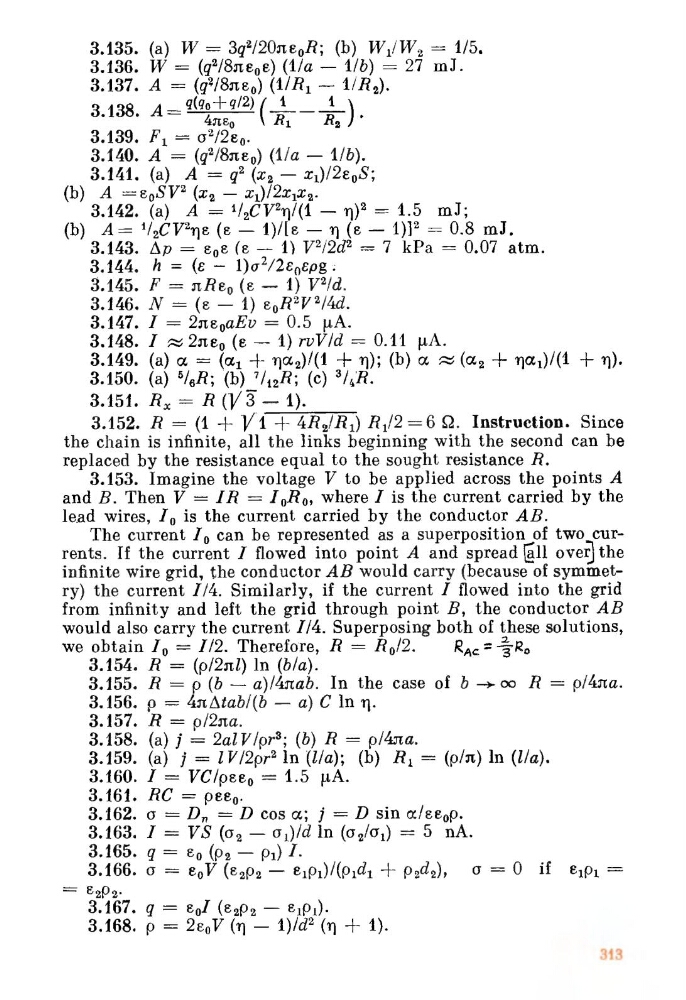
3.135. (a) W = 3q2/20ne0R; (b) W1/W2 = 1/5,
3.136. W = (q2/8ne0 e) (1/a — 1/b) = 27 mJ.
3.137. A = (0182180) (11R1 — 11R2).
3.138. A—q(4o+q12)
1
\
47E80
1
R1
R2 )
3.139. F1 = a2/2e0.
3.140. A = (q2/8ne0) (1/a — 1/b).
3.141. (a) A = q2 (x2 — x1)/2e0S;
(b) A -- ---80SV 2 (x2 — xl)/2x1x2.
3.142. (a) A = '12CV211(1 — 1)2 = 1.5 mJ;
(b) A = 112CV 2ria (a — WEE — 1 (a — 1)12 = 0.8 mJ.
3.143. Ap = 808 (a — 1) V2/2d2 = 7 kPa = 0.07 atm.
3.144. h = (a — 1)62/2a0epg
3.145. F = nRe0 (a — 1) V2/d.
3.146. N = (8 — 1) e0R2V 2/4d.
3.147. I = 2na0aEv = 0.5 RA.
3.148. I
27(60 (a — 1) rvV Id = 0.11 p,A.
3.149. (a) a = (al
la2)/(1
i); (b) a
(a2
rlai)/(1 -1- 1).
3.150. (a) 516R; (b) 7/12R; (c) 3/ 4R.
3.151. Ric =
(ij- — 1).
3.152. R = (1 -1-1/ 1 + 4R21R1) R1 12=6 Q. Instruction. Since
the chain is infinite, all the links beginning with the second can be
replaced by the resistance equal to the sought resistance R.
3.153. Imagine the voltage V to be applied across the points A
and B. Then V = IR = I 0R0, where I is the current carried by the
lead wires, 10 is the current carried by the conductor AB.
The current / 0 can be represented as a superposition of two currents. If the current I flowed into point A and spread over the
infinite wire grid, the conductor AB would carry (because of symmetry) the current 1/4. Similarly, if the current I flowed into the grid
from infinity and left the grid through point B, the conductor AB
would also carry the current I/4. Superposing both of these solutions,
we obtain /0 = 1/2. Therefore, R = R0/2.
RAc= iRo
3.154. R = (p/2a/) In (b/a).
3.155. R = p (b — a)/4aab. In the case of b
oo R = p/4.1-Ea.
3.156. p = 4nAtabl(b — a) C In
3.157. R = p/2na.
3.158. (a) j = 2a1V1pr3; (b) R = p/4na.
3.159. (a) j = Z VI2pr2 In (11a); (b) RI = (p/n) In (11a).
3.160. I = VC/paa0 = 1.5 [LA.
3.161. RC = pea,.
3.162. a = D, = D cos a; j = D sin cr:/ 8801)•
3.163. I = VS (a 2 — al)/d In (62/a1) = 5 nA.
3.165. q= so (p2 — pi)
3.166. a = c0 V (821)2 — eiPi)/(Pidi
p 2d2), a = 0 if gip,. =
E2P2•
3.167. q = 801 (8 21)2 —
3.168. p = 2e0V (rt — 1)/d2 (7) + 1).
3.136. W = (q2/8ne0 e) (1/a — 1/b) = 27 mJ.
3.137. A = (0182180) (11R1 — 11R2).
3.138. A—q(4o+q12)
1
\
47E80
1
R1
R2 )
3.139. F1 = a2/2e0.
3.140. A = (q2/8ne0) (1/a — 1/b).
3.141. (a) A = q2 (x2 — x1)/2e0S;
(b) A -- ---80SV 2 (x2 — xl)/2x1x2.
3.142. (a) A = '12CV211(1 — 1)2 = 1.5 mJ;
(b) A = 112CV 2ria (a — WEE — 1 (a — 1)12 = 0.8 mJ.
3.143. Ap = 808 (a — 1) V2/2d2 = 7 kPa = 0.07 atm.
3.144. h = (a — 1)62/2a0epg
3.145. F = nRe0 (a — 1) V2/d.
3.146. N = (8 — 1) e0R2V 2/4d.
3.147. I = 2na0aEv = 0.5 RA.
3.148. I
27(60 (a — 1) rvV Id = 0.11 p,A.
3.149. (a) a = (al
la2)/(1
i); (b) a
(a2
rlai)/(1 -1- 1).
3.150. (a) 516R; (b) 7/12R; (c) 3/ 4R.
3.151. Ric =
(ij- — 1).
3.152. R = (1 -1-1/ 1 + 4R21R1) R1 12=6 Q. Instruction. Since
the chain is infinite, all the links beginning with the second can be
replaced by the resistance equal to the sought resistance R.
3.153. Imagine the voltage V to be applied across the points A
and B. Then V = IR = I 0R0, where I is the current carried by the
lead wires, 10 is the current carried by the conductor AB.
The current / 0 can be represented as a superposition of two currents. If the current I flowed into point A and spread over the
infinite wire grid, the conductor AB would carry (because of symmetry) the current 1/4. Similarly, if the current I flowed into the grid
from infinity and left the grid through point B, the conductor AB
would also carry the current I/4. Superposing both of these solutions,
we obtain /0 = 1/2. Therefore, R = R0/2.
RAc= iRo
3.154. R = (p/2a/) In (b/a).
3.155. R = p (b — a)/4aab. In the case of b
oo R = p/4.1-Ea.
3.156. p = 4nAtabl(b — a) C In
3.157. R = p/2na.
3.158. (a) j = 2a1V1pr3; (b) R = p/4na.
3.159. (a) j = Z VI2pr2 In (11a); (b) RI = (p/n) In (11a).
3.160. I = VC/paa0 = 1.5 [LA.
3.161. RC = pea,.
3.162. a = D, = D cos a; j = D sin cr:/ 8801)•
3.163. I = VS (a 2 — al)/d In (62/a1) = 5 nA.
3.165. q= so (p2 — pi)
3.166. a = c0 V (821)2 — eiPi)/(Pidi
p 2d2), a = 0 if gip,. =
E2P2•
3.167. q = 801 (8 21)2 —
3.168. p = 2e0V (rt — 1)/d2 (7) + 1).