

that charge and parallel to the plates, the charges ql and q 2 remain,
obviously, unchanged. What changes is only their distribution, and
the electric field becomes easy to
calculate.
fx
3.68. dFldS = 1/262/80.
3.69. F = q
0.5 kN.
32xce
2
oR2
—
0
3.70. F = 1/4nR2aV80.
3.71. N — nel)
—
3.103,
Fig. 19.
(e- 1) 4E
where no is the concentration of molecules.
3.72. F= 3131)2 4:1260/7
1.1R (attraction)
3.73. (a) x = R/17- ; (b) x = { 0.29R (repulsion). See Fig. 19.
3.74. P — ee l
1
r,
q
,
=
e e l
q.
i
3.76. qinn = — q (8-1)1e, q;,,,t =q (e —1)/8.
(a)
r
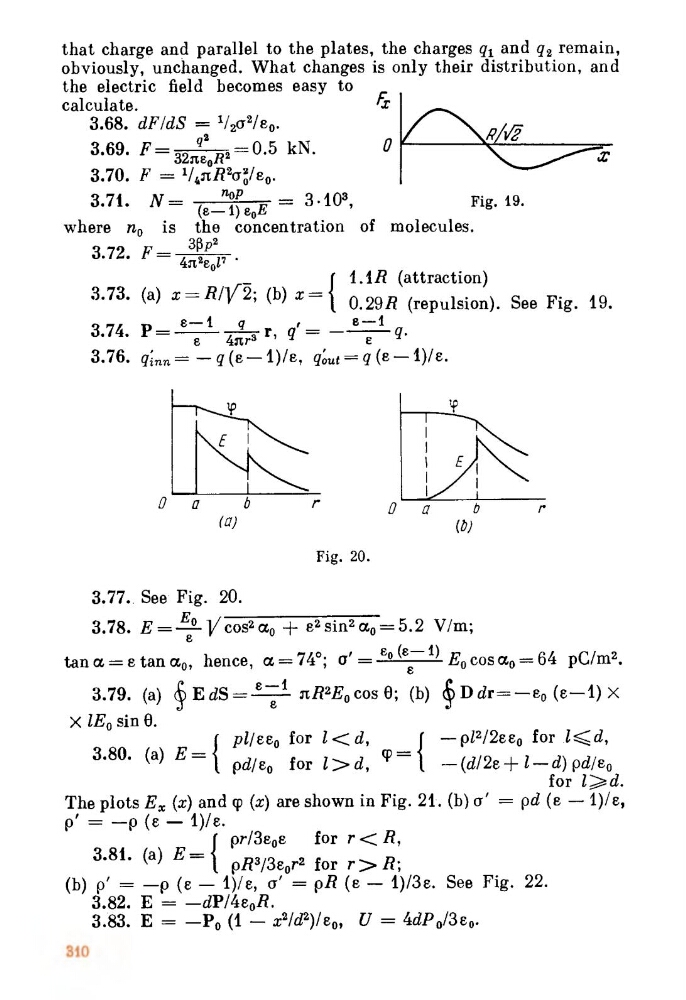
Fig. 20.
3.77. See Fig. 20.
3.78. E
cos2 ao + 82 sin2 ao = 5.2 V/m;
tan a = 8 tan ao , hence, a = 740;
al = g o (8_1)
e
E0 cos ao = 64 pC/m2.
3.79. (a) () E dS =-- 8— e 1 nR2E0 cos 0; (b) § D dr=--so (6-1) X
X 1E0 sin 0.
1 pd
p/1 lc ee 00 for 1
for / > d, (1)=- 1 — (d/2e + 1— d) pd/e0
for 1_>-d.
The plots Ex (x) and p (x) are shown in Fig. 21. (b) a' = pd (e — 1)/8,
p' = —p (a — 1)/8.
1 pr/3808 for r < R,
3.81. (a) E = pR3/380r2 for r > R;
(b) p' = —p (8 — 1)/8, a' = pR (8 — 1)/3e. See Fig. 22.
3.82. E = —dP/480R.
3.83. E = —Po (1 — x21d2)180, U = 4dP0/3co.
obviously, unchanged. What changes is only their distribution, and
the electric field becomes easy to
calculate.
fx
3.68. dFldS = 1/262/80.
3.69. F = q
0.5 kN.
32xce
2
oR2
—
0
3.70. F = 1/4nR2aV80.
3.71. N — nel)
—
3.103,
Fig. 19.
(e- 1) 4E
where no is the concentration of molecules.
3.72. F= 3131)2 4:1260/7
1.1R (attraction)
3.73. (a) x = R/17- ; (b) x = { 0.29R (repulsion). See Fig. 19.
3.74. P — ee l
1
r,
q
,
=
e e l
q.
i
3.76. qinn = — q (8-1)1e, q;,,,t =q (e —1)/8.
(a)
r
Fig. 20.
3.77. See Fig. 20.
3.78. E
cos2 ao + 82 sin2 ao = 5.2 V/m;
tan a = 8 tan ao , hence, a = 740;
al = g o (8_1)
e
E0 cos ao = 64 pC/m2.
3.79. (a) () E dS =-- 8— e 1 nR2E0 cos 0; (b) § D dr=--so (6-1) X
X 1E0 sin 0.
1 pd
p/1 lc ee 00 for 1
for / > d, (1)=- 1 — (d/2e + 1— d) pd/e0
for 1_>-d.
The plots Ex (x) and p (x) are shown in Fig. 21. (b) a' = pd (e — 1)/8,
p' = —p (a — 1)/8.
1 pr/3808 for r < R,
3.81. (a) E = pR3/380r2 for r > R;
(b) p' = —p (8 — 1)/8, a' = pR (8 — 1)/3e. See Fig. 22.
3.82. E = —dP/480R.
3.83. E = —Po (1 — x21d2)180, U = 4dP0/3co.