

pot
38o
and E
3.16. E = — 1/3ar/e0.
3.17. E = —1/3ka0/80, where k is the unit vector of the z axis
with respect to which the angle 0 is read off. Clearly, the field inside
the given sphere is uniform.
3.18. E = —1/6aR2/e0.
3.19. I (1) I = 1/2kR/e0. The sign of (I) depends on how the direction of the normal to the circle is chosen.
3.20. I (D I
eo
171+ (R//)2 /
1 • The sign of 413 depends on
how the direction of the normal to the circle is chosen.
3.21. I (I)I = 1/33tpro (R2 — 4)/80.
3.22. Emax = Xhted.
3.23. E = 1/2 a 0/80, with the direction of the vector E corresponding to the angle cp =
3.24. (1) = 421.//a.
(b) Emax 1/9 poR/e0 for r,„= 213 R.
3.26. q= 22tR2a, E = 1/2a/80.
3.27. E=--132 r2 (1—e-ar3). Accordingly, E
--1 °r2
Po
Uoar2 •
3.28. E = 1/3 ap/so3.29. E = 1/2ap/g0 ,
axis of the cavity.
1
)
ateon
,
1+ (a/R)2
3.30. Acp
r, 1
3.31. cpl — cp2 = — 288o In = 5 kV.
3.32. (p. = 1/2 aR/ec ,, E= 114c1/Eo.
3.33. co
e°
al Cjil + (R/02-1),a /,,
± R.
l—,- 0, then (p=
, E= 2a 80 ; when / ), R, then cp
E z 4a q 8012 ' where q=- - aaR2.
3.34. IT = GR/neo.
3.35. E = —a, i.e. the field is uniform.
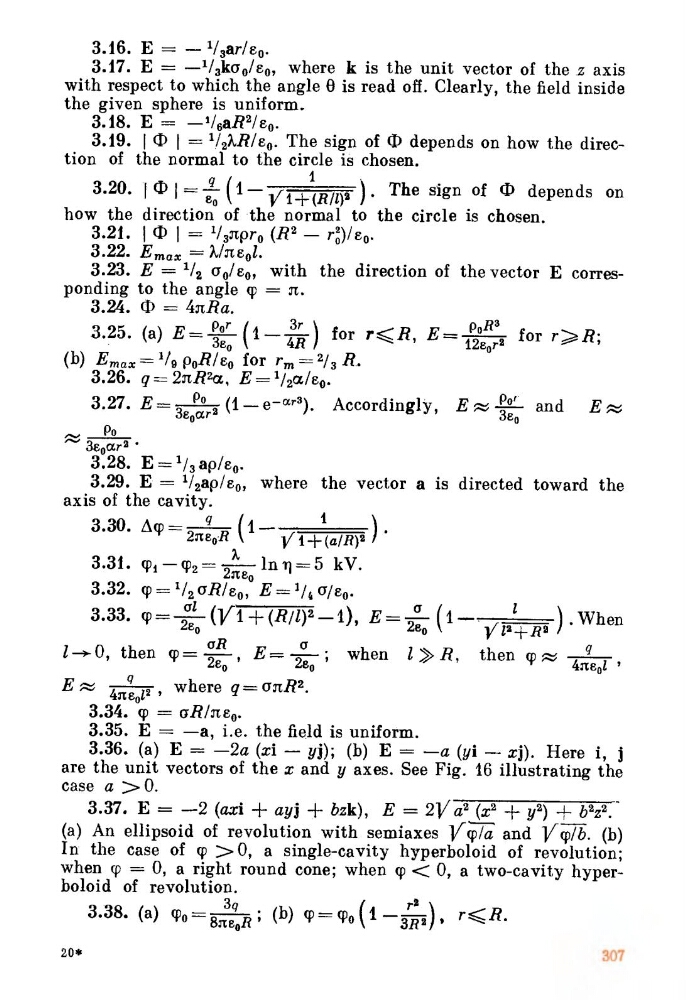
3.36. (a) E
—2a (xi — yj); (b) E = —a (yi — xj). Here i, j
are the unit vectors of the x and y axes. See Fig. 16 illustrating the
case a >0.
3.37. E = —2 (axi ayj
bzk), E = 217a2 ( x2 + y2) + b2z2.
(a) An ellipsoid of revolution with semiaxes licp/a and 1/4/b. (b)
In the case of (ID >0, a single-cavity hyperboloid of revolution;
when = 0, a right round cone; when cp < 0, a two-cavity hyperboloid of revolution.
3q
3.38. (a) (po meoR ; (b)
cpc,
— 312 ) , r
3r for r
P° R3 71 for r>.- R;
where the vector a is directed toward the
When
q
43180/
20*
38o
and E
3.16. E = — 1/3ar/e0.
3.17. E = —1/3ka0/80, where k is the unit vector of the z axis
with respect to which the angle 0 is read off. Clearly, the field inside
the given sphere is uniform.
3.18. E = —1/6aR2/e0.
3.19. I (1) I = 1/2kR/e0. The sign of (I) depends on how the direction of the normal to the circle is chosen.
3.20. I (D I
eo
171+ (R//)2 /
1 • The sign of 413 depends on
how the direction of the normal to the circle is chosen.
3.21. I (I)I = 1/33tpro (R2 — 4)/80.
3.22. Emax = Xhted.
3.23. E = 1/2 a 0/80, with the direction of the vector E corresponding to the angle cp =
3.24. (1) = 421.//a.
(b) Emax 1/9 poR/e0 for r,„= 213 R.
3.26. q= 22tR2a, E = 1/2a/80.
3.27. E=--132 r2 (1—e-ar3). Accordingly, E
--1 °r2
Po
Uoar2 •
3.28. E = 1/3 ap/so3.29. E = 1/2ap/g0 ,
axis of the cavity.
1
)
ateon
,
1+ (a/R)2
3.30. Acp
r, 1
3.31. cpl — cp2 = — 288o In = 5 kV.
3.32. (p. = 1/2 aR/ec ,, E= 114c1/Eo.
3.33. co
e°
al Cjil + (R/02-1),a /,,
± R.
l—,- 0, then (p=
, E= 2a 80 ; when / ), R, then cp
E z 4a q 8012 ' where q=- - aaR2.
3.34. IT = GR/neo.
3.35. E = —a, i.e. the field is uniform.
3.36. (a) E
—2a (xi — yj); (b) E = —a (yi — xj). Here i, j
are the unit vectors of the x and y axes. See Fig. 16 illustrating the
case a >0.
3.37. E = —2 (axi ayj
bzk), E = 217a2 ( x2 + y2) + b2z2.
(a) An ellipsoid of revolution with semiaxes licp/a and 1/4/b. (b)
In the case of (ID >0, a single-cavity hyperboloid of revolution;
when = 0, a right round cone; when cp < 0, a two-cavity hyperboloid of revolution.
3q
3.38. (a) (po meoR ; (b)
cpc,
— 312 ) , r
3r for r
P° R3 71 for r>.- R;
where the vector a is directed toward the
When
q
43180/
20*