

2.112. (a) dN= (2nno/a3/2) e-UMT V U dU; (b) Up, =1/2kT.
2.113. In the latter case.
2.114. (a) II= 1 — ni--? = 0.25; (b) = 1 — ni /Y-1 = 0.18.
2.115. 8 = (1 — 11)/1 = 9.
2.116. -11 = 1 — 2T3/(T1 + T2).
2.117. n = —
= 60%.
2.118. 1 1 = 1 — n-(1-1/1 )•
2.119. 71 = 1 — (n + 7)41 + yn)
2.120. In both cases 11 =1
2.121. In both cases Ti =1 n
- 1
2.122. =1 : 1-"I nn •
n- 1
2.123. (a) 11=1— 7 -‘,
,
(b) = 1
ni — 1
y (n-1) 0-1
(n—i)
2.124. (a) 11= 1 n-1-1-(y — 1) n Inn '
(b) it =1
n-1+(y-1)Inn
y (n-1)
2.125. —
(T- 1) In v
ti In v
—1)/(y —1) '
2.126. rl =
(t— 1) In n
ti In n
(T-1) y/(y —1) •
2.127. 11-1 2 7+1/T
(1-1-v) (1-1-177)
2.128. The inequality .Q 1 — 8Q; <0 becomes even stronger
T2
when Ti is replaced by T,,,„„ and T2 by Trnin Then Qiirmax
Q;amin< O. Hence
Qi —Q; Tnta:m — aTurin
<
or 1
41
(61
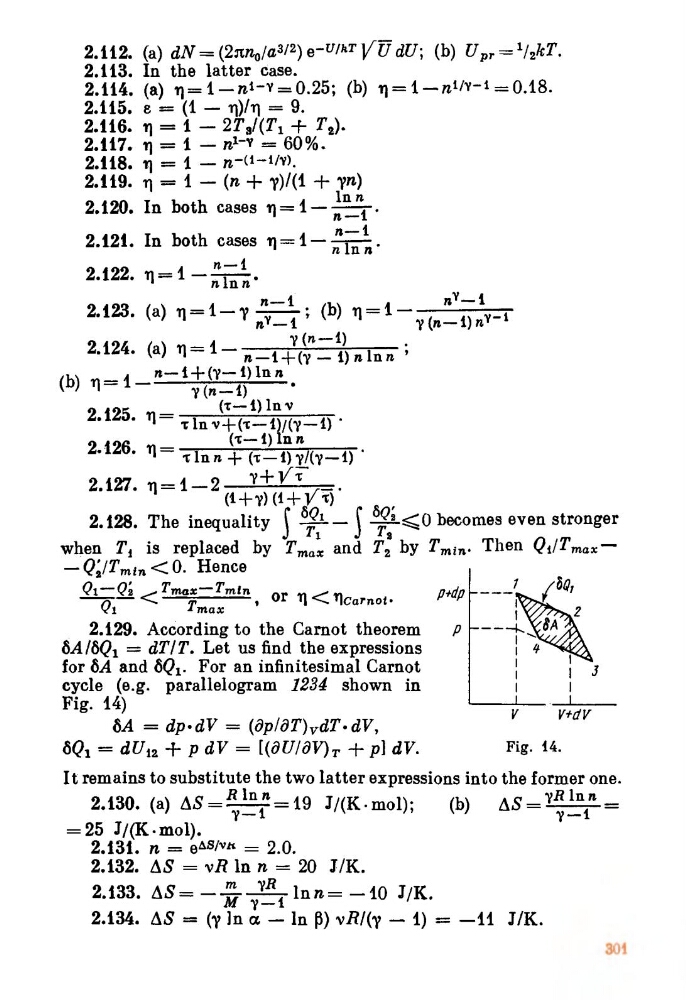
2.129. According to the Carnot theorem
P
WW1 = dTIT. Let us find the expressions
for 811 and 8Q1. For an infinitesimal Carnot
cycle (e.g. parallelogram 1234 shown in
Fig. 14)
SA = dp-dV = (OpIOT)vdT • dV,
=
p dV = [( away), + p] dV.
Fig. 14.
It remains to substitute the two latter expressions into the former one.
2.130. (a) AS =
Ryln1. 19 JAK • mol);
(b) AS —
yR In
1
n =
y —
= 25 J/(K • mol).
2.131. n = eAs/". = 2.0.
2.132. AS = vR ln n = 20 PK.
2.133. AS =
M y-1
In n = —10 37K.
2.134. AS = In a — in 6) vR/(? — 1) = —11 J/K.
lkfc/V
2.113. In the latter case.
2.114. (a) II= 1 — ni--? = 0.25; (b) = 1 — ni /Y-1 = 0.18.
2.115. 8 = (1 — 11)/1 = 9.
2.116. -11 = 1 — 2T3/(T1 + T2).
2.117. n = —
= 60%.
2.118. 1 1 = 1 — n-(1-1/1 )•
2.119. 71 = 1 — (n + 7)41 + yn)
2.120. In both cases 11 =1
2.121. In both cases Ti =1 n
- 1
2.122. =1 : 1-"I nn •
n- 1
2.123. (a) 11=1— 7 -‘,
,
(b) = 1
ni — 1
y (n-1) 0-1
(n—i)
2.124. (a) 11= 1 n-1-1-(y — 1) n Inn '
(b) it =1
n-1+(y-1)Inn
y (n-1)
2.125. —
(T- 1) In v
ti In v
—1)/(y —1) '
2.126. rl =
(t— 1) In n
ti In n
(T-1) y/(y —1) •
2.127. 11-1 2 7+1/T
(1-1-v) (1-1-177)
2.128. The inequality .Q 1 — 8Q; <0 becomes even stronger
T2
when Ti is replaced by T,,,„„ and T2 by Trnin Then Qiirmax
Q;amin< O. Hence
Qi —Q; Tnta:m — aTurin
<
or 1
41
(61
2.129. According to the Carnot theorem
P
WW1 = dTIT. Let us find the expressions
for 811 and 8Q1. For an infinitesimal Carnot
cycle (e.g. parallelogram 1234 shown in
Fig. 14)
SA = dp-dV = (OpIOT)vdT • dV,
=
p dV = [( away), + p] dV.
Fig. 14.
It remains to substitute the two latter expressions into the former one.
2.130. (a) AS =
Ryln1. 19 JAK • mol);
(b) AS —
yR In
1
n =
y —
= 25 J/(K • mol).
2.131. n = eAs/". = 2.0.
2.132. AS = vR ln n = 20 PK.
2.133. AS =
M y-1
In n = —10 37K.
2.134. AS = In a — in 6) vR/(? — 1) = —11 J/K.
lkfc/V