

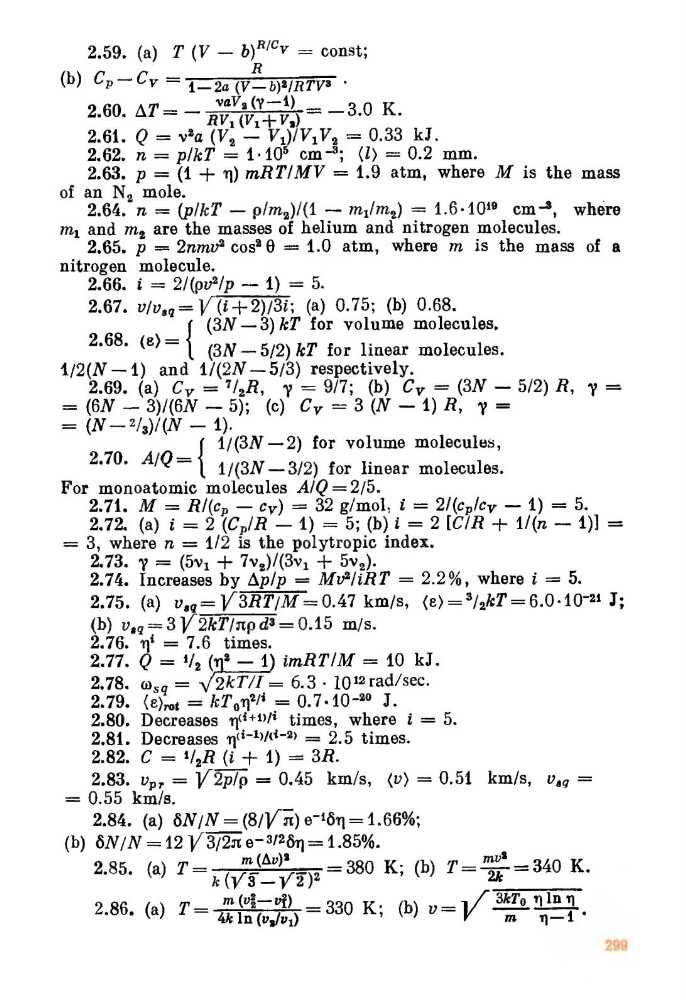
2.59. (a) T (V — b)Ricv = const;
(b) Cp —CV — I-2a (V — RTV3 •
2.60. AT=
vaV 2 (y-1)
3.0 K.
Rv, (V„-{-v,)
2.61. Q = Oa (V2 — V1)1VIV2 = 0.33 kJ.
2.62. n = p/kT = 1.105 cm-3; (1) = 0.2 mm.
2.63. p = (1
mRTI MV = 1.9 atm, where M is the mass
of an N2 mole.
2.64. n = (p/kT — p/m2)/(1 — ml/m2) = 1.6.1019 cm-3, where
ml and m2 are the masses of helium and nitrogen molecules.
2.65. p = 2nmv2 cost 0 = 1.0 atm, where m is the mass of a
nitrogen molecule.
2.66. i = 2/(pv2/p — 1) = 5.
2.67. v/vn
+ 2)/3i; (a) 0.75; (b) 0.68.
(3N — 3) kT for volume molecules.
2.68. (8)= (3N — 5/2) kT for linear molecules.
1/2(N-1) and 1/(2N-5/3) respectively.
2.69. (a) CV = 7/2R, y = 9/7; (b) CV = (3N — 5/2) R, y
= (6N — 3)/(6N — 5); (c) Cr = 3 (N — 1) R, y =
= (N — 213)/(N — 1).
1/(3N — 2) for volume molecules,
2.70. A/Q= 1/(3N — 3/2) for linear molecules.
For monoatomic molecules A/Q = 2/5.
2.71. M = RI(cp — cv.) = 32 g/mol. i = 2/(cp/cv — 1) = 5.
2.72. (a) i = 2 (CpIR — 1) = 5; (b) i = 2 [C/R
1/(n — 1)] =
= 3, where n = 1/2 is the polytropic index.
2.73. y = (5v1
7v2)/(3v1
5v2).
2.74. Increases by Aplp = Mv2IiRT = 2.2%, where i = 5.
2.75. (a) vn= -113RTIM= 0.47 km/s, (8)= 3/2kT = 6.0-10-21 J;
(b)
3 1/2kTlapd3= 0.15 m/s.
2.76. 11 = 7.6 times.
2.77. Q = 1 12 — 1) imRTIM = 10 kJ.
2.78. Wsq = 172 kTa = 6.3 • 1012 rad/sec.
2.79. (€),..,t = kToi2/i = 0.7.10-2° J.
2.80. Decreases 11(11-1)/1 times, where i = 5.
2.81. Decreases 11(i-10-2) = 2.5 times.
2.82. C = 1/2R (i
1) = 3R.
2.83. vp, = 112p/p = 0.45 km/s, (v) = 0.51 km/s,
= 0.55 km/s.
2.84. (a) 6NIN = (8/1/n) e-161 = 1.66%;
(b) ON IN = 12 1/-3/2n e-3/28i = 1.85%.
)
2 )2
MV2
2.85. (a) T =
k
m (Av
-v—380 K; (b) T = 2k =340 K.
2.86. (a) T —
—330 K; (b) v=
3kTo
•ri
4k ln (v2/vi
i)
)
V m 1-1 •
(b) Cp —CV — I-2a (V — RTV3 •
2.60. AT=
vaV 2 (y-1)
3.0 K.
Rv, (V„-{-v,)
2.61. Q = Oa (V2 — V1)1VIV2 = 0.33 kJ.
2.62. n = p/kT = 1.105 cm-3; (1) = 0.2 mm.
2.63. p = (1
mRTI MV = 1.9 atm, where M is the mass
of an N2 mole.
2.64. n = (p/kT — p/m2)/(1 — ml/m2) = 1.6.1019 cm-3, where
ml and m2 are the masses of helium and nitrogen molecules.
2.65. p = 2nmv2 cost 0 = 1.0 atm, where m is the mass of a
nitrogen molecule.
2.66. i = 2/(pv2/p — 1) = 5.
2.67. v/vn
+ 2)/3i; (a) 0.75; (b) 0.68.
(3N — 3) kT for volume molecules.
2.68. (8)= (3N — 5/2) kT for linear molecules.
1/2(N-1) and 1/(2N-5/3) respectively.
2.69. (a) CV = 7/2R, y = 9/7; (b) CV = (3N — 5/2) R, y
= (6N — 3)/(6N — 5); (c) Cr = 3 (N — 1) R, y =
= (N — 213)/(N — 1).
1/(3N — 2) for volume molecules,
2.70. A/Q= 1/(3N — 3/2) for linear molecules.
For monoatomic molecules A/Q = 2/5.
2.71. M = RI(cp — cv.) = 32 g/mol. i = 2/(cp/cv — 1) = 5.
2.72. (a) i = 2 (CpIR — 1) = 5; (b) i = 2 [C/R
1/(n — 1)] =
= 3, where n = 1/2 is the polytropic index.
2.73. y = (5v1
7v2)/(3v1
5v2).
2.74. Increases by Aplp = Mv2IiRT = 2.2%, where i = 5.
2.75. (a) vn= -113RTIM= 0.47 km/s, (8)= 3/2kT = 6.0-10-21 J;
(b)
3 1/2kTlapd3= 0.15 m/s.
2.76. 11 = 7.6 times.
2.77. Q = 1 12 — 1) imRTIM = 10 kJ.
2.78. Wsq = 172 kTa = 6.3 • 1012 rad/sec.
2.79. (€),..,t = kToi2/i = 0.7.10-2° J.
2.80. Decreases 11(11-1)/1 times, where i = 5.
2.81. Decreases 11(i-10-2) = 2.5 times.
2.82. C = 1/2R (i
1) = 3R.
2.83. vp, = 112p/p = 0.45 km/s, (v) = 0.51 km/s,
= 0.55 km/s.
2.84. (a) 6NIN = (8/1/n) e-161 = 1.66%;
(b) ON IN = 12 1/-3/2n e-3/28i = 1.85%.
)
2 )2
MV2
2.85. (a) T =
k
m (Av
-v—380 K; (b) T = 2k =340 K.
2.86. (a) T —
—330 K; (b) v=
3kTo
•ri
4k ln (v2/vi
i)
)
V m 1-1 •