

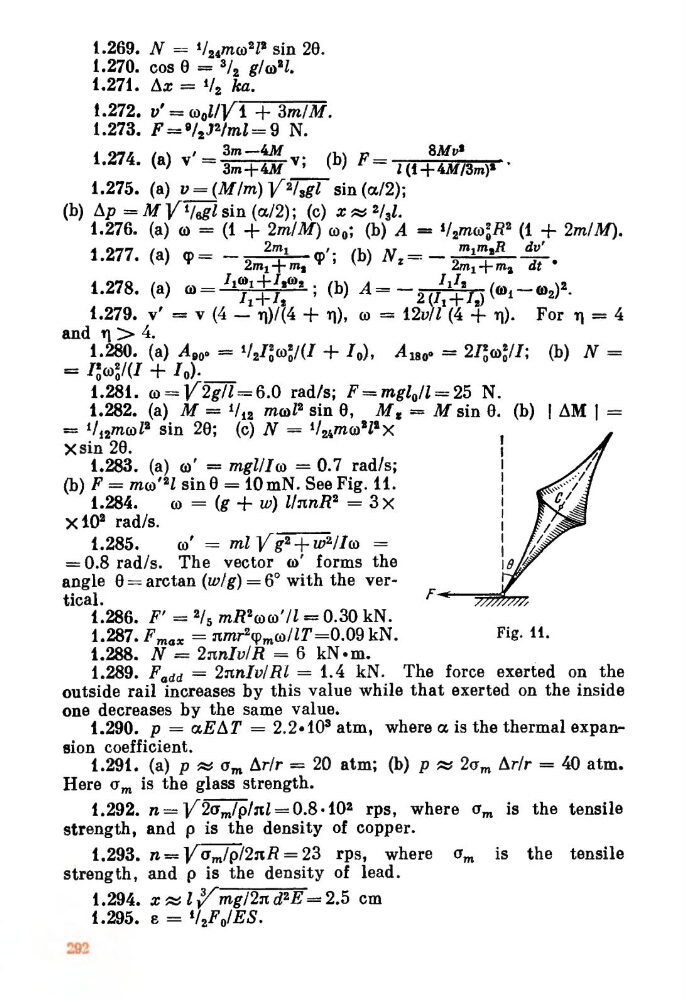
Fig. 11.
1.269. N = 1/24m012 sin 20.
1.270. cos 0 = 3/2 gl 01.
1.271. Ax = 1 /2 ka.
1.272. v' = 0)01/V1 + 3m/M.
1.273. F =a1232Im1= 9 N.
3m — 4M
My
1.274. (a) v — 3m + 4M
V; (b) F — 1(1±431/3m),
1.275. (a) v = (M/m) - 112/3g/ sin (a/2);
(b) Ap = MYthig/ sin (a/2); (c) x 2/31.
1.276. (a) co = (1 -I- 2m/M) 0)0; (b) A = 1 2mco:R2 (1 + 2m1 M).
1.277. (a) cp —
2m1 2+ m1m2 q)'; (b) Nz= 2m mlimi!R in2 d dv;
1.278. (a) w — h1
; (b) A- 2(/1 11+ 12/2)
W2)2"
1.279. v' = v (4 — 11)/(4 -I- II),
= 12v// (4 + TO. For it = 4
and 11> 4.
1.280. (a) Age = '/2/:(0:/(I
/07 A180. = 2/:co://; (b) N =
=
+ /0).
1.281. co = V
6.0 rad/s; F =mg1011= 25 N.
1.282. (a) M = I/12 mw/2 sin 0, M, = M sin 0. (b) AM I
1112m0) 12 sin 20; (c) N = 1 l24me)212 X
X sin 20.
1.283. (a) w' = mg11.1w = 0.7 rad/s;
(b) F = mo.)121 sin 0 = 10 mN. See Fig. 11.
1.284. w = (g w) IlanR2 = 3 x
x 102 rad/s.
1.285.
co' = ml Vg2 w 2/
=
= 0.8 rad/s. The vector w' forms the
angle 0 = arctan (w/ g) = 6° with the vertical.
1.286. F' = 215 mR20)co'// = 0.30 kN.
1.287. Fmax = nmr2q)m0)//T=0.09 kN.
1.288. N = 2nnIvIR = 6 kN•m.
1.289. Fodd = 2nnIvl RI = 1.4 kN. The force exerted on the
outside rail increases by this value while that exerted on the inside
one decreases by the same value.
1.290. p = aE AT = 2.2.102 atm, where a is the thermal expansion coefficient.
1.291. (a) p am Ar/r = 20 atm; (b) p 2am Ar/r = 40 atm.
Here am is the glass strength.
1.292. rt=j12amlpInl= 0.8.102 rps, where am is the tensile
strength, and p is the density of copper.
1.293. n = Vam/p/2nR = 23 rps, where am is the tensile
strength, and p is the density of lead.
1.294. x l Vmg/23-c (PE= 2.5 cm
1.295. s = 2/2F0/ES.
1.269. N = 1/24m012 sin 20.
1.270. cos 0 = 3/2 gl 01.
1.271. Ax = 1 /2 ka.
1.272. v' = 0)01/V1 + 3m/M.
1.273. F =a1232Im1= 9 N.
3m — 4M
My
1.274. (a) v — 3m + 4M
V; (b) F — 1(1±431/3m),
1.275. (a) v = (M/m) - 112/3g/ sin (a/2);
(b) Ap = MYthig/ sin (a/2); (c) x 2/31.
1.276. (a) co = (1 -I- 2m/M) 0)0; (b) A = 1 2mco:R2 (1 + 2m1 M).
1.277. (a) cp —
2m1 2+ m1m2 q)'; (b) Nz= 2m mlimi!R in2 d dv;
1.278. (a) w — h1
; (b) A- 2(/1 11+ 12/2)
W2)2"
1.279. v' = v (4 — 11)/(4 -I- II),
= 12v// (4 + TO. For it = 4
and 11> 4.
1.280. (a) Age = '/2/:(0:/(I
/07 A180. = 2/:co://; (b) N =
=
+ /0).
1.281. co = V
6.0 rad/s; F =mg1011= 25 N.
1.282. (a) M = I/12 mw/2 sin 0, M, = M sin 0. (b) AM I
1112m0) 12 sin 20; (c) N = 1 l24me)212 X
X sin 20.
1.283. (a) w' = mg11.1w = 0.7 rad/s;
(b) F = mo.)121 sin 0 = 10 mN. See Fig. 11.
1.284. w = (g w) IlanR2 = 3 x
x 102 rad/s.
1.285.
co' = ml Vg2 w 2/
=
= 0.8 rad/s. The vector w' forms the
angle 0 = arctan (w/ g) = 6° with the vertical.
1.286. F' = 215 mR20)co'// = 0.30 kN.
1.287. Fmax = nmr2q)m0)//T=0.09 kN.
1.288. N = 2nnIvIR = 6 kN•m.
1.289. Fodd = 2nnIvl RI = 1.4 kN. The force exerted on the
outside rail increases by this value while that exerted on the inside
one decreases by the same value.
1.290. p = aE AT = 2.2.102 atm, where a is the thermal expansion coefficient.
1.291. (a) p am Ar/r = 20 atm; (b) p 2am Ar/r = 40 atm.
Here am is the glass strength.
1.292. rt=j12amlpInl= 0.8.102 rps, where am is the tensile
strength, and p is the density of copper.
1.293. n = Vam/p/2nR = 23 rps, where am is the tensile
strength, and p is the density of lead.
1.294. x l Vmg/23-c (PE= 2.5 cm
1.295. s = 2/2F0/ES.