

ing this equation, we obtain k (ln no)/n; (b) w= g — lovoi +TO.
1.94. F = (mv„ 21R) cost a.
1.95. F = —mco2r, where r is the radius vector of the particle
relative to the origin of coordinates;
F - m (1)2 V x2 + y2.
1.96. (a) Ap = mgt; (b) I Ap I =
—2m(vog)Ig.
1.97. (a) p = at3/6; (b) s =
=--a-r4/12m.
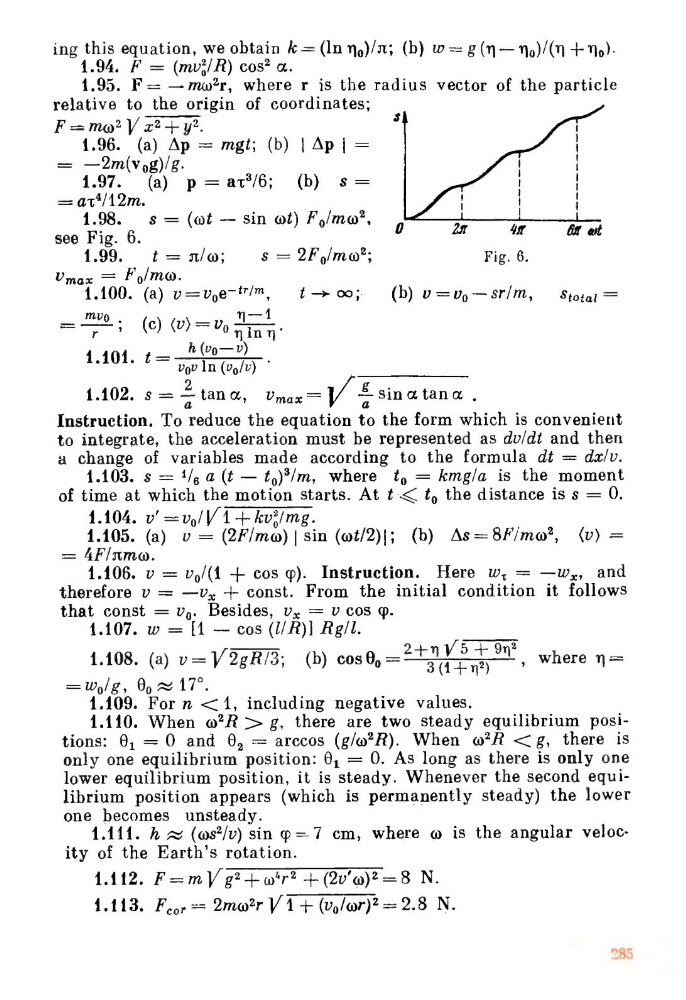
1.98.
s = (cot — sin cot) Fo/ma)2,
see Fig. 6.
1.99.
t = n/o);
s = 2F 01m(03;
vmax = Foinuo.
1.100. (a) v=voe -trlm,
00;
(b) v=vo —srlm,
'
1.101. t =
h (vo — v)
vov In (vo/u) '
1.102. s =
2
— tan a, vmax = 171 - sin a tan a
a
a
Instruction. To reduce the equation to the form which is convenient
to integrate, the acceleration must be represented as dv1dt and then
a change of variables made according to the formula dt = dxlv.
1.103. s
a (t — to)31m, where to = kmgla is the moment
of time at which the motion starts. At t < to the distance is s = 0.
1.104. v' = vo /
kvVmg.
1.105. (a) v = (2F/mw) I sin (o)t/2)I; (b) As = 8Firnco2, (v)
= 4F/nnuo.
1.106. v = vo/(1 + cos cp). Instruction. Here w,
—wx, and
therefore v = —vx
const. From the initial condition it follows
that const = vo. Besides, vx = v cos q.
1.107. w = [1 — cos (11R)] Rgll.
1.108. (a) v = - 1/2gfl /3; (b) cos % =
2 +11
± 9112
' where 1=
3 (1+ 2)
= wo/g, 00 17°.
1.109. For n <1, including negative values.
1.110. When c02R > g, there are two steady equilibrium positions: 01 = 0 and 02 = arccos (g1(02R). When OR
lower equilibrium position, it is steady. Whenever the second equilibrium position appears (which is permanently steady) the lower
one becomes unsteady.
1.111. h z ((os21v) sin cp = 7 cm, where 0) is the angular velocity of the Earth's rotation.
1.112. F = m g2 w 4r 2 ± (211(0)2 = 8 N.
1.113. Feor = 2m0)2r 1/1 (vohor)2 ---- - 2.8 N.
Off
fit ad
Fig. 6.
Stotal
1.94. F = (mv„ 21R) cost a.
1.95. F = —mco2r, where r is the radius vector of the particle
relative to the origin of coordinates;
F - m (1)2 V x2 + y2.
1.96. (a) Ap = mgt; (b) I Ap I =
—2m(vog)Ig.
1.97. (a) p = at3/6; (b) s =
=--a-r4/12m.
1.98.
s = (cot — sin cot) Fo/ma)2,
see Fig. 6.
1.99.
t = n/o);
s = 2F 01m(03;
vmax = Foinuo.
1.100. (a) v=voe -trlm,
00;
(b) v=vo —srlm,
'
1.101. t =
h (vo — v)
vov In (vo/u) '
1.102. s =
2
— tan a, vmax = 171 - sin a tan a
a
a
Instruction. To reduce the equation to the form which is convenient
to integrate, the acceleration must be represented as dv1dt and then
a change of variables made according to the formula dt = dxlv.
1.103. s
a (t — to)31m, where to = kmgla is the moment
of time at which the motion starts. At t < to the distance is s = 0.
1.104. v' = vo /
kvVmg.
1.105. (a) v = (2F/mw) I sin (o)t/2)I; (b) As = 8Firnco2, (v)
= 4F/nnuo.
1.106. v = vo/(1 + cos cp). Instruction. Here w,
—wx, and
therefore v = —vx
const. From the initial condition it follows
that const = vo. Besides, vx = v cos q.
1.107. w = [1 — cos (11R)] Rgll.
1.108. (a) v = - 1/2gfl /3; (b) cos % =
2 +11
± 9112
' where 1=
3 (1+ 2)
= wo/g, 00 17°.
1.109. For n <1, including negative values.
1.110. When c02R > g, there are two steady equilibrium positions: 01 = 0 and 02 = arccos (g1(02R). When OR
lower equilibrium position, it is steady. Whenever the second equilibrium position appears (which is permanently steady) the lower
one becomes unsteady.
1.111. h z ((os21v) sin cp = 7 cm, where 0) is the angular velocity of the Earth's rotation.
1.112. F = m g2 w 4r 2 ± (211(0)2 = 8 N.
1.113. Feor = 2m0)2r 1/1 (vohor)2 ---- - 2.8 N.
Off
fit ad
Fig. 6.
Stotal