

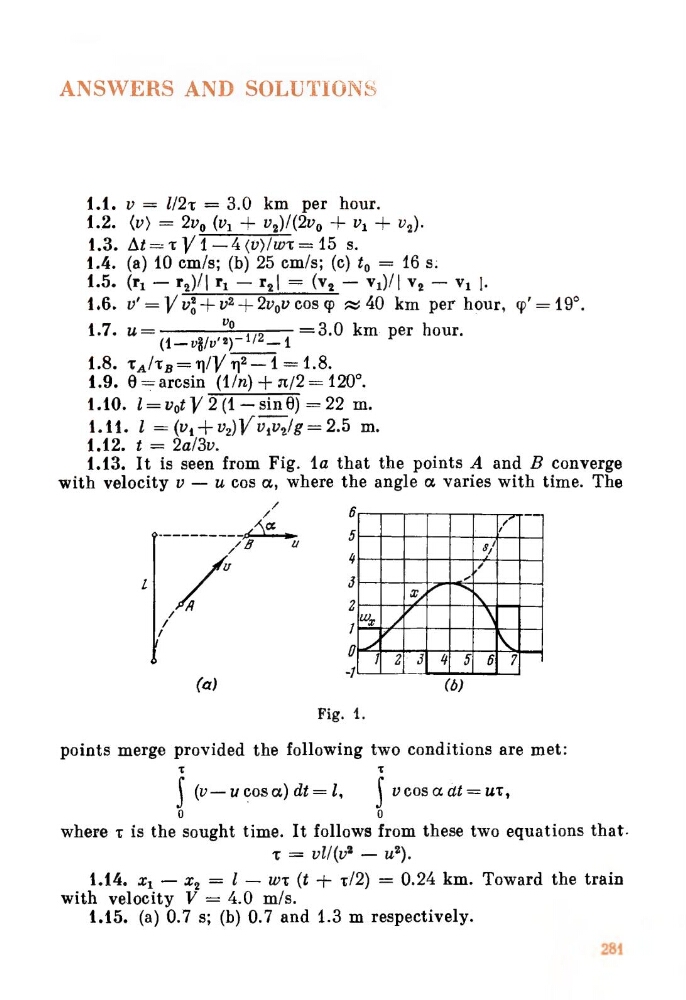
Fig. 1.
(a)
A
3
2
1
g
-1
5
5
4
1
3
2
4
ANSWERS AND SOLUTIONS
1A. v = 112-c = 3.0 km per hour.
1.2. (v) = 2v0 (v1 + v2)/(2vo + v1 + v2).
1.3. At= - 1/ 1 — 4 (v)/urt 15 s.
1.4. (a) 10 cm/s; (b) 25 cm/s; (c) to = 16 s.
1.5. (r1 — r2)/1 r1
r21 == (v2 -- vi)/1 v2 -- vl
1.6. v' = V 4 + v2 + 2vov cos q)
40 km per hour, cp' = 19°.
1.7. u— (1—va/v'2
vo
)- 1 /2 -
1 =3.0 km per hour.
1.8. TA/TB =1/1/ 112— 1 -- 1.8.
1.9. A=aresin (1/n) + a/2 -- 120°.
1.10. / = vot y 2 (1— sin 0) = 22 m.
1.11. 1 = (vi + v2)-liviv21g = 2.5 m.
1.12. t = 2a/3v.
1.13. It is seen from Fig. 1a that the points A and B converge
with velocity v — u cos a, where the angle a varies with time. The
points merge provided the following two conditions are met:
S
(V U cos cc) dt=1,
vcosa at = UT,
0
0
where .t is the sought time. It follows from these two equations that.
T =vl/(v2 -
1.14. x1 — x2 = 1— /VT (t + T12) = 0.24 km. Toward the train
with velocity V = 4.0 m/s.
1.15. (a) 0.7 s; (b) 0.7 and 1.3 m respectively.
(a)
A
3
2
1
g
-1
5
5
4
1
3
2
4
ANSWERS AND SOLUTIONS
1A. v = 112-c = 3.0 km per hour.
1.2. (v) = 2v0 (v1 + v2)/(2vo + v1 + v2).
1.3. At= - 1/ 1 — 4 (v)/urt 15 s.
1.4. (a) 10 cm/s; (b) 25 cm/s; (c) to = 16 s.
1.5. (r1 — r2)/1 r1
r21 == (v2 -- vi)/1 v2 -- vl
1.6. v' = V 4 + v2 + 2vov cos q)
40 km per hour, cp' = 19°.
1.7. u— (1—va/v'2
vo
)- 1 /2 -
1 =3.0 km per hour.
1.8. TA/TB =1/1/ 112— 1 -- 1.8.
1.9. A=aresin (1/n) + a/2 -- 120°.
1.10. / = vot y 2 (1— sin 0) = 22 m.
1.11. 1 = (vi + v2)-liviv21g = 2.5 m.
1.12. t = 2a/3v.
1.13. It is seen from Fig. 1a that the points A and B converge
with velocity v — u cos a, where the angle a varies with time. The
points merge provided the following two conditions are met:
S
(V U cos cc) dt=1,
vcosa at = UT,
0
0
where .t is the sought time. It follows from these two equations that.
T =vl/(v2 -
1.14. x1 — x2 = 1— /VT (t + T12) = 0.24 km. Toward the train
with velocity V = 4.0 m/s.
1.15. (a) 0.7 s; (b) 0.7 and 1.3 m respectively.