

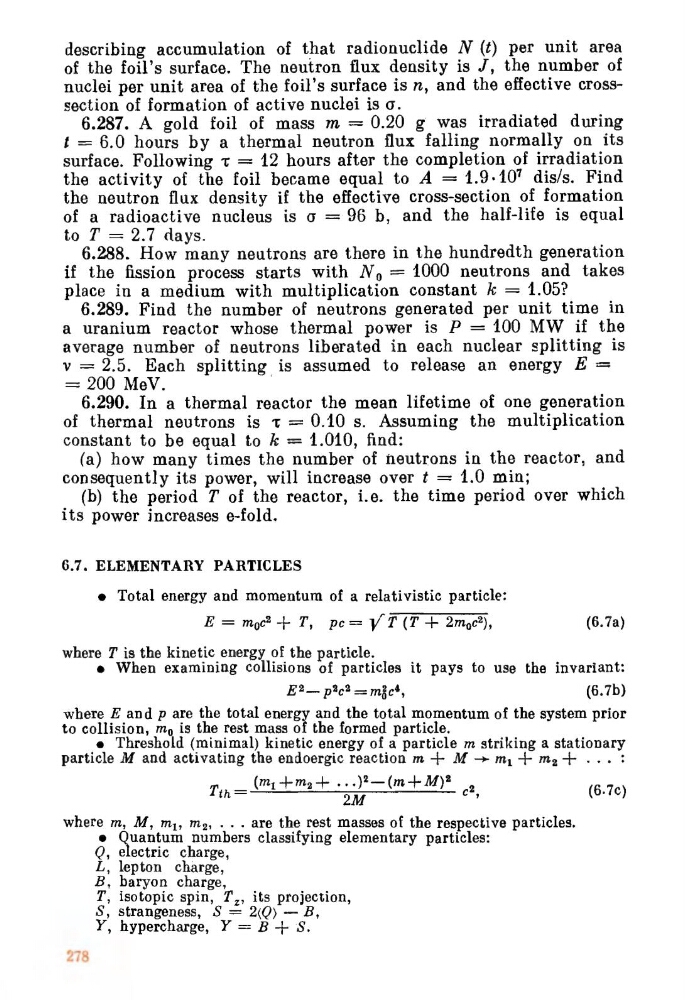
describing accumulation of that radionuclide N (t) per unit area
of the foil's surface. The neutron flux density is J, the number of
nuclei per unit area of the foil's surface is n, and the effective crosssection of formation of active nuclei is a.
6.287. A gold foil of mass m = 0.20 g was irradiated during
= 6.0 hours by a thermal neutron flux falling normally on its
surface. Following i = 12 hours after the completion of irradiation
the activity of the foil became equal to A = 1.9.107 dis/s. Find
the neutron flux density if the effective cross-section of formation
of a radioactive nucleus is a --= 96 b, and the half-life is equal
to T = 2.7 days.
6.288. How many neutrons are there in the hundredth generation
if the fission process starts with No = 1000 neutrons and takes
place in a medium with multiplication constant k = 1.05?
6.289. Find the number of neutrons generated per unit time in
a uranium reactor whose thermal power is P = 100 MW if the
average number of neutrons liberated in each nuclear splitting is
v = 2.5. Each splitting is assumed to release an energy E =
= 200 MeV.
6.290. In a thermal reactor the mean lifetime of one generation
of thermal neutrons is ti = 0.10 s. Assuming the multiplication
constant to be equal to k = 1.010, find:
(a) how many times the number of neutrons in the reactor, and
consequently its power, will increase over t = 1.0 min;
(b) the period T of the reactor, i.e. the time period over which
its power increases e-fold.
6.7. ELEMENTARY PARTICLES
• Total energy and momentum of a relativistic particle:
E = moc2
T, pc =ITT (T
2rnoc2),
(6.7a)
where T is the kinetic energy of the particle.
• When examining collisions of particles it pays to use the invariant:
E2 —p2c2 =m8c4,
(6.7b)
where E and p are the total energy and the total momentum of the system prior
to collision, mo is the rest mass of the formed particle.
• Threshold (minimal) kinetic energy of a particle m striking a stationary
particle M and activating the endoergic reaction in
M
m1 + m2 + ... :
(rni+m2+ • • •)2— (m+M)2
Tth=
c2,
(6.7c)
2M
where in, M, m1, m 2, . . . are the rest masses of the respective particles.
• Quantum numbers classifying elementary particles:
Q, electric charge,
L, lepton charge,
B, baryon charge,
T, isotopic spin, T2, its projection,
S, strangeness, S = 2(Q) — B,
Y, hypercharge, Y = B + S.
of the foil's surface. The neutron flux density is J, the number of
nuclei per unit area of the foil's surface is n, and the effective crosssection of formation of active nuclei is a.
6.287. A gold foil of mass m = 0.20 g was irradiated during
= 6.0 hours by a thermal neutron flux falling normally on its
surface. Following i = 12 hours after the completion of irradiation
the activity of the foil became equal to A = 1.9.107 dis/s. Find
the neutron flux density if the effective cross-section of formation
of a radioactive nucleus is a --= 96 b, and the half-life is equal
to T = 2.7 days.
6.288. How many neutrons are there in the hundredth generation
if the fission process starts with No = 1000 neutrons and takes
place in a medium with multiplication constant k = 1.05?
6.289. Find the number of neutrons generated per unit time in
a uranium reactor whose thermal power is P = 100 MW if the
average number of neutrons liberated in each nuclear splitting is
v = 2.5. Each splitting is assumed to release an energy E =
= 200 MeV.
6.290. In a thermal reactor the mean lifetime of one generation
of thermal neutrons is ti = 0.10 s. Assuming the multiplication
constant to be equal to k = 1.010, find:
(a) how many times the number of neutrons in the reactor, and
consequently its power, will increase over t = 1.0 min;
(b) the period T of the reactor, i.e. the time period over which
its power increases e-fold.
6.7. ELEMENTARY PARTICLES
• Total energy and momentum of a relativistic particle:
E = moc2
T, pc =ITT (T
2rnoc2),
(6.7a)
where T is the kinetic energy of the particle.
• When examining collisions of particles it pays to use the invariant:
E2 —p2c2 =m8c4,
(6.7b)
where E and p are the total energy and the total momentum of the system prior
to collision, mo is the rest mass of the formed particle.
• Threshold (minimal) kinetic energy of a particle m striking a stationary
particle M and activating the endoergic reaction in
M
m1 + m2 + ... :
(rni+m2+ • • •)2— (m+M)2
Tth=
c2,
(6.7c)
2M
where in, M, m1, m 2, . . . are the rest masses of the respective particles.
• Quantum numbers classifying elementary particles:
Q, electric charge,
L, lepton charge,
B, baryon charge,
T, isotopic spin, T2, its projection,
S, strangeness, S = 2(Q) — B,
Y, hypercharge, Y = B + S.