

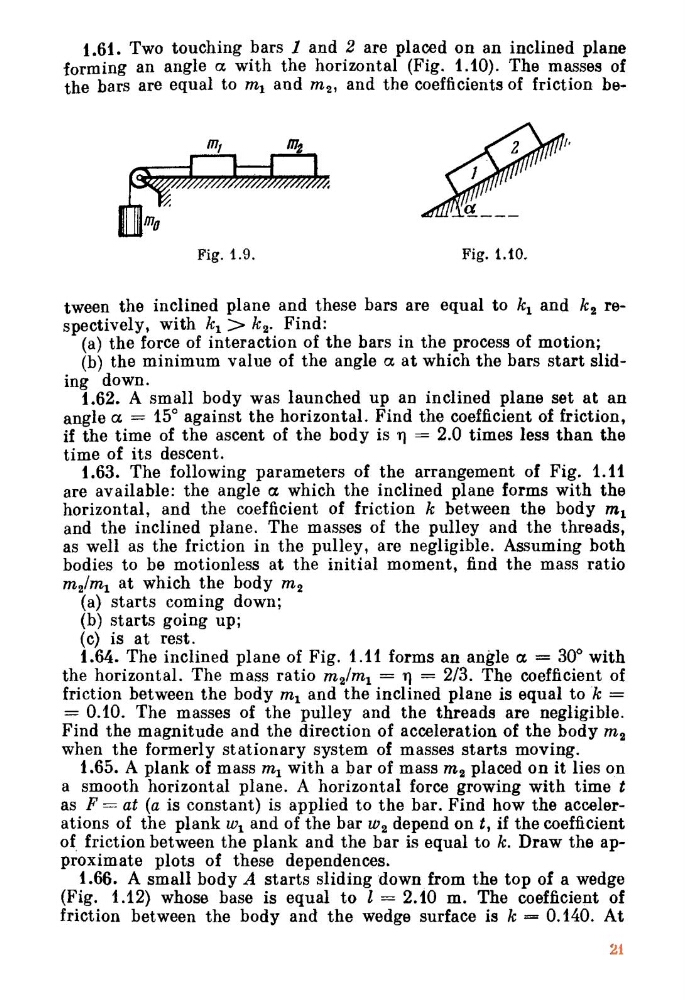
1.61. Two touching bars 1 and 2 are placed on an inclined plane
forming an angle a with the horizontal (Fig. 1.10). The masses of
the bars are equal to m1 and m2, and the coefficients of friction beFig. 1.9.
Fig. 1.10.
tween the inclined plane and these bars are equal to k1 and k2 respectively, with k1 > k 2. Find:
(a) the force of interaction of the bars in the process of motion;
(b) the minimum value of the angle a at which the bars start sliding down.
1.62. A small body was launched up an inclined plane set at an
angle a = 15° against the horizontal. Find the coefficient of friction,
if the time of the ascent of the body is ri = 2.0 times less than the
time of its descent.
1.63. The following parameters of the arrangement of Fig. 1.11
are available: the angle a which the inclined plane forms with the
horizontal, and the coefficient of friction k between the body m1
and the inclined plane. The masses of the pulley and the threads,
as well as the friction in the pulley, are negligible. Assuming both
bodies to be motionless at the initial moment, find the mass ratio
m2/m1 at which the body m2
(a) starts coming down;
(b) starts going up;
(c) is at rest.
1.64. The inclined plane of Fig. 1.11 forms an angle a = 30° with
the horizontal. The mass ratio m2/m1 = rl = 2/3. The coefficient of
friction between the body m1 and the inclined plane is equal to k =
= 0.10. The masses of the pulley and the threads are negligible.
Find the magnitude and the direction of acceleration of the body m2
when the formerly stationary system of masses starts moving.
1.65. A plank of mass m1 with a bar of mass m2 placed on it lies on
a smooth horizontal plane. A horizontal force growing with time t
as F = at (a is constant) is applied to the bar. Find how the accelerations of the plank w1 and of the bar w2 depend on t, if the coefficient
of friction between the plank and the bar is equal to k. Draw the approximate plots of these dependences.
1.66. A small body A starts sliding down from the top of a wedge
(Fig. 1.12) whose base is equal to 1 = 2.10 m. The coefficient of
friction between the body and the wedge surface is k = 0.140. At
21
forming an angle a with the horizontal (Fig. 1.10). The masses of
the bars are equal to m1 and m2, and the coefficients of friction beFig. 1.9.
Fig. 1.10.
tween the inclined plane and these bars are equal to k1 and k2 respectively, with k1 > k 2. Find:
(a) the force of interaction of the bars in the process of motion;
(b) the minimum value of the angle a at which the bars start sliding down.
1.62. A small body was launched up an inclined plane set at an
angle a = 15° against the horizontal. Find the coefficient of friction,
if the time of the ascent of the body is ri = 2.0 times less than the
time of its descent.
1.63. The following parameters of the arrangement of Fig. 1.11
are available: the angle a which the inclined plane forms with the
horizontal, and the coefficient of friction k between the body m1
and the inclined plane. The masses of the pulley and the threads,
as well as the friction in the pulley, are negligible. Assuming both
bodies to be motionless at the initial moment, find the mass ratio
m2/m1 at which the body m2
(a) starts coming down;
(b) starts going up;
(c) is at rest.
1.64. The inclined plane of Fig. 1.11 forms an angle a = 30° with
the horizontal. The mass ratio m2/m1 = rl = 2/3. The coefficient of
friction between the body m1 and the inclined plane is equal to k =
= 0.10. The masses of the pulley and the threads are negligible.
Find the magnitude and the direction of acceleration of the body m2
when the formerly stationary system of masses starts moving.
1.65. A plank of mass m1 with a bar of mass m2 placed on it lies on
a smooth horizontal plane. A horizontal force growing with time t
as F = at (a is constant) is applied to the bar. Find how the accelerations of the plank w1 and of the bar w2 depend on t, if the coefficient
of friction between the plank and the bar is equal to k. Draw the approximate plots of these dependences.
1.66. A small body A starts sliding down from the top of a wedge
(Fig. 1.12) whose base is equal to 1 = 2.10 m. The coefficient of
friction between the body and the wedge surface is k = 0.140. At
21