

of registered beta-particles was 2.66 times greater. Find the mean
lifetime of the given nuclei.
6.218. The activity of a certain preparation decreases 2.5 times
after 7.0 days. Find its half-life.
6.219. At the initial moment the activity of a certain radionuclide
totalled 650 particles per minute. What will be the activity of the
preparation after half its half-life period?
6.220. Find the decay constant and the mean lifetime of Co"
radionuclide if its activity is known to decrease 4.0% per hour.
The decay product is nonradioactive.
6.221. A U238 preparation of mass 1.0 g emits 1.24.104 alphaparticles per second. Find the half-life of this nuclide and the activity
of the preparation.
6.222. Determine the age of ancient wooden items if it is known
that the specific activity of C" nuclide in them amounts to 3/5 of
that in lately felled trees. The half-life of C" nuclei is 5570 years.
6.223. In a uranium ore the ratio of U238 nuclei to P132°8 nuclei
is = 2.8. Evaluate the age of the ore, assuming all the lead Pb2°8
to be a final decay product of the uranium series. The half-life of
U238 nuclei is 4.5.109 years.
6.224. Calculate the specific activities of Na24 and U235 nuclides
whose half-lifes are 15 hours and 7.1.108 years respectively.
6.225. A small amount of solution containing Na24 radionuclide
with activity A = 2.0.103 disintegrations per second was injected
in the bloodstream of a man. The activity of 1 cm3 of blood sample
taken t = 5.0 hours later turned out to be A' = 16 disintegrations
per minute per cm3. The half-life of the radionuclide is T = 15 hours.
Find the volume of the man's blood.
6.226. The specific activity of a preparation consisting of radioactive Co58 and nonradioactive Co" is equal to 2.2.1012 dis/(s•g).
The half-life of Co58 is 71.3 days. Find the ratio of the mass of radioactive cobalt in that preparation to the total mass of the preparation
(in per cent).
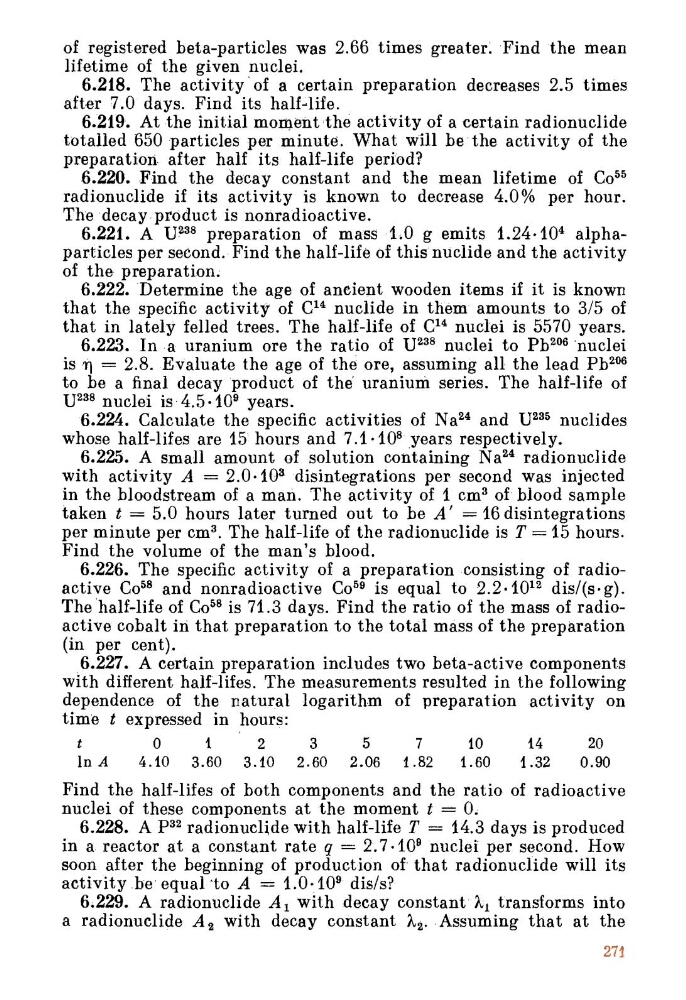
6.227. A certain preparation includes two beta-active components
with different half-lifes. The measurements resulted in the following
dependence of the natural logarithm of preparation activity on
time t expressed in hours:
t
0
1
2
3
5
7
10
14
20
In A
4.10 3.60 3.10 2.60 2.06 1.82 1.60
1.32
0.90
Find the half-lifes of both components and the ratio of radioactive
nuclei of these components at the moment t = 0.
6.228. A P32 radionuclide with half-life 7' = 14.3 days is produced
in a reactor at a constant rate q = 2.7.10' nuclei per second. How
soon after the beginning of production of that radionuclide will its
activity be equal to A = 1.0.109 dis/s?
6.229. A radionuclide A, with decay constant ki transforms into
a radionuclide A 2 with decay constant A,2. Assuming that at the
271
lifetime of the given nuclei.
6.218. The activity of a certain preparation decreases 2.5 times
after 7.0 days. Find its half-life.
6.219. At the initial moment the activity of a certain radionuclide
totalled 650 particles per minute. What will be the activity of the
preparation after half its half-life period?
6.220. Find the decay constant and the mean lifetime of Co"
radionuclide if its activity is known to decrease 4.0% per hour.
The decay product is nonradioactive.
6.221. A U238 preparation of mass 1.0 g emits 1.24.104 alphaparticles per second. Find the half-life of this nuclide and the activity
of the preparation.
6.222. Determine the age of ancient wooden items if it is known
that the specific activity of C" nuclide in them amounts to 3/5 of
that in lately felled trees. The half-life of C" nuclei is 5570 years.
6.223. In a uranium ore the ratio of U238 nuclei to P132°8 nuclei
is = 2.8. Evaluate the age of the ore, assuming all the lead Pb2°8
to be a final decay product of the uranium series. The half-life of
U238 nuclei is 4.5.109 years.
6.224. Calculate the specific activities of Na24 and U235 nuclides
whose half-lifes are 15 hours and 7.1.108 years respectively.
6.225. A small amount of solution containing Na24 radionuclide
with activity A = 2.0.103 disintegrations per second was injected
in the bloodstream of a man. The activity of 1 cm3 of blood sample
taken t = 5.0 hours later turned out to be A' = 16 disintegrations
per minute per cm3. The half-life of the radionuclide is T = 15 hours.
Find the volume of the man's blood.
6.226. The specific activity of a preparation consisting of radioactive Co58 and nonradioactive Co" is equal to 2.2.1012 dis/(s•g).
The half-life of Co58 is 71.3 days. Find the ratio of the mass of radioactive cobalt in that preparation to the total mass of the preparation
(in per cent).
6.227. A certain preparation includes two beta-active components
with different half-lifes. The measurements resulted in the following
dependence of the natural logarithm of preparation activity on
time t expressed in hours:
t
0
1
2
3
5
7
10
14
20
In A
4.10 3.60 3.10 2.60 2.06 1.82 1.60
1.32
0.90
Find the half-lifes of both components and the ratio of radioactive
nuclei of these components at the moment t = 0.
6.228. A P32 radionuclide with half-life 7' = 14.3 days is produced
in a reactor at a constant rate q = 2.7.10' nuclei per second. How
soon after the beginning of production of that radionuclide will its
activity be equal to A = 1.0.109 dis/s?
6.229. A radionuclide A, with decay constant ki transforms into
a radionuclide A 2 with decay constant A,2. Assuming that at the
271