

.17
===
4
3
Diffuse
series
2
Principal series
3
Sharp
series
H
K-series
Fig. 6.8.
N
• Terms of alkali metal atoms:
T —
(6.3a)
(n± CO2
where R is the Rydberg constant, a is the Rydberg correction.
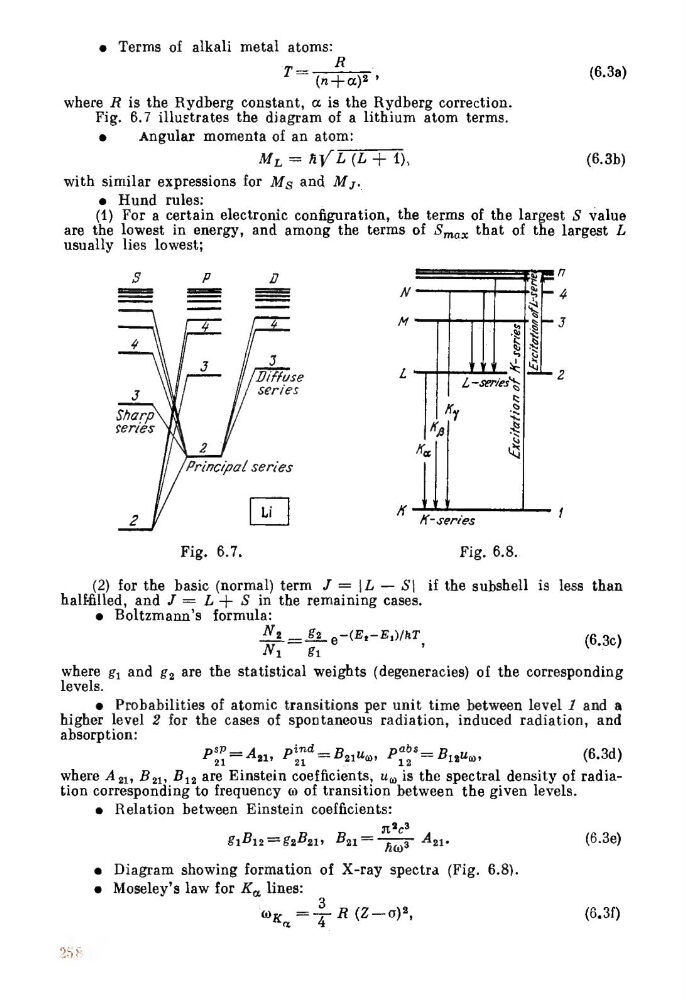
Fig. 6.7 illustrates the diagram of a lithium atom terms.
•
Angular momenta of an atom:
ML = hjlL (L
1),
(6.3b)
with similar expressions for Ms and M1.
• Hund rules:
(1) For a certain electronic configuration, the terms of the largest S value
are the lowest in energy, and among the terms of Smax that of the largest L
usually lies lowest;
Li
Fig. 6.7.
(2) for the basic (normal) term J = IL — SI if the subshell is less than
half-filled, and J = L
S in the remaining cases.
• Boltzmann's formula:
Ns = g2
e —(E,--E1)111T
(6.3c)
N I g i
where g1 and g2 are the statistical weights (degeneracies) of the corresponding
levels.
• Probabilities of atomic transitions per unit time between level 1 and a
higher level 2 for the cases of spontaneous radiation, induced radiation, and
absorption:
PsP -
=
pind
p ,
pabs
21
21
12
BAUM,
where A 21, B 21, B12 are Einstein coefficients, uo, is the spectral density of radiation corresponding to frequency co of transition between the given levels.
• Relation between Einstein coefficients:
n2c3
g1B12=g2,821, B21 kw 3A21.
• Diagram showing formation of X-ray spectra (Fig. 6.8).
• Moseley's law for K, lines:
s
K = 3 LI (Z— o)2,
a
4
(6.3d)
(6.3e)
(6.3f)
===
4
3
Diffuse
series
2
Principal series
3
Sharp
series
H
K-series
Fig. 6.8.
N
• Terms of alkali metal atoms:
T —
(6.3a)
(n± CO2
where R is the Rydberg constant, a is the Rydberg correction.
Fig. 6.7 illustrates the diagram of a lithium atom terms.
•
Angular momenta of an atom:
ML = hjlL (L
1),
(6.3b)
with similar expressions for Ms and M1.
• Hund rules:
(1) For a certain electronic configuration, the terms of the largest S value
are the lowest in energy, and among the terms of Smax that of the largest L
usually lies lowest;
Li
Fig. 6.7.
(2) for the basic (normal) term J = IL — SI if the subshell is less than
half-filled, and J = L
S in the remaining cases.
• Boltzmann's formula:
Ns = g2
e —(E,--E1)111T
(6.3c)
N I g i
where g1 and g2 are the statistical weights (degeneracies) of the corresponding
levels.
• Probabilities of atomic transitions per unit time between level 1 and a
higher level 2 for the cases of spontaneous radiation, induced radiation, and
absorption:
PsP -
=
pind
p ,
pabs
21
21
12
BAUM,
where A 21, B 21, B12 are Einstein coefficients, uo, is the spectral density of radiation corresponding to frequency co of transition between the given levels.
• Relation between Einstein coefficients:
n2c3
g1B12=g2,821, B21 kw 3A21.
• Diagram showing formation of X-ray spectra (Fig. 6.8).
• Moseley's law for K, lines:
s
K = 3 LI (Z— o)2,
a
4
(6.3d)
(6.3e)
(6.3f)