

ference of refractive indices of quartz for ordinary and extraordinary
rays at the wavelength indicated above.
5.185. Natural monochromatic light of intensity •/ 0 falls on a system of two Polaroids between which a crystalline plate is inserted,
cut parallel to its optical axis. The plate introduces a phase difference 6 between the ordinary and extraordinary rays. Demonstrate
that the intensity of light transmitted through that system is equal to
I -T.
1
-
I ° [cos2 (q) — cp') — sin 2cp• sin 2p' sin2 (6/2)1,
where cp and cp' are the angles between the optical axis of the crystal
and the principal directions of the Polaroids. In particular, consider
the cases of crossed and parallel Polaroids.
5.186. Monochromatic light with circular polarization falls normally on a crystalline plate cut parallel to the optical axis. Behind
the plate there is a Nicol prism whose principal direction forms an
angle cp with the optical axis of the plate. Demonstrate that the
intensity of light transmitted through that system is equal to
/ = / 0 (1 -I- sin 2T•sin 8),
where S is the phase difference between the ordinary and extraordinary rays which is introduced by the plate.
5.187. Explain how, using a Polaroid and a quarter-wave plate
made of positive uniaxial crystal (ne > no), to distinguish
(a) light with left-hand circular polarization from that with
right-hand polarization;
(b) natural light from light with circular polarization and from
the composition of natural light and that with circular polarization.
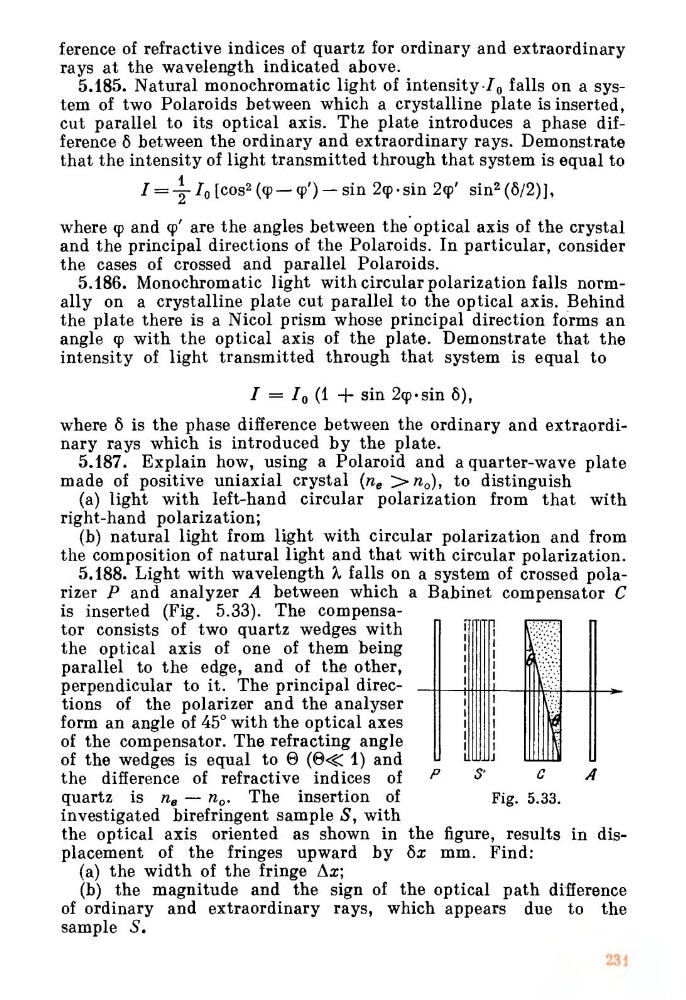
5.188. Light with wavelength falls on a system of crossed polarizer P and analyzer A between which a Babinet compensator C
is inserted (Fig. 5.33). The compensator consists of two quartz wedges with
the optical axis of one of them being
parallel to the edge, and of the other,
perpendicular to it. The principal directions of the polarizer and the analyser
form an angle of 45° with the optical axes
of the compensator. The refracting angle
of the wedges is equal to O (e< 1) and
L _J
the difference of refractive indices of
P
S
C
A
quartz is n. — no. The insertion of
Fig. 5.33.
investigated birefringent sample S, with
the optical axis oriented as shown in the figure, results in displacement of the fringes upward by 6x mm. Find:
(a) the width of the fringe Ax;
(b) the magnitude and the sign of the optical path difference
of ordinary and extraordinary rays, which appears due to the
sample S.
rays at the wavelength indicated above.
5.185. Natural monochromatic light of intensity •/ 0 falls on a system of two Polaroids between which a crystalline plate is inserted,
cut parallel to its optical axis. The plate introduces a phase difference 6 between the ordinary and extraordinary rays. Demonstrate
that the intensity of light transmitted through that system is equal to
I -T.
1
-
I ° [cos2 (q) — cp') — sin 2cp• sin 2p' sin2 (6/2)1,
where cp and cp' are the angles between the optical axis of the crystal
and the principal directions of the Polaroids. In particular, consider
the cases of crossed and parallel Polaroids.
5.186. Monochromatic light with circular polarization falls normally on a crystalline plate cut parallel to the optical axis. Behind
the plate there is a Nicol prism whose principal direction forms an
angle cp with the optical axis of the plate. Demonstrate that the
intensity of light transmitted through that system is equal to
/ = / 0 (1 -I- sin 2T•sin 8),
where S is the phase difference between the ordinary and extraordinary rays which is introduced by the plate.
5.187. Explain how, using a Polaroid and a quarter-wave plate
made of positive uniaxial crystal (ne > no), to distinguish
(a) light with left-hand circular polarization from that with
right-hand polarization;
(b) natural light from light with circular polarization and from
the composition of natural light and that with circular polarization.
5.188. Light with wavelength falls on a system of crossed polarizer P and analyzer A between which a Babinet compensator C
is inserted (Fig. 5.33). The compensator consists of two quartz wedges with
the optical axis of one of them being
parallel to the edge, and of the other,
perpendicular to it. The principal directions of the polarizer and the analyser
form an angle of 45° with the optical axes
of the compensator. The refracting angle
of the wedges is equal to O (e< 1) and
L _J
the difference of refractive indices of
P
S
C
A
quartz is n. — no. The insertion of
Fig. 5.33.
investigated birefringent sample S, with
the optical axis oriented as shown in the figure, results in displacement of the fringes upward by 6x mm. Find:
(a) the width of the fringe Ax;
(b) the magnitude and the sign of the optical path difference
of ordinary and extraordinary rays, which appears due to the
sample S.