

(a) the position of rings;
(b) the angular width of fringes
depends on the order of interference.
5.96. For the Fabry-Perot etalon of thickness d = 2.5 cm find:
(a) the highest order of interference of light with wavelength
= 0.50 p,m;
(b) the dispersion region \X, i.e. the spectral interval of wavelengths, within which there is still no overlap with other orders of
interference if the observation is carried out approximately at
wavelength X = 0.50 pm.
5.3. DIFFRACTION OF LIGHT
• Radius of the periphery of the kth Fresnel zone:
rk=17
ab
a+b '
k-1
'
2 ' 3 ' • •
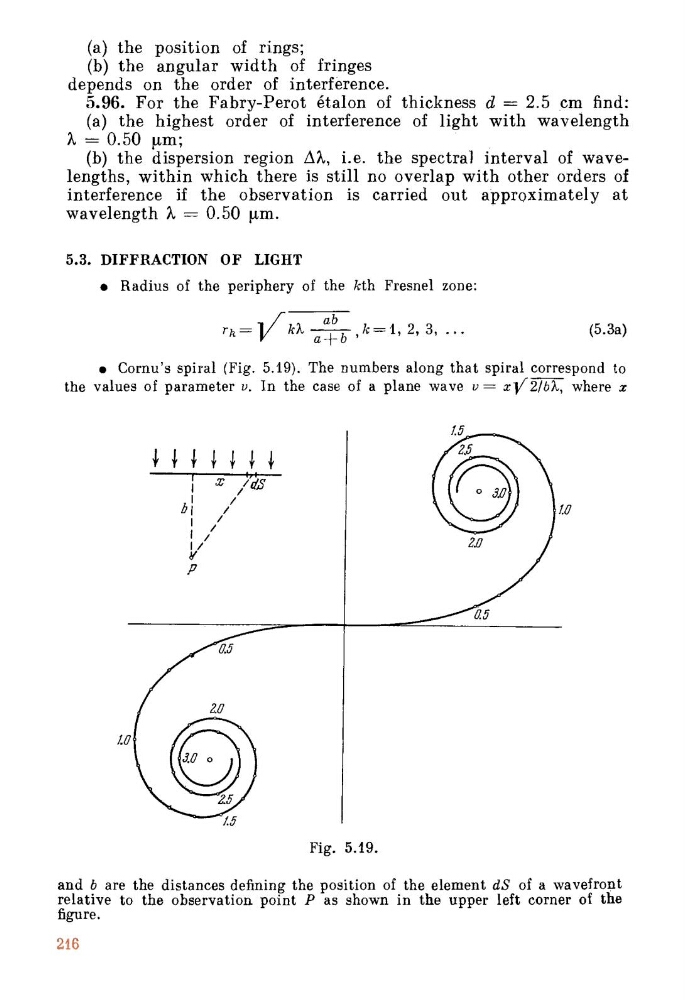
• Cornu's spiral (Fig. 5.19). The numbers along that spiral correspond to
the values of parameter v. In the case of a plane wave v = xii2lbk, where x
Fig. 5.19.
and b are the distances defining the position of the element dS of a wavefront
relative to the observation. point P as shown in the upper left corner of the
figure.
(5.3a)
216
(b) the angular width of fringes
depends on the order of interference.
5.96. For the Fabry-Perot etalon of thickness d = 2.5 cm find:
(a) the highest order of interference of light with wavelength
= 0.50 p,m;
(b) the dispersion region \X, i.e. the spectral interval of wavelengths, within which there is still no overlap with other orders of
interference if the observation is carried out approximately at
wavelength X = 0.50 pm.
5.3. DIFFRACTION OF LIGHT
• Radius of the periphery of the kth Fresnel zone:
rk=17
ab
a+b '
k-1
'
2 ' 3 ' • •
• Cornu's spiral (Fig. 5.19). The numbers along that spiral correspond to
the values of parameter v. In the case of a plane wave v = xii2lbk, where x
Fig. 5.19.
and b are the distances defining the position of the element dS of a wavefront
relative to the observation. point P as shown in the upper left corner of the
figure.
(5.3a)
216