

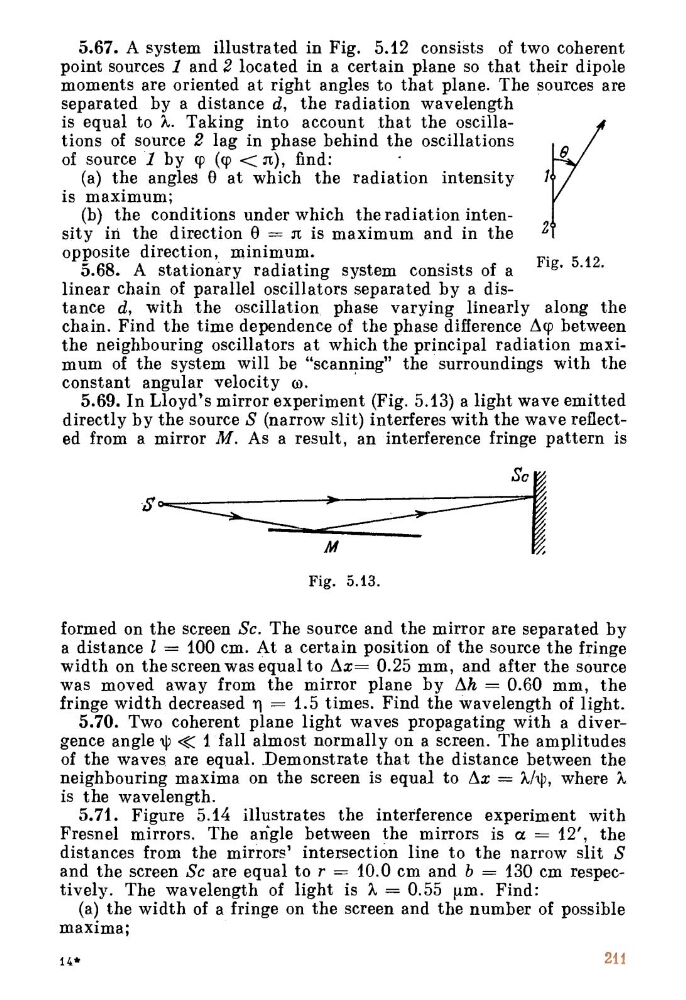
5.67. A system illustrated in Fig. 5.12 consists of two coherent
point sources 1 and 2 located in a certain plane so that their dipole
moments are oriented at right angles to that plane. The sources are
separated by a distance d, the radiation wavelength
is equal to X. Taking into account that the oscillations of source 2 lag in phase behind the oscillations
of source 1 by y (cp < a), find:
(a) the angles 0 at which the radiation intensity
is maximum;
(b) the conditions under which the radiation intensity in the direction 0 = a is maximum and in the
2
opposite direction, minimum.
Fig. 5.12.
5.68. A stationary radiating system consists of a
linear chain of parallel oscillators separated by a distance d, with the oscillation, phase varying linearly along the
chain. Find the time dependence of the phase difference AT between
the neighbouring oscillators at which the principal radiation maximum of the system will be "scanning" the surroundings with the
constant angular velocity co.
5.69. In Lloyd's mirror experiment (Fig. 5.13) a light wave emitted
directly by the source S (narrow slit) interferes with the wave reflected from a mirror M. As a result, an interference fringe pattern is
Sc
M
Fig. 5.13.
formed on the screen Sc. The source and the mirror are separated by
a distance 1 = 100 cm. At a certain position of the source the fringe
width on the screen was equal to Ax= 0.25 mm, and after the source
was moved away from the mirror plane by Ah = 0.60 mm, the
fringe width decreased 1 1 = 1.5 times. Find the wavelength of light.
5.70. Two coherent plane light waves propagating with a divergence angle 1) < 1 fall almost normally on a screen. The amplitudes
of the waves are equal. Demonstrate that the distance between the
neighbouring maxima on the screen is equal to Ax = X/11), where X
is the wavelength.
5.71. Figure 5.14 illustrates the interference experiment with
Fresnel mirrors. The angle between the mirrors is a = 12', the
distances from the mirrors' intersection line to the narrow slit S
and the screen Sc are equal to r = 10.0 cm and b = 130 cm respectively. The wavelength of light is X = 0.55 p.m. Find:
(a) the width of a fringe on the screen and the number of possible
maxima;
14•
211
point sources 1 and 2 located in a certain plane so that their dipole
moments are oriented at right angles to that plane. The sources are
separated by a distance d, the radiation wavelength
is equal to X. Taking into account that the oscillations of source 2 lag in phase behind the oscillations
of source 1 by y (cp < a), find:
(a) the angles 0 at which the radiation intensity
is maximum;
(b) the conditions under which the radiation intensity in the direction 0 = a is maximum and in the
2
opposite direction, minimum.
Fig. 5.12.
5.68. A stationary radiating system consists of a
linear chain of parallel oscillators separated by a distance d, with the oscillation, phase varying linearly along the
chain. Find the time dependence of the phase difference AT between
the neighbouring oscillators at which the principal radiation maximum of the system will be "scanning" the surroundings with the
constant angular velocity co.
5.69. In Lloyd's mirror experiment (Fig. 5.13) a light wave emitted
directly by the source S (narrow slit) interferes with the wave reflected from a mirror M. As a result, an interference fringe pattern is
Sc
M
Fig. 5.13.
formed on the screen Sc. The source and the mirror are separated by
a distance 1 = 100 cm. At a certain position of the source the fringe
width on the screen was equal to Ax= 0.25 mm, and after the source
was moved away from the mirror plane by Ah = 0.60 mm, the
fringe width decreased 1 1 = 1.5 times. Find the wavelength of light.
5.70. Two coherent plane light waves propagating with a divergence angle 1) < 1 fall almost normally on a screen. The amplitudes
of the waves are equal. Demonstrate that the distance between the
neighbouring maxima on the screen is equal to Ax = X/11), where X
is the wavelength.
5.71. Figure 5.14 illustrates the interference experiment with
Fresnel mirrors. The angle between the mirrors is a = 12', the
distances from the mirrors' intersection line to the narrow slit S
and the screen Sc are equal to r = 10.0 cm and b = 130 cm respectively. The wavelength of light is X = 0.55 p.m. Find:
(a) the width of a fringe on the screen and the number of possible
maxima;
14•
211