

of the pulley. Find the frequency of small oscillations of the arrangement.
4.56. A solid uniform cylinder of radius r rolls without sliding
along the inside surface of a cylinder of radius R, performing small
oscillations. Find their period.
4.57. A solid uniform cylinder of plass m performs small oscillations due to the action of two springs whose combined stiffness is
equal to x (Fig. 4.18). Find the period of these oscillations in the
absence of sliding.
4.58. Two cubes with masses m1 and m2 were interconnected by a
weightless spring of stiffness x and placed on a smooth horizontal
surface. Then the cubes were drawn closer to each other and released
simultaneously. Find the natural oscillation frequency of the
system.
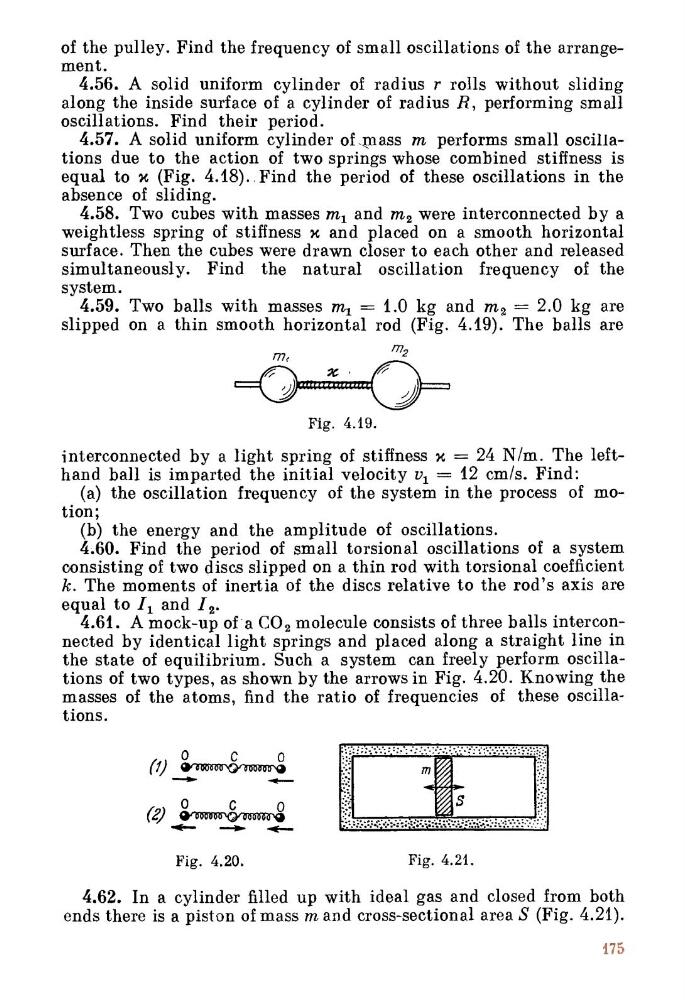
4.59. Two balls with masses m1 = 1.0 kg and m2 = 2.0 kg are
slipped on a thin smooth horizontal rod (Fig. 4.19). The balls are
/77 2
Fig. 4.19.
interconnected by a light spring of stiffness x = 24 N/m. The lefthand ball is imparted the initial velocity v1 = 12 cm/s. Find:
(a) the oscillation frequency of the system in the process of motion;
(b) the energy and the amplitude of oscillations.
4.60. Find the period of small torsional oscillations of a system
consisting of two discs slipped on a thin rod with torsional coefficient
k. The moments of inertia of the discs relative to the rod's axis are
equal to Il and /2.
4.61. A mock-up of a CO2 molecule consists of three balls interconnected by identical light springs and placed along a straight line in
the state of equilibrium. Such a system can freely perform oscillations of two types, as shown by the arrows in Fig. 4.20. Knowing the
masses of the atoms, find the ratio of frequencies of these oscillations.
(1) ?DrrommEvaigroni 0 D
0
c
(2) enninranortrunratrva
Fig. 4.20.
Fig. 4.21.
4.62. In a cylinder filled up with ideal gas and closed from both
ends there is a piston of mass m, and cross-sectional area S (Fig. 4.21).
175
4.56. A solid uniform cylinder of radius r rolls without sliding
along the inside surface of a cylinder of radius R, performing small
oscillations. Find their period.
4.57. A solid uniform cylinder of plass m performs small oscillations due to the action of two springs whose combined stiffness is
equal to x (Fig. 4.18). Find the period of these oscillations in the
absence of sliding.
4.58. Two cubes with masses m1 and m2 were interconnected by a
weightless spring of stiffness x and placed on a smooth horizontal
surface. Then the cubes were drawn closer to each other and released
simultaneously. Find the natural oscillation frequency of the
system.
4.59. Two balls with masses m1 = 1.0 kg and m2 = 2.0 kg are
slipped on a thin smooth horizontal rod (Fig. 4.19). The balls are
/77 2
Fig. 4.19.
interconnected by a light spring of stiffness x = 24 N/m. The lefthand ball is imparted the initial velocity v1 = 12 cm/s. Find:
(a) the oscillation frequency of the system in the process of motion;
(b) the energy and the amplitude of oscillations.
4.60. Find the period of small torsional oscillations of a system
consisting of two discs slipped on a thin rod with torsional coefficient
k. The moments of inertia of the discs relative to the rod's axis are
equal to Il and /2.
4.61. A mock-up of a CO2 molecule consists of three balls interconnected by identical light springs and placed along a straight line in
the state of equilibrium. Such a system can freely perform oscillations of two types, as shown by the arrows in Fig. 4.20. Knowing the
masses of the atoms, find the ratio of frequencies of these oscillations.
(1) ?DrrommEvaigroni 0 D
0
c
(2) enninranortrunratrva
Fig. 4.20.
Fig. 4.21.
4.62. In a cylinder filled up with ideal gas and closed from both
ends there is a piston of mass m, and cross-sectional area S (Fig. 4.21).
175