

.'..'..'.
•
• • • • ••••••••
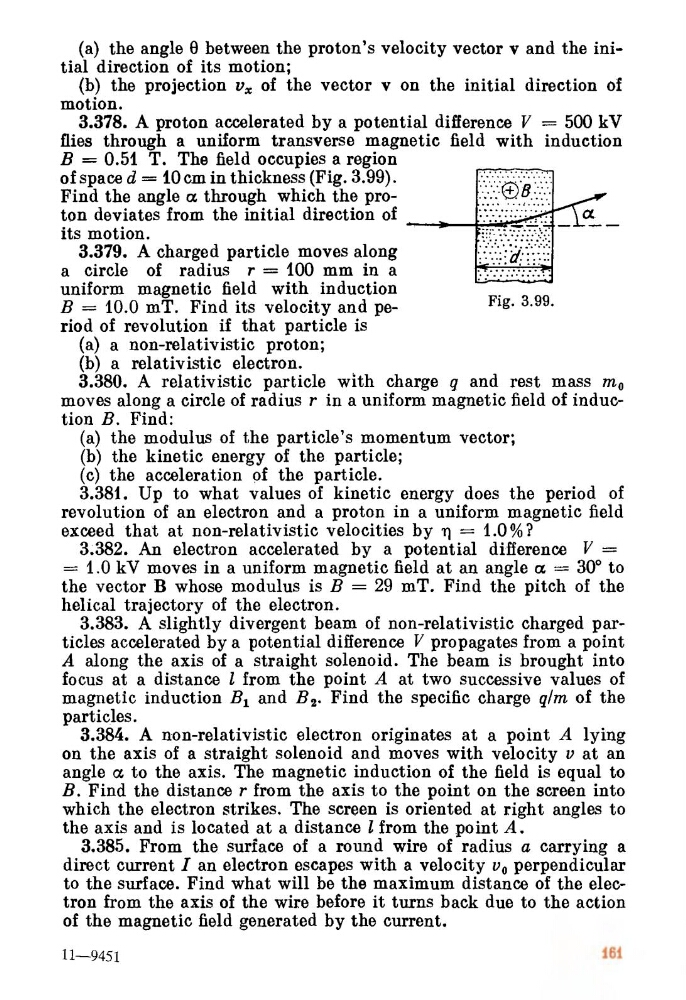
Fig. 3.99
(a) the angle 0 between the proton's velocity vector v and the initial direction of its motion;
(b) the projection vx of the vector v on the initial direction of
motion.
3.378. A proton accelerated by a potential difference V = 500 kV
flies through a uniform transverse magnetic field with induction
B = 0.51 T. The field occupies a region
of space d =10 cm in thickness (Fig. 3.99).
Find the angle a through which the proton deviates from the initial direction of
its motion.
3.379. A charged particle moves along
a circle of radius r = 100 mm in a
uniform magnetic field with induction
B = 10.0 mT. Find its velocity and period of revolution if that particle is
(a) a non-relativistic proton;
(b) a relativistic electron.
3.380. A relativistic particle with charge q and rest mass ma
moves along a circle of radius r in a uniform magnetic field of induction B. Find:
(a) the modulus of the particle's momentum vector;
(b) the kinetic energy of the particle;
(c) the acceleration of the particle.
3.381. Up to what values of kinetic energy does the period of
revolution of an electron and a proton in a uniform magnetic field
exceed that at non-relativistic velocities by it = 1.0 % ?
3.382. An electron accelerated by a potential difference V =
= 1.0 kV moves in a uniform magnetic field at an angle a = 30° to
the vector B whose modulus is B = 29 mT. Find the pitch of the
helical trajectory of the electron.
3.383. A slightly divergent beam of non-relativistic charged particles accelerated by a potential difference V propagates from a point
A along the axis of a straight solenoid. The beam is brought into
focus at a distance 1 from the point A at two successive values of
magnetic induction B1 and B2. Find the specific charge qlm of the
particles.
3.384. A non-relativistic electron originates at a point A lying
on the axis of a straight solenoid and moves with velocity v at an
angle a to the axis. The magnetic induction of the field is equal to
B. Find the distance r from the axis to the point on the screen into
which the electron strikes. The screen is oriented at right angles to
the axis and is located at a distance 1 from the point A.
3.385. From the surface of a round wire of radius a carrying a
direct current I an electron escapes with a velocity vo perpendicular
to the surface. Find what will be the maximum distance of the electron from the axis of the wire before it turns back due to the action
of the magnetic field generated by the current.
11-9451
•
• • • • ••••••••
Fig. 3.99
(a) the angle 0 between the proton's velocity vector v and the initial direction of its motion;
(b) the projection vx of the vector v on the initial direction of
motion.
3.378. A proton accelerated by a potential difference V = 500 kV
flies through a uniform transverse magnetic field with induction
B = 0.51 T. The field occupies a region
of space d =10 cm in thickness (Fig. 3.99).
Find the angle a through which the proton deviates from the initial direction of
its motion.
3.379. A charged particle moves along
a circle of radius r = 100 mm in a
uniform magnetic field with induction
B = 10.0 mT. Find its velocity and period of revolution if that particle is
(a) a non-relativistic proton;
(b) a relativistic electron.
3.380. A relativistic particle with charge q and rest mass ma
moves along a circle of radius r in a uniform magnetic field of induction B. Find:
(a) the modulus of the particle's momentum vector;
(b) the kinetic energy of the particle;
(c) the acceleration of the particle.
3.381. Up to what values of kinetic energy does the period of
revolution of an electron and a proton in a uniform magnetic field
exceed that at non-relativistic velocities by it = 1.0 % ?
3.382. An electron accelerated by a potential difference V =
= 1.0 kV moves in a uniform magnetic field at an angle a = 30° to
the vector B whose modulus is B = 29 mT. Find the pitch of the
helical trajectory of the electron.
3.383. A slightly divergent beam of non-relativistic charged particles accelerated by a potential difference V propagates from a point
A along the axis of a straight solenoid. The beam is brought into
focus at a distance 1 from the point A at two successive values of
magnetic induction B1 and B2. Find the specific charge qlm of the
particles.
3.384. A non-relativistic electron originates at a point A lying
on the axis of a straight solenoid and moves with velocity v at an
angle a to the axis. The magnetic induction of the field is equal to
B. Find the distance r from the axis to the point on the screen into
which the electron strikes. The screen is oriented at right angles to
the axis and is located at a distance 1 from the point A.
3.385. From the surface of a round wire of radius a carrying a
direct current I an electron escapes with a velocity vo perpendicular
to the surface. Find what will be the maximum distance of the electron from the axis of the wire before it turns back due to the action
of the magnetic field generated by the current.
11-9451