

L2
in the same plane, with the side b being closest to the wire, separated
by a distance 1 from it and oriented parallel to it.
L7
Fig. 3.93.
Fig. 3.94.
3.330. Determine the mutual inductance of a doughnut coil and
an infinite straight wire passing along its axis. The coil has a rectangular cross-section, its inside radius is equal to a and the outside one,
to b. The length of the doughnut's cross-sectional side parallel to the
wire is equal to h. The coil has N turns. The system is located in a
uniform magnetic with permeability IA.
3.331. Two thin concentric wires shaped as circles with radii a
and b lie in the same plane. Allowing for a < b, find:
(a) their mutual inductance;
(b) the magnetic flux through the surface enclosed by the outside
wire, when the inside wire carries a current I.
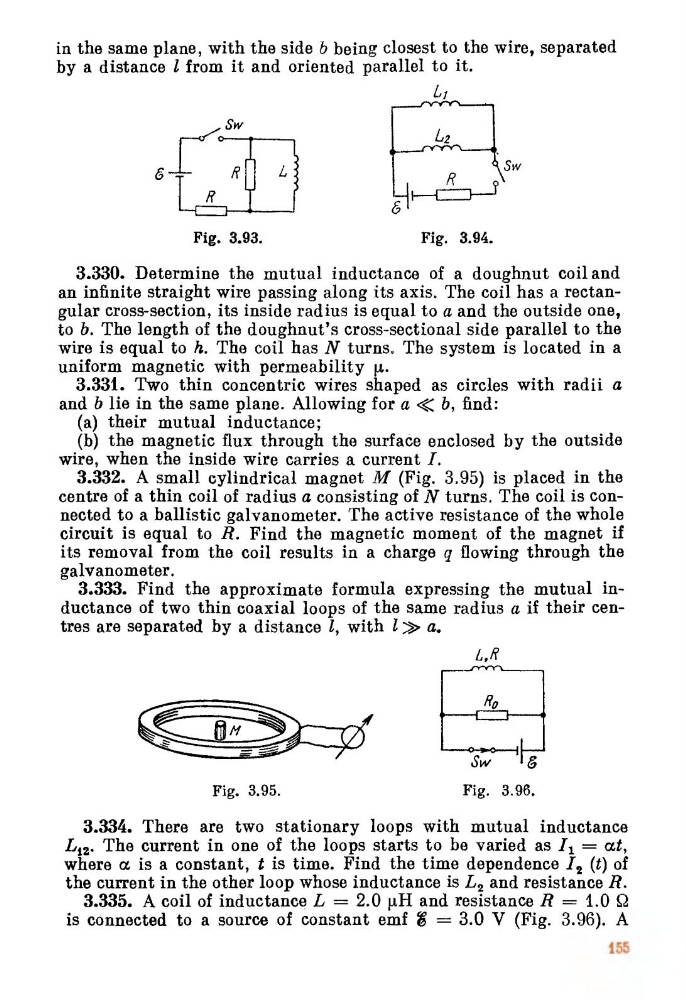
3.332. A small cylindrical magnet M (Fig. 3.95) is placed in the
centre of a thin coil of radius a consisting of N turns. The coil is connected to a ballistic galvanometer. The active resistance of the whole
circuit is equal to R. Find the magnetic moment of the magnet if
its removal from the coil results in a charge q flowing through the
galvanometer.
3.333. Find the approximate formula expressing the mutual inductance of two thin coaxial loops of the same radius a if their centres are separated by a distance 1, with 1> a.
L,R
Fig. 3.95.
3.334. There are two stationary loops with mutual inductance
La. The current in one of the loops starts to be varied as /1 = at,
where a is a constant, t is time. Find the time dependence /2 (t) of
the current in the other loop whose inductance is L2 and resistance R.
3.335. A coil of inductance L = 2.0 µH and resistance R = 1.0 S2
is connected to a source of constant emf g = 3.0 V (Fig. 3.96). A
in the same plane, with the side b being closest to the wire, separated
by a distance 1 from it and oriented parallel to it.
L7
Fig. 3.93.
Fig. 3.94.
3.330. Determine the mutual inductance of a doughnut coil and
an infinite straight wire passing along its axis. The coil has a rectangular cross-section, its inside radius is equal to a and the outside one,
to b. The length of the doughnut's cross-sectional side parallel to the
wire is equal to h. The coil has N turns. The system is located in a
uniform magnetic with permeability IA.
3.331. Two thin concentric wires shaped as circles with radii a
and b lie in the same plane. Allowing for a < b, find:
(a) their mutual inductance;
(b) the magnetic flux through the surface enclosed by the outside
wire, when the inside wire carries a current I.
3.332. A small cylindrical magnet M (Fig. 3.95) is placed in the
centre of a thin coil of radius a consisting of N turns. The coil is connected to a ballistic galvanometer. The active resistance of the whole
circuit is equal to R. Find the magnetic moment of the magnet if
its removal from the coil results in a charge q flowing through the
galvanometer.
3.333. Find the approximate formula expressing the mutual inductance of two thin coaxial loops of the same radius a if their centres are separated by a distance 1, with 1> a.
L,R
Fig. 3.95.
3.334. There are two stationary loops with mutual inductance
La. The current in one of the loops starts to be varied as /1 = at,
where a is a constant, t is time. Find the time dependence /2 (t) of
the current in the other loop whose inductance is L2 and resistance R.
3.335. A coil of inductance L = 2.0 µH and resistance R = 1.0 S2
is connected to a source of constant emf g = 3.0 V (Fig. 3.96). A