

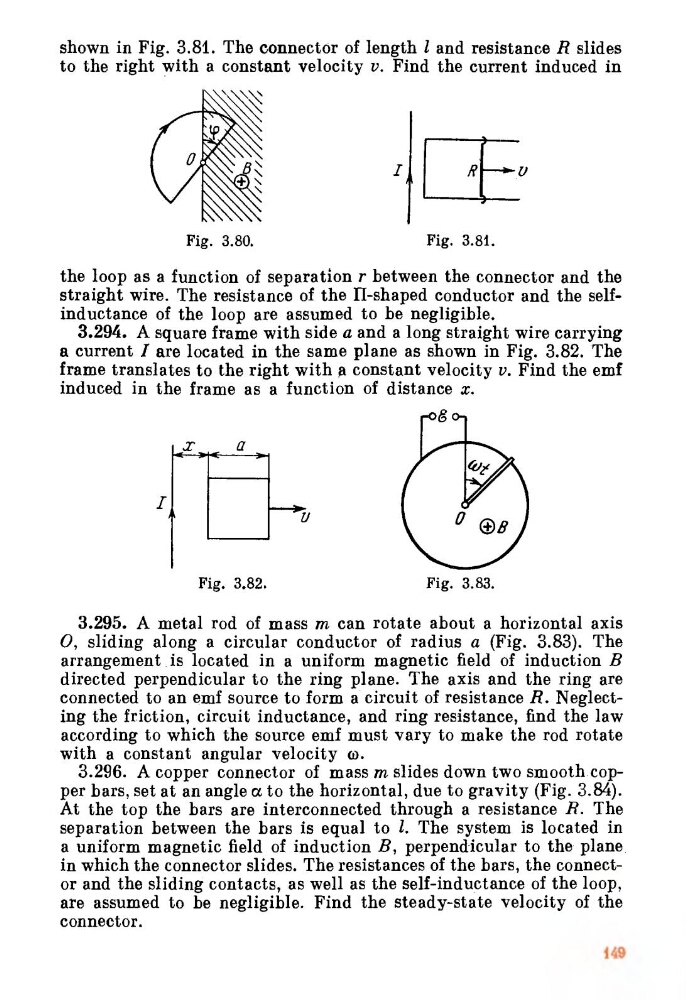
Fig. 3.80.
Fig. 3.81.
shown in Fig. 3.81. The connector of length 1 and resistance R slides
to the right with a constant velocity v. Find the current induced in
the loop as a function of separation r between the connector and the
straight wire. The resistance of the H-shaped conductor and the selfinductance of the loop are assumed to be negligible.
3.294. A square frame with side a and a long straight wire carrying
a current I are located in the same plane as shown in Fig. 3.82. The
frame translates to the right with a constant velocity v. Find the emf
induced in the frame as a function of distance x.
a
Fig. 3.82.
Fig. 3.83.
3.295. A metal rod of mass m can rotate about a horizontal axis
0, sliding along a circular conductor of radius a (Fig. 3.83). The
arrangement is located in a uniform magnetic field of induction B
directed perpendicular to the ring plane. The axis and the ring are
connected to an emf source to form a circuit of resistance R. Neglecting the friction, circuit inductance, and ring resistance, find the law
according to which the source emf must vary to make the rod rotate
with a constant angular velocity co.
3.296. A copper connector of mass m slides down two smooth copper bars, set at an angle a to the horizontal, due to gravity (Fig. 3.84).
At the top the bars are interconnected through a resistance R. The
separation between the bars is equal to 1. The system is located in
a uniform magnetic field of induction B, perpendicular to the plane
in which the connector slides. The resistances of the bars, the connector and the sliding contacts, as well as the self-inductance of the loop,
are assumed to be negligible. Find the steady-state velocity of the
connector.
Fig. 3.81.
shown in Fig. 3.81. The connector of length 1 and resistance R slides
to the right with a constant velocity v. Find the current induced in
the loop as a function of separation r between the connector and the
straight wire. The resistance of the H-shaped conductor and the selfinductance of the loop are assumed to be negligible.
3.294. A square frame with side a and a long straight wire carrying
a current I are located in the same plane as shown in Fig. 3.82. The
frame translates to the right with a constant velocity v. Find the emf
induced in the frame as a function of distance x.
a
Fig. 3.82.
Fig. 3.83.
3.295. A metal rod of mass m can rotate about a horizontal axis
0, sliding along a circular conductor of radius a (Fig. 3.83). The
arrangement is located in a uniform magnetic field of induction B
directed perpendicular to the ring plane. The axis and the ring are
connected to an emf source to form a circuit of resistance R. Neglecting the friction, circuit inductance, and ring resistance, find the law
according to which the source emf must vary to make the rod rotate
with a constant angular velocity co.
3.296. A copper connector of mass m slides down two smooth copper bars, set at an angle a to the horizontal, due to gravity (Fig. 3.84).
At the top the bars are interconnected through a resistance R. The
separation between the bars is equal to 1. The system is located in
a uniform magnetic field of induction B, perpendicular to the plane
in which the connector slides. The resistances of the bars, the connector and the sliding contacts, as well as the self-inductance of the loop,
are assumed to be negligible. Find the steady-state velocity of the
connector.