

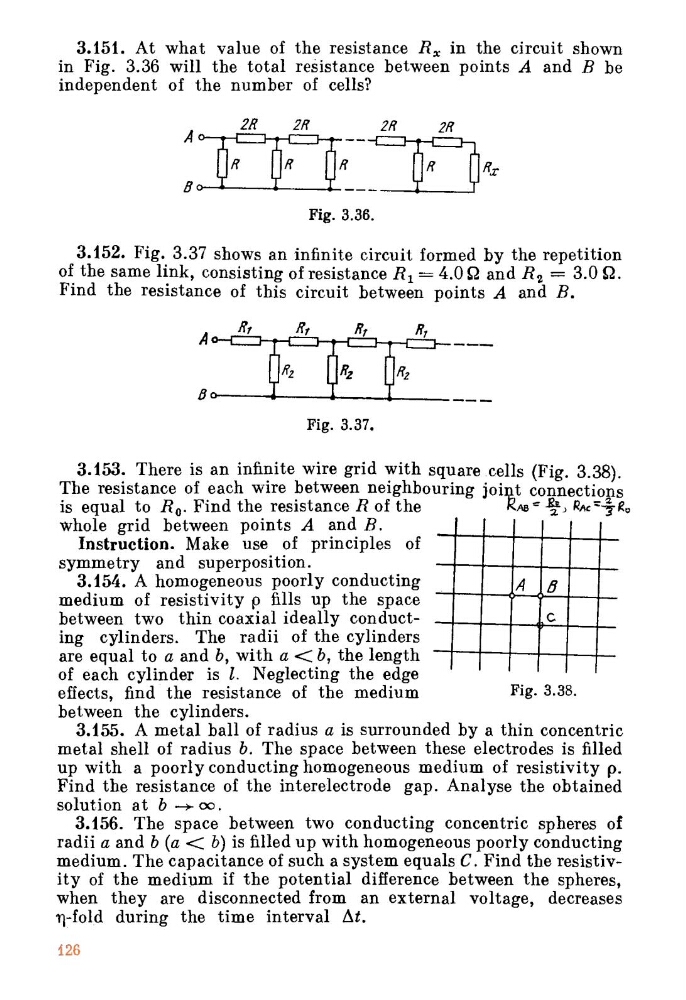
3.151. At what value of the resistance Rx in the circuit shown
in Fig. 3.36 will the total resistance between points A and B be
independent of the number of cells?
2R
28
2/7
2/f
Fig. 3.36.
3.152. Fig. 3.37 shows an infinite circuit formed by the repetition
of the same link, consisting of resistance R1 =- - 4.052 and R2 = 3.0 O.
Find the resistance of this circuit between points A and B.
A
R2
RZ
R2
B
Fig. 3.37.
3.153. There is an infinite wire grid with square cells (Fig. 3.38).
The resistance of each wire between neighbouring joint connections
is equal to R0. Find the resistance R of the = 2
-et R R®
AC 7
whole grid between points A and B.
Instruction. Make use of principles of
symmetry and superposition.
3.154. A homogeneous poorly conducting
medium of resistivity p fills up the space
between two thin coaxial ideally conducting cylinders. The radii of the cylinders
are equal to a and b, with a
effects, find the resistance of the medium
between the cylinders.
3.155. A metal ball of radius a is surrounded by a thin concentric
metal shell of radius b. The space between these electrodes is filled
up with a poorly conducting homogeneous medium of resistivity p.
Find the resistance of the interelectrode gap. Analyse the obtained
solution at b
3.156. The space between two conducting concentric spheres of
radii a and b (a < b) is filled up with homogeneous poorly conducting
medium. The capacitance of such a system equals C. Find the resistivity of the medium if the potential difference between the spheres,
when they are disconnected from an external voltage, decreases
it-fold during the time interval At.
A •
•
Fig. 3.38.
126
in Fig. 3.36 will the total resistance between points A and B be
independent of the number of cells?
2R
28
2/7
2/f
Fig. 3.36.
3.152. Fig. 3.37 shows an infinite circuit formed by the repetition
of the same link, consisting of resistance R1 =- - 4.052 and R2 = 3.0 O.
Find the resistance of this circuit between points A and B.
A
R2
RZ
R2
B
Fig. 3.37.
3.153. There is an infinite wire grid with square cells (Fig. 3.38).
The resistance of each wire between neighbouring joint connections
is equal to R0. Find the resistance R of the = 2
-et R R®
AC 7
whole grid between points A and B.
Instruction. Make use of principles of
symmetry and superposition.
3.154. A homogeneous poorly conducting
medium of resistivity p fills up the space
between two thin coaxial ideally conducting cylinders. The radii of the cylinders
are equal to a and b, with a
effects, find the resistance of the medium
between the cylinders.
3.155. A metal ball of radius a is surrounded by a thin concentric
metal shell of radius b. The space between these electrodes is filled
up with a poorly conducting homogeneous medium of resistivity p.
Find the resistance of the interelectrode gap. Analyse the obtained
solution at b
3.156. The space between two conducting concentric spheres of
radii a and b (a < b) is filled up with homogeneous poorly conducting
medium. The capacitance of such a system equals C. Find the resistivity of the medium if the potential difference between the spheres,
when they are disconnected from an external voltage, decreases
it-fold during the time interval At.
A •
•
Fig. 3.38.
126