

82
3 Jet Substructure at the LHC
CMS Simulation
Misid. probability (multijet)
3
−
10
2
−
10
1
−
10
1 1
Subjet CSVv2, minimum among two subjets
C
u
o
Subjet CSVv2 minimum among two subjets
S bj t CSV 2 i i
t
bj t
AK8 jet CSVv2
C
j
AK8 jet CSVv2
R(AK4 jet, AK8 jet)<0.4
A
e
R(AK4 jet AK8 jet)<0 4
Δ Δ
AK4 jet CSVv2,
C
AK4 jet CSVv2
double-b b
double-b
AK8 jet j
< 500 GeV
< < 500 GeV
< 500 GeV
T T T
300 < p
p
300 < p
300 < p
50 < m < 200 GeV
2
)
b
b
→
Tagging efficiency (H→ →
0
0.2
0.4
0.6
0.8
1
0.01
0.02
0.03
0.04
0.05
Double-b-tagging rate
ATLAS
-1
=13 TeV, 36.1 fb
s
bb - enriched sample
→
g
Two b-tags at 70% WP
data
Pythia8 MC
b-tagging uncert.
modelling uncert.
total uncert.
500 550 600 650 700 750 800 850 900 950 1000
[GeV]
T
Large-R jet p
0.5
1
1.5
Data/MC Data/MC
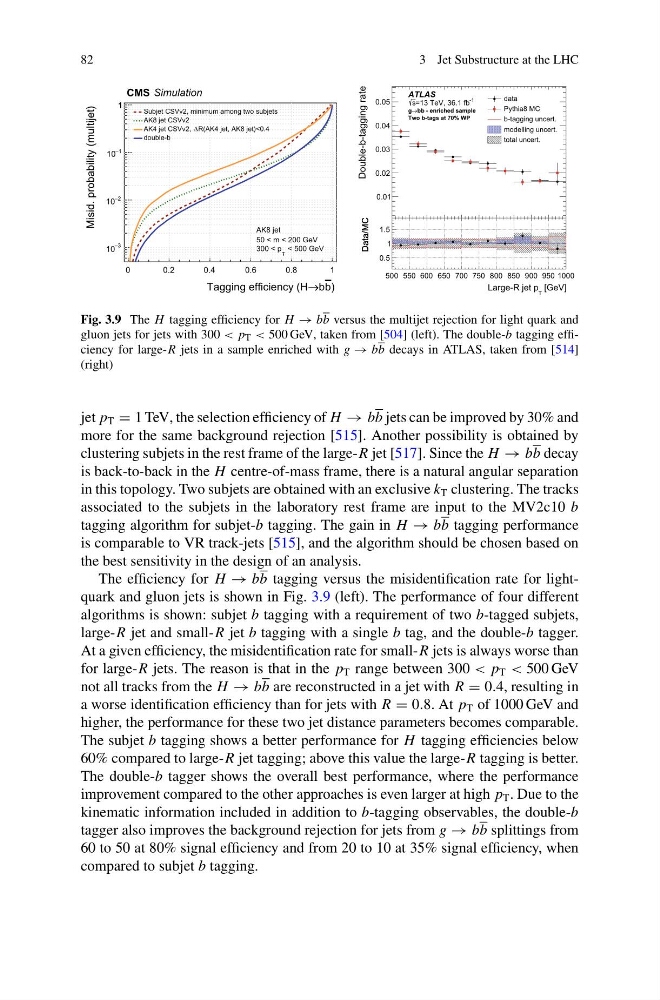
Fig. 3.9 The H tagging efficiency for H → bb versus the multijet rejection for light quark and
gluon jets for jets with 300 < p T < 500 GeV, taken from [504] (left). The double-b tagging efficiency for large-R jets in a sample enriched with g → bb decays in ATLAS, taken from [514]
(right)
jet p T = 1 TeV, the selection efficiency of H → bb jets can be improved by 30% and
more for the same background rejection [515]. Another possibility is obtained by
clustering subjets in the rest frame of the large-R jet [517]. Since the H → bb decay
is back-to-back in the H centre-of-mass frame, there is a natural angular separation
in this topology. Two subjets are obtained with an exclusive k T clustering. The tracks
associated to the subjets in the laboratory rest frame are input to the MV2c10 b
tagging algorithm for subjet-b tagging. The gain in H → bb tagging performance
is comparable to VR track-jets [515], and the algorithm should be chosen based on
the best sensitivity in the design of an analysis.
The efficiency for H → bb tagging versus the misidentification rate for lightquark and gluon jets is shown in Fig. 3.9 (left). The performance of four different
algorithms is shown: subjet b tagging with a requirement of two b-tagged subjets,
large-R jet and small-R jet b tagging with a single b tag, and the double-b tagger.
At a given efficiency, the misidentification rate for small-R jets is always worse than
for large-R jets. The reason is that in the p T range between 300 < p T < 500 GeV
not all tracks from the H → bb are reconstructed in a jet with R = 0.4, resulting in
a worse identification efficiency than for jets with R = 0.8. At p T of 1000 GeV and
higher, the performance for these two jet distance parameters becomes comparable.
The subjet b tagging shows a better performance for H tagging efficiencies below
60% compared to large-R jet tagging; above this value the large-R tagging is better.
The double-b tagger shows the overall best performance, where the performance
improvement compared to the other approaches is even larger at high p T . Due to the
kinematic information included in addition to b-tagging observables, the double-b
tagger also improves the background rejection for jets from g → bb splittings from
60 to 50 at 80% signal efficiency and from 20 to 10 at 35% signal efficiency, when
compared to subjet b tagging.
3 Jet Substructure at the LHC
CMS Simulation
Misid. probability (multijet)
3
−
10
2
−
10
1
−
10
1 1
Subjet CSVv2, minimum among two subjets
C
u
o
Subjet CSVv2 minimum among two subjets
S bj t CSV 2 i i
t
bj t
AK8 jet CSVv2
C
j
AK8 jet CSVv2
R(AK4 jet, AK8 jet)<0.4
A
e
R(AK4 jet AK8 jet)<0 4
Δ Δ
AK4 jet CSVv2,
C
AK4 jet CSVv2
double-b b
double-b
AK8 jet j
< 500 GeV
< < 500 GeV
< 500 GeV
T T T
300 < p
p
300 < p
300 < p
50 < m < 200 GeV
2
)
b
b
→
Tagging efficiency (H→ →
0
0.2
0.4
0.6
0.8
1
0.01
0.02
0.03
0.04
0.05
Double-b-tagging rate
ATLAS
-1
=13 TeV, 36.1 fb
s
bb - enriched sample
→
g
Two b-tags at 70% WP
data
Pythia8 MC
b-tagging uncert.
modelling uncert.
total uncert.
500 550 600 650 700 750 800 850 900 950 1000
[GeV]
T
Large-R jet p
0.5
1
1.5
Data/MC Data/MC
Fig. 3.9 The H tagging efficiency for H → bb versus the multijet rejection for light quark and
gluon jets for jets with 300 < p T < 500 GeV, taken from [504] (left). The double-b tagging efficiency for large-R jets in a sample enriched with g → bb decays in ATLAS, taken from [514]
(right)
jet p T = 1 TeV, the selection efficiency of H → bb jets can be improved by 30% and
more for the same background rejection [515]. Another possibility is obtained by
clustering subjets in the rest frame of the large-R jet [517]. Since the H → bb decay
is back-to-back in the H centre-of-mass frame, there is a natural angular separation
in this topology. Two subjets are obtained with an exclusive k T clustering. The tracks
associated to the subjets in the laboratory rest frame are input to the MV2c10 b
tagging algorithm for subjet-b tagging. The gain in H → bb tagging performance
is comparable to VR track-jets [515], and the algorithm should be chosen based on
the best sensitivity in the design of an analysis.
The efficiency for H → bb tagging versus the misidentification rate for lightquark and gluon jets is shown in Fig. 3.9 (left). The performance of four different
algorithms is shown: subjet b tagging with a requirement of two b-tagged subjets,
large-R jet and small-R jet b tagging with a single b tag, and the double-b tagger.
At a given efficiency, the misidentification rate for small-R jets is always worse than
for large-R jets. The reason is that in the p T range between 300 < p T < 500 GeV
not all tracks from the H → bb are reconstructed in a jet with R = 0.4, resulting in
a worse identification efficiency than for jets with R = 0.8. At p T of 1000 GeV and
higher, the performance for these two jet distance parameters becomes comparable.
The subjet b tagging shows a better performance for H tagging efficiencies below
60% compared to large-R jet tagging; above this value the large-R tagging is better.
The double-b tagger shows the overall best performance, where the performance
improvement compared to the other approaches is even larger at high p T . Due to the
kinematic information included in addition to b-tagging observables, the double-b
tagger also improves the background rejection for jets from g → bb splittings from
60 to 50 at 80% signal efficiency and from 20 to 10 at 35% signal efficiency, when
compared to subjet b tagging.