

72
3 Jet Substructure at the LHC
0
10
20
30
40
50
Number of vertices
76
77
78
79
80
81
82
Median jet mass [GeV]
CHS W boson jets
PUPPI W boson jets
< 600 GeV
T
400 < p
, R = 0.8
T
Anti-k
Bulk graviton
(13 TeV)
CMS
Simulation
0
10
20
30
40
50
Number of vertices
0.2
0.4
0.6
0.8
1
1.2
1.4
21
τ
Median
CHS q/g jets
PUPPI q/g jets
CHS W boson jets
PUPPI W boson jets
< 600 GeV
T
400 < p
, R=0.8
T
Anti-k
(13 TeV)
CMS
Simulation
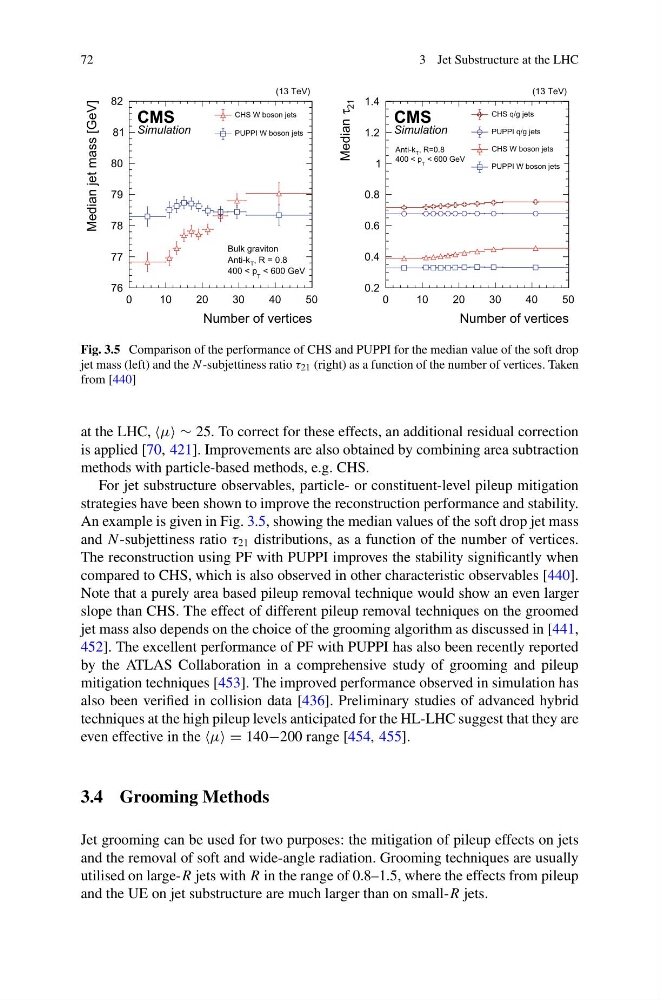
Fig. 3.5 Comparison of the performance of CHS and PUPPI for the median value of the soft drop
jet mass (left) and the N -subjettiness ratio τ 21 (right) as a function of the number of vertices. Taken
from [440]
at the LHC, ∼ 25. To correct for these effects, an additional residual correction
is applied [70, 421]. Improvements are also obtained by combining area subtraction
methods with particle-based methods, e.g. CHS.
For jet substructure observables, particle- or constituent-level pileup mitigation
strategies have been shown to improve the reconstruction performance and stability.
An example is given in Fig. 3.5, showing the median values of the soft drop jet mass
and N -subjettiness ratio τ 21 distributions, as a function of the number of vertices.
The reconstruction using PF with PUPPI improves the stability significantly when
compared to CHS, which is also observed in other characteristic observables [440].
Note that a purely area based pileup removal technique would show an even larger
slope than CHS. The effect of different pileup removal techniques on the groomed
jet mass also depends on the choice of the grooming algorithm as discussed in [441,
452]. The excellent performance of PF with PUPPI has also been recently reported
by the ATLAS Collaboration in a comprehensive study of grooming and pileup
mitigation techniques [453]. The improved performance observed in simulation has
also been verified in collision data [436]. Preliminary studies of advanced hybrid
techniques at the high pileup levels anticipated for the HL-LHC suggest that they are
even effective in the = 140−200 range [454, 455].
3.4 Grooming Methods
Jet grooming can be used for two purposes: the mitigation of pileup effects on jets
and the removal of soft and wide-angle radiation. Grooming techniques are usually
utilised on large-R jets with R in the range of 0.8–1.5, where the effects from pileup
and the UE on jet substructure are much larger than on small-R jets.
3 Jet Substructure at the LHC
0
10
20
30
40
50
Number of vertices
76
77
78
79
80
81
82
Median jet mass [GeV]
CHS W boson jets
PUPPI W boson jets
< 600 GeV
T
400 < p
, R = 0.8
T
Anti-k
Bulk graviton
(13 TeV)
CMS
Simulation
0
10
20
30
40
50
Number of vertices
0.2
0.4
0.6
0.8
1
1.2
1.4
21
τ
Median
CHS q/g jets
PUPPI q/g jets
CHS W boson jets
PUPPI W boson jets
< 600 GeV
T
400 < p
, R=0.8
T
Anti-k
(13 TeV)
CMS
Simulation
Fig. 3.5 Comparison of the performance of CHS and PUPPI for the median value of the soft drop
jet mass (left) and the N -subjettiness ratio τ 21 (right) as a function of the number of vertices. Taken
from [440]
at the LHC, ∼ 25. To correct for these effects, an additional residual correction
is applied [70, 421]. Improvements are also obtained by combining area subtraction
methods with particle-based methods, e.g. CHS.
For jet substructure observables, particle- or constituent-level pileup mitigation
strategies have been shown to improve the reconstruction performance and stability.
An example is given in Fig. 3.5, showing the median values of the soft drop jet mass
and N -subjettiness ratio τ 21 distributions, as a function of the number of vertices.
The reconstruction using PF with PUPPI improves the stability significantly when
compared to CHS, which is also observed in other characteristic observables [440].
Note that a purely area based pileup removal technique would show an even larger
slope than CHS. The effect of different pileup removal techniques on the groomed
jet mass also depends on the choice of the grooming algorithm as discussed in [441,
452]. The excellent performance of PF with PUPPI has also been recently reported
by the ATLAS Collaboration in a comprehensive study of grooming and pileup
mitigation techniques [453]. The improved performance observed in simulation has
also been verified in collision data [436]. Preliminary studies of advanced hybrid
techniques at the high pileup levels anticipated for the HL-LHC suggest that they are
even effective in the = 140−200 range [454, 455].
3.4 Grooming Methods
Jet grooming can be used for two purposes: the mitigation of pileup effects on jets
and the removal of soft and wide-angle radiation. Grooming techniques are usually
utilised on large-R jets with R in the range of 0.8–1.5, where the effects from pileup
and the UE on jet substructure are much larger than on small-R jets.