

70
3 Jet Substructure at the LHC
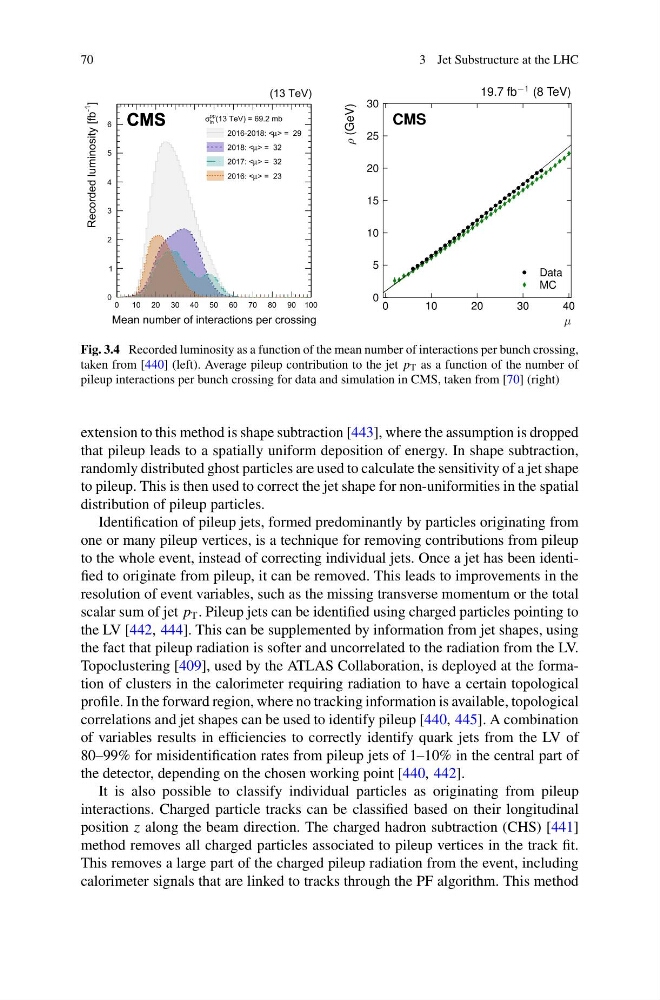
Fig. 3.4 Recorded luminosity as a function of the mean number of interactions per bunch crossing,
taken from [440] (left). Average pileup contribution to the jet p T as a function of the number of
pileup interactions per bunch crossing for data and simulation in CMS, taken from [70] (right)
extension to this method is shape subtraction [443], where the assumption is dropped
that pileup leads to a spatially uniform deposition of energy. In shape subtraction,
randomly distributed ghost particles are used to calculate the sensitivity of a jet shape
to pileup. This is then used to correct the jet shape for non-uniformities in the spatial
distribution of pileup particles.
Identification of pileup jets, formed predominantly by particles originating from
one or many pileup vertices, is a technique for removing contributions from pileup
to the whole event, instead of correcting individual jets. Once a jet has been identified to originate from pileup, it can be removed. This leads to improvements in the
resolution of event variables, such as the missing transverse momentum or the total
scalar sum of jet p T . Pileup jets can be identified using charged particles pointing to
the LV [442, 444]. This can be supplemented by information from jet shapes, using
the fact that pileup radiation is softer and uncorrelated to the radiation from the LV.
Topoclustering [409], used by the ATLAS Collaboration, is deployed at the formation of clusters in the calorimeter requiring radiation to have a certain topological
profile. In the forward region, where no tracking information is available, topological
correlations and jet shapes can be used to identify pileup [440, 445]. A combination
of variables results in efficiencies to correctly identify quark jets from the LV of
80–99% for misidentification rates from pileup jets of 1–10% in the central part of
the detector, depending on the chosen working point [440, 442].
It is also possible to classify individual particles as originating from pileup
interactions. Charged particle tracks can be classified based on their longitudinal
position z along the beam direction. The charged hadron subtraction (CHS) [441]
method removes all charged particles associated to pileup vertices in the track fit.
This removes a large part of the charged pileup radiation from the event, including
calorimeter signals that are linked to tracks through the PF algorithm. This method
3 Jet Substructure at the LHC
Fig. 3.4 Recorded luminosity as a function of the mean number of interactions per bunch crossing,
taken from [440] (left). Average pileup contribution to the jet p T as a function of the number of
pileup interactions per bunch crossing for data and simulation in CMS, taken from [70] (right)
extension to this method is shape subtraction [443], where the assumption is dropped
that pileup leads to a spatially uniform deposition of energy. In shape subtraction,
randomly distributed ghost particles are used to calculate the sensitivity of a jet shape
to pileup. This is then used to correct the jet shape for non-uniformities in the spatial
distribution of pileup particles.
Identification of pileup jets, formed predominantly by particles originating from
one or many pileup vertices, is a technique for removing contributions from pileup
to the whole event, instead of correcting individual jets. Once a jet has been identified to originate from pileup, it can be removed. This leads to improvements in the
resolution of event variables, such as the missing transverse momentum or the total
scalar sum of jet p T . Pileup jets can be identified using charged particles pointing to
the LV [442, 444]. This can be supplemented by information from jet shapes, using
the fact that pileup radiation is softer and uncorrelated to the radiation from the LV.
Topoclustering [409], used by the ATLAS Collaboration, is deployed at the formation of clusters in the calorimeter requiring radiation to have a certain topological
profile. In the forward region, where no tracking information is available, topological
correlations and jet shapes can be used to identify pileup [440, 445]. A combination
of variables results in efficiencies to correctly identify quark jets from the LV of
80–99% for misidentification rates from pileup jets of 1–10% in the central part of
the detector, depending on the chosen working point [440, 442].
It is also possible to classify individual particles as originating from pileup
interactions. Charged particle tracks can be classified based on their longitudinal
position z along the beam direction. The charged hadron subtraction (CHS) [441]
method removes all charged particles associated to pileup vertices in the track fit.
This removes a large part of the charged pileup radiation from the event, including
calorimeter signals that are linked to tracks through the PF algorithm. This method