

68
3 Jet Substructure at the LHC
the missing momentum from neutral particles is accounted for in small-R track-jets,
which are then clustered to form large-R jets. In this way, local fluctuations in the
neutral components can be accounted for in track-jets, which improves the experimental resolution of several substructure observables. A more unified approach,
combining the ATLAS particle-flow algorithm with the TCC method has recently
been studied for large-R jets [434]. The resulting list of unified flow objects (UFOs)
can be further processed by pileup mitigation techniques (see below), and is then
used as input to jet clustering algorithms. The resulting jets show better performance
in terms of substructure reconstruction than previous approaches. This approach will
improve the efficiency and precision of future jet substructure measurements and
searches for new physics.
In CMS, the jet mass is by default reconstructed as a combination of track and
calorimeter measurements via the virtues of the PF algorithm. Thus the strategy for
calibrating the jet mass in CMS differs from the one in ATLAS. In CMS, the individual
PF objects are input to the jet reconstruction, and are locally calibrated to account
for the detector’s single particle response. After correcting the individual inputs,
the jet four-vector is corrected using JES corrections. Small residual differences in
the jet mass between data and simulation are corrected using dedicated samples.
The residual jet energy corrections are not applied when reconstructing jet masses.
Therefore, dedicated corrections are derived from simulation and data. The jet mass
response is measured using W jets in a data sample enriched in tt production [435,
436]. After a dedicated selection, large-R jets in this sample show a peak at the W
mass in the jet mass distribution (see Sect. 4.1.2). The excellent performance of the
PF algorithm results in a JMR of about 10%. The absolute response and the resolution
are well described by the simulation, and are within 1–2% for the JMS and about
10% for the JMR. Since these measurements are performed in samples of W jets
with p T ≈ 200 GeV, additional systematic uncertainties apply at higher p T [437]. A
detailed study of the various contributions to the JMS has also been performed for
fully merged top-jets in the context of an unfolded top-jet mass measurement [438].
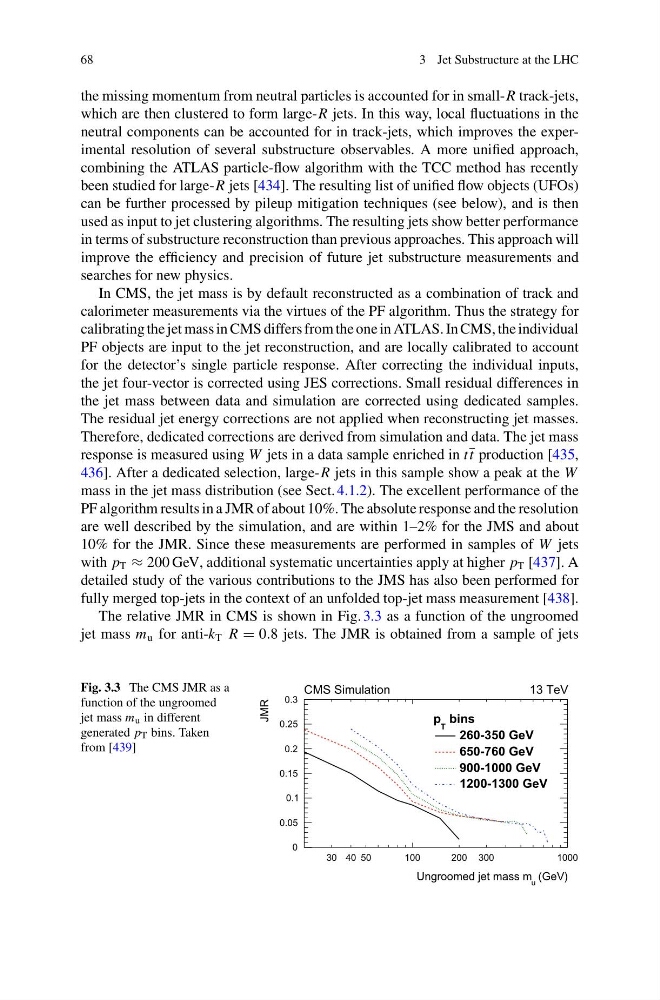
The relative JMR in CMS is shown in Fig. 3.3 as a function of the ungroomed
jet mass m u for anti-k T R = 0.8 jets. The JMR is obtained from a sample of jets
Fig. 3.3 The CMS JMR as a
function of the ungroomed
jet mass m u in different
generated p T bins. Taken
from [439]
30 40 50
100
200 300
1000
(GeV)
u
Ungroomed jet mass m
0
0.05
0.1
0.15
0.2
0.25
0.3
JMR
CMS Simulation
13 TeV
bins
T
p
260-350 GeV
650-760 GeV
900-1000 GeV
1200-1300 GeV
3 Jet Substructure at the LHC
the missing momentum from neutral particles is accounted for in small-R track-jets,
which are then clustered to form large-R jets. In this way, local fluctuations in the
neutral components can be accounted for in track-jets, which improves the experimental resolution of several substructure observables. A more unified approach,
combining the ATLAS particle-flow algorithm with the TCC method has recently
been studied for large-R jets [434]. The resulting list of unified flow objects (UFOs)
can be further processed by pileup mitigation techniques (see below), and is then
used as input to jet clustering algorithms. The resulting jets show better performance
in terms of substructure reconstruction than previous approaches. This approach will
improve the efficiency and precision of future jet substructure measurements and
searches for new physics.
In CMS, the jet mass is by default reconstructed as a combination of track and
calorimeter measurements via the virtues of the PF algorithm. Thus the strategy for
calibrating the jet mass in CMS differs from the one in ATLAS. In CMS, the individual
PF objects are input to the jet reconstruction, and are locally calibrated to account
for the detector’s single particle response. After correcting the individual inputs,
the jet four-vector is corrected using JES corrections. Small residual differences in
the jet mass between data and simulation are corrected using dedicated samples.
The residual jet energy corrections are not applied when reconstructing jet masses.
Therefore, dedicated corrections are derived from simulation and data. The jet mass
response is measured using W jets in a data sample enriched in tt production [435,
436]. After a dedicated selection, large-R jets in this sample show a peak at the W
mass in the jet mass distribution (see Sect. 4.1.2). The excellent performance of the
PF algorithm results in a JMR of about 10%. The absolute response and the resolution
are well described by the simulation, and are within 1–2% for the JMS and about
10% for the JMR. Since these measurements are performed in samples of W jets
with p T ≈ 200 GeV, additional systematic uncertainties apply at higher p T [437]. A
detailed study of the various contributions to the JMS has also been performed for
fully merged top-jets in the context of an unfolded top-jet mass measurement [438].
The relative JMR in CMS is shown in Fig. 3.3 as a function of the ungroomed
jet mass m u for anti-k T R = 0.8 jets. The JMR is obtained from a sample of jets
Fig. 3.3 The CMS JMR as a
function of the ungroomed
jet mass m u in different
generated p T bins. Taken
from [439]
30 40 50
100
200 300
1000
(GeV)
u
Ungroomed jet mass m
0
0.05
0.1
0.15
0.2
0.25
0.3
JMR
CMS Simulation
13 TeV
bins
T
p
260-350 GeV
650-760 GeV
900-1000 GeV
1200-1300 GeV