

62
3 Jet Substructure at the LHC
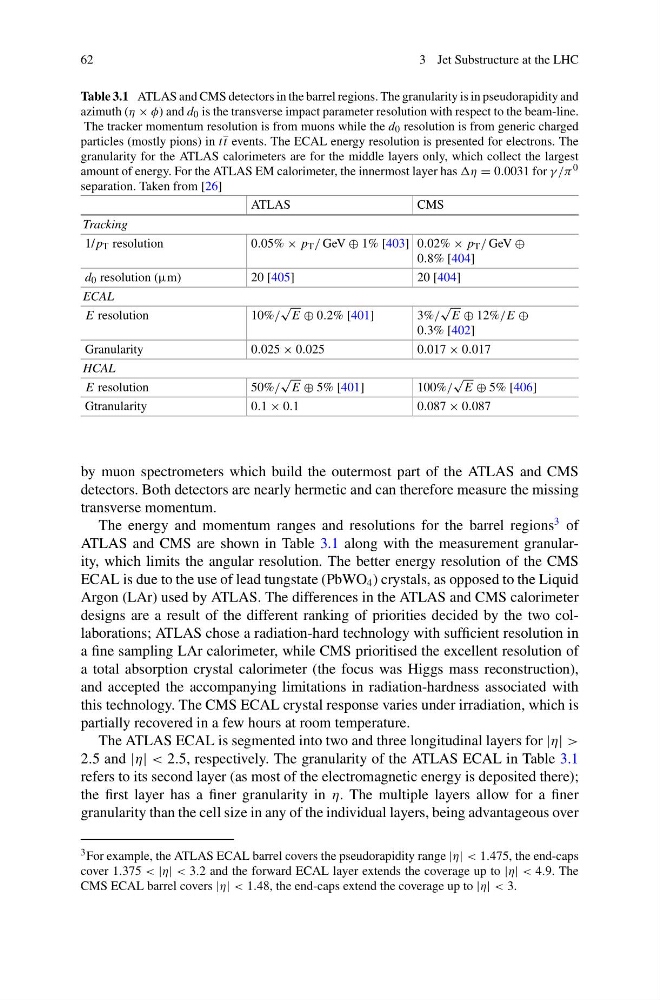
Table 3.1 ATLAS and CMS detectors in the barrel regions. The granularity is in pseudorapidity and
azimuth (η × φ) and d 0 is the transverse impact parameter resolution with respect to the beam-line.
The tracker momentum resolution is from muons while the d 0 resolution is from generic charged
particles (mostly pions) in tt events. The ECAL energy resolution is presented for electrons. The
granularity for the ATLAS calorimeters are for the middle layers only, which collect the largest
amount of energy. For the ATLAS EM calorimeter, the innermost layer has η = 0.0031 for γ /π 0
separation. Taken from [26]
ATLAS
CMS
Tracking
1/ p T resolution
0.05% × p T / GeV ⊕ 1% [403] 0.02% × p T / GeV ⊕
0.8% [404]
d 0 resolution (µm)
20 [405]
20 [404]
ECAL
E resolution
10%/
√
E ⊕ 0.2% [401]
3%/
√
E ⊕ 12%/E ⊕
0.3% [402]
Granularity
0.025 × 0.025
0.017 × 0.017
HCAL
E resolution
50%/
√
E ⊕ 5% [401]
100%/
√
E ⊕ 5% [406]
Gtranularity
0.1 × 0.1
0.087 × 0.087
by muon spectrometers which build the outermost part of the ATLAS and CMS
detectors. Both detectors are nearly hermetic and can therefore measure the missing
transverse momentum.
The energy and momentum ranges and resolutions for the barrel regions
3 of
ATLAS and CMS are shown in Table 3.1 along with the measurement granularity, which limits the angular resolution. The better energy resolution of the CMS
ECAL is due to the use of lead tungstate (PbWO 4 ) crystals, as opposed to the Liquid
Argon (LAr) used by ATLAS. The differences in the ATLAS and CMS calorimeter
designs are a result of the different ranking of priorities decided by the two collaborations; ATLAS chose a radiation-hard technology with sufficient resolution in
a fine sampling LAr calorimeter, while CMS prioritised the excellent resolution of
a total absorption crystal calorimeter (the focus was Higgs mass reconstruction),
and accepted the accompanying limitations in radiation-hardness associated with
this technology. The CMS ECAL crystal response varies under irradiation, which is
partially recovered in a few hours at room temperature.
The ATLAS ECAL is segmented into two and three longitudinal layers for |η| >
2.5 and |η| < 2.5, respectively. The granularity of the ATLAS ECAL in Table 3.1
refers to its second layer (as most of the electromagnetic energy is deposited there);
the first layer has a finer granularity in η. The multiple layers allow for a finer
granularity than the cell size in any of the individual layers, being advantageous over
3 For example, the ATLAS ECAL barrel covers the pseudorapidity range |η| < 1.475, the end-caps
cover 1.375 < |η| < 3.2 and the forward ECAL layer extends the coverage up to |η| < 4.9. The
CMS ECAL barrel covers |η| < 1.48, the end-caps extend the coverage up to |η| < 3.
3 Jet Substructure at the LHC
Table 3.1 ATLAS and CMS detectors in the barrel regions. The granularity is in pseudorapidity and
azimuth (η × φ) and d 0 is the transverse impact parameter resolution with respect to the beam-line.
The tracker momentum resolution is from muons while the d 0 resolution is from generic charged
particles (mostly pions) in tt events. The ECAL energy resolution is presented for electrons. The
granularity for the ATLAS calorimeters are for the middle layers only, which collect the largest
amount of energy. For the ATLAS EM calorimeter, the innermost layer has η = 0.0031 for γ /π 0
separation. Taken from [26]
ATLAS
CMS
Tracking
1/ p T resolution
0.05% × p T / GeV ⊕ 1% [403] 0.02% × p T / GeV ⊕
0.8% [404]
d 0 resolution (µm)
20 [405]
20 [404]
ECAL
E resolution
10%/
√
E ⊕ 0.2% [401]
3%/
√
E ⊕ 12%/E ⊕
0.3% [402]
Granularity
0.025 × 0.025
0.017 × 0.017
HCAL
E resolution
50%/
√
E ⊕ 5% [401]
100%/
√
E ⊕ 5% [406]
Gtranularity
0.1 × 0.1
0.087 × 0.087
by muon spectrometers which build the outermost part of the ATLAS and CMS
detectors. Both detectors are nearly hermetic and can therefore measure the missing
transverse momentum.
The energy and momentum ranges and resolutions for the barrel regions
3 of
ATLAS and CMS are shown in Table 3.1 along with the measurement granularity, which limits the angular resolution. The better energy resolution of the CMS
ECAL is due to the use of lead tungstate (PbWO 4 ) crystals, as opposed to the Liquid
Argon (LAr) used by ATLAS. The differences in the ATLAS and CMS calorimeter
designs are a result of the different ranking of priorities decided by the two collaborations; ATLAS chose a radiation-hard technology with sufficient resolution in
a fine sampling LAr calorimeter, while CMS prioritised the excellent resolution of
a total absorption crystal calorimeter (the focus was Higgs mass reconstruction),
and accepted the accompanying limitations in radiation-hardness associated with
this technology. The CMS ECAL crystal response varies under irradiation, which is
partially recovered in a few hours at room temperature.
The ATLAS ECAL is segmented into two and three longitudinal layers for |η| >
2.5 and |η| < 2.5, respectively. The granularity of the ATLAS ECAL in Table 3.1
refers to its second layer (as most of the electromagnetic energy is deposited there);
the first layer has a finer granularity in η. The multiple layers allow for a finer
granularity than the cell size in any of the individual layers, being advantageous over
3 For example, the ATLAS ECAL barrel covers the pseudorapidity range |η| < 1.475, the end-caps
cover 1.375 < |η| < 3.2 and the forward ECAL layer extends the coverage up to |η| < 4.9. The
CMS ECAL barrel covers |η| < 1.48, the end-caps extend the coverage up to |η| < 3.