

58
2 Phenomenology of Jet Substructure
form of the potential has also been confirmed by lattice QCD simulations [387]. This
potential can be viewed as the one-dimensional colour flux tube stretched between
a colour-anticolour state. Originally formulated for qq states, the formalism has
been extended to multi-gluon states [388]. The string produces a linear confinement
potential, which breaks up through new qq pairs produced in the intense colour
field, resulting in regions with no colour field between singlet states. If the invariant
mass of the individual systems is large, further breaks may occur and after n − 1
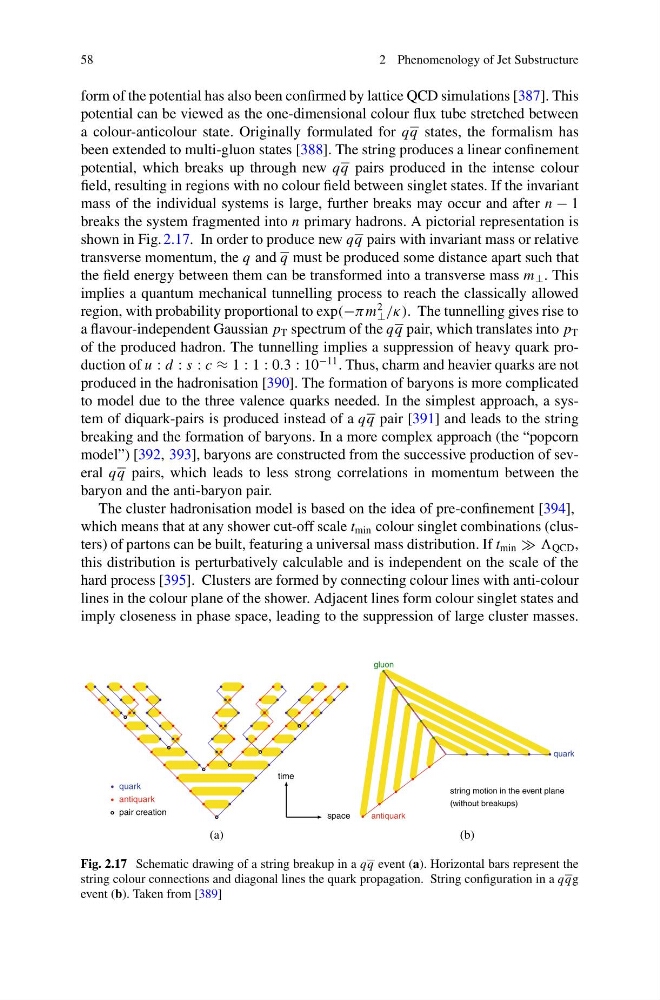
breaks the system fragmented into n primary hadrons. A pictorial representation is
shown in Fig. 2.17. In order to produce new qq pairs with invariant mass or relative
transverse momentum, the q and q must be produced some distance apart such that
the field energy between them can be transformed into a transverse mass m ⊥ . This
implies a quantum mechanical tunnelling process to reach the classically allowed
region, with probability proportional to exp(−π m
2
⊥ /κ). The tunnelling gives rise to
a flavour-independent Gaussian p T spectrum of the qq pair, which translates into p T
of the produced hadron. The tunnelling implies a suppression of heavy quark production of u : d : s : c ≈ 1 : 1 : 0.3 : 10
−11 . Thus, charm and heavier quarks are not
produced in the hadronisation [390]. The formation of baryons is more complicated
to model due to the three valence quarks needed. In the simplest approach, a system of diquark-pairs is produced instead of a qq pair [391] and leads to the string
breaking and the formation of baryons. In a more complex approach (the “popcorn
model”) [392, 393], baryons are constructed from the successive production of several qq pairs, which leads to less strong correlations in momentum between the
baryon and the anti-baryon pair.
The cluster hadronisation model is based on the idea of pre-confinement [394],
which means that at any shower cut-off scale t min colour singlet combinations (clusters) of partons can be built, featuring a universal mass distribution. If t min QCD ,
this distribution is perturbatively calculable and is independent on the scale of the
hard process [395]. Clusters are formed by connecting colour lines with anti-colour
lines in the colour plane of the shower. Adjacent lines form colour singlet states and
imply closeness in phase space, leading to the suppression of large cluster masses.
space
time
quark
antiquark
pair creation
(a)
quark
antiquark
gluon
string motion in the event plane
(without breakups)
(b)
Fig. 2.17 Schematic drawing of a string breakup in a qq event (a). Horizontal bars represent the
string colour connections and diagonal lines the quark propagation. String configuration in a qqg
event (b). Taken from [389]
2 Phenomenology of Jet Substructure
form of the potential has also been confirmed by lattice QCD simulations [387]. This
potential can be viewed as the one-dimensional colour flux tube stretched between
a colour-anticolour state. Originally formulated for qq states, the formalism has
been extended to multi-gluon states [388]. The string produces a linear confinement
potential, which breaks up through new qq pairs produced in the intense colour
field, resulting in regions with no colour field between singlet states. If the invariant
mass of the individual systems is large, further breaks may occur and after n − 1
breaks the system fragmented into n primary hadrons. A pictorial representation is
shown in Fig. 2.17. In order to produce new qq pairs with invariant mass or relative
transverse momentum, the q and q must be produced some distance apart such that
the field energy between them can be transformed into a transverse mass m ⊥ . This
implies a quantum mechanical tunnelling process to reach the classically allowed
region, with probability proportional to exp(−π m
2
⊥ /κ). The tunnelling gives rise to
a flavour-independent Gaussian p T spectrum of the qq pair, which translates into p T
of the produced hadron. The tunnelling implies a suppression of heavy quark production of u : d : s : c ≈ 1 : 1 : 0.3 : 10
−11 . Thus, charm and heavier quarks are not
produced in the hadronisation [390]. The formation of baryons is more complicated
to model due to the three valence quarks needed. In the simplest approach, a system of diquark-pairs is produced instead of a qq pair [391] and leads to the string
breaking and the formation of baryons. In a more complex approach (the “popcorn
model”) [392, 393], baryons are constructed from the successive production of several qq pairs, which leads to less strong correlations in momentum between the
baryon and the anti-baryon pair.
The cluster hadronisation model is based on the idea of pre-confinement [394],
which means that at any shower cut-off scale t min colour singlet combinations (clusters) of partons can be built, featuring a universal mass distribution. If t min QCD ,
this distribution is perturbatively calculable and is independent on the scale of the
hard process [395]. Clusters are formed by connecting colour lines with anti-colour
lines in the colour plane of the shower. Adjacent lines form colour singlet states and
imply closeness in phase space, leading to the suppression of large cluster masses.
space
time
quark
antiquark
pair creation
(a)
quark
antiquark
gluon
string motion in the event plane
(without breakups)
(b)
Fig. 2.17 Schematic drawing of a string breakup in a qq event (a). Horizontal bars represent the
string colour connections and diagonal lines the quark propagation. String configuration in a qqg
event (b). Taken from [389]