

2.6 Event Generators
55
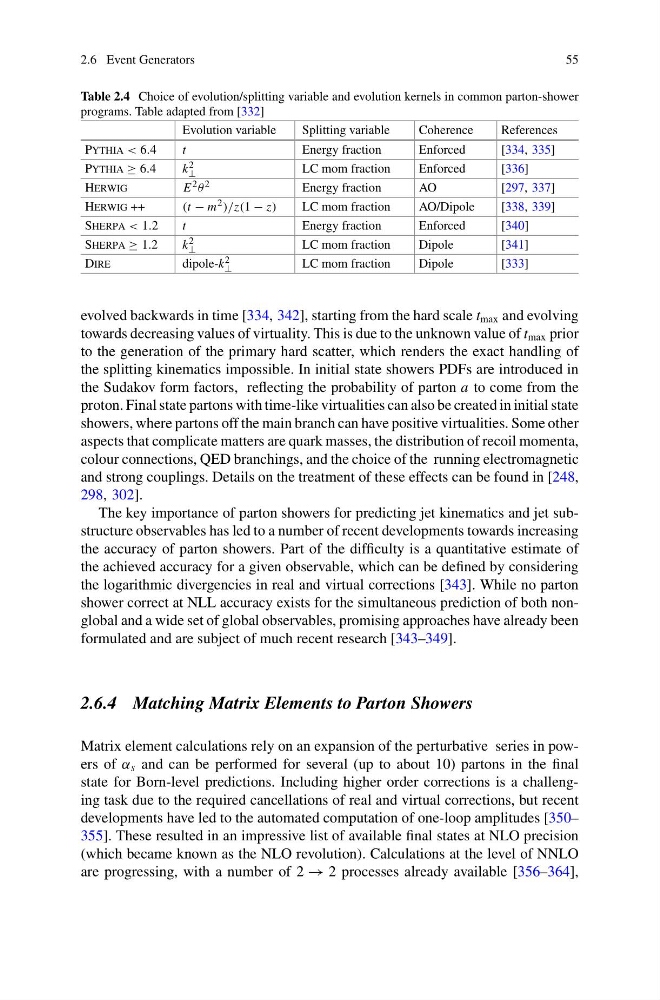
Table 2.4 Choice of evolution/splitting variable and evolution kernels in common parton-shower
programs. Table adapted from [332]
Evolution variable
Splitting variable
Coherence
References
Pythia < 6.4
t
Energy fraction
Enforced
[334, 335]
Pythia ≥ 6.4
k 2
⊥
LC mom fraction
Enforced
[336]
Herwig
E 2 θ 2
Energy fraction
AO
[297, 337]
Herwig ++
(t − m 2 )/z(1 − z)
LC mom fraction
AO/Dipole
[338, 339]
Sherpa < 1.2
t
Energy fraction
Enforced
[340]
Sherpa ≥ 1.2
k 2
⊥
LC mom fraction
Dipole
[341]
Dire
dipole-k 2
⊥
LC mom fraction
Dipole
[333]
evolved backwards in time [334, 342], starting from the hard scale t max and evolving
towards decreasing values of virtuality. This is due to the unknown value of t max prior
to the generation of the primary hard scatter, which renders the exact handling of
the splitting kinematics impossible. In initial state showers PDFs are introduced in
the Sudakov form factors, reflecting the probability of parton a to come from the
proton. Final state partons with time-like virtualities can also be created in initial state
showers, where partons off the main branch can have positive virtualities. Some other
aspects that complicate matters are quark masses, the distribution of recoil momenta,
colour connections, QED branchings, and the choice of the running electromagnetic
and strong couplings. Details on the treatment of these effects can be found in [248,
298, 302].
The key importance of parton showers for predicting jet kinematics and jet substructure observables has led to a number of recent developments towards increasing
the accuracy of parton showers. Part of the difficulty is a quantitative estimate of
the achieved accuracy for a given observable, which can be defined by considering
the logarithmic divergencies in real and virtual corrections [343]. While no parton
shower correct at NLL accuracy exists for the simultaneous prediction of both nonglobal and a wide set of global observables, promising approaches have already been
formulated and are subject of much recent research [343–349].
2.6.4 Matching Matrix Elements to Parton Showers
Matrix element calculations rely on an expansion of the perturbative series in powers of α S and can be performed for several (up to about 10) partons in the final
state for Born-level predictions. Including higher order corrections is a challenging task due to the required cancellations of real and virtual corrections, but recent
developments have led to the automated computation of one-loop amplitudes [350–
355]. These resulted in an impressive list of available final states at NLO precision
(which became known as the NLO revolution). Calculations at the level of NNLO
are progressing, with a number of 2 → 2 processes already available [356–364],
55
Table 2.4 Choice of evolution/splitting variable and evolution kernels in common parton-shower
programs. Table adapted from [332]
Evolution variable
Splitting variable
Coherence
References
Pythia < 6.4
t
Energy fraction
Enforced
[334, 335]
Pythia ≥ 6.4
k 2
⊥
LC mom fraction
Enforced
[336]
Herwig
E 2 θ 2
Energy fraction
AO
[297, 337]
Herwig ++
(t − m 2 )/z(1 − z)
LC mom fraction
AO/Dipole
[338, 339]
Sherpa < 1.2
t
Energy fraction
Enforced
[340]
Sherpa ≥ 1.2
k 2
⊥
LC mom fraction
Dipole
[341]
Dire
dipole-k 2
⊥
LC mom fraction
Dipole
[333]
evolved backwards in time [334, 342], starting from the hard scale t max and evolving
towards decreasing values of virtuality. This is due to the unknown value of t max prior
to the generation of the primary hard scatter, which renders the exact handling of
the splitting kinematics impossible. In initial state showers PDFs are introduced in
the Sudakov form factors, reflecting the probability of parton a to come from the
proton. Final state partons with time-like virtualities can also be created in initial state
showers, where partons off the main branch can have positive virtualities. Some other
aspects that complicate matters are quark masses, the distribution of recoil momenta,
colour connections, QED branchings, and the choice of the running electromagnetic
and strong couplings. Details on the treatment of these effects can be found in [248,
298, 302].
The key importance of parton showers for predicting jet kinematics and jet substructure observables has led to a number of recent developments towards increasing
the accuracy of parton showers. Part of the difficulty is a quantitative estimate of
the achieved accuracy for a given observable, which can be defined by considering
the logarithmic divergencies in real and virtual corrections [343]. While no parton
shower correct at NLL accuracy exists for the simultaneous prediction of both nonglobal and a wide set of global observables, promising approaches have already been
formulated and are subject of much recent research [343–349].
2.6.4 Matching Matrix Elements to Parton Showers
Matrix element calculations rely on an expansion of the perturbative series in powers of α S and can be performed for several (up to about 10) partons in the final
state for Born-level predictions. Including higher order corrections is a challenging task due to the required cancellations of real and virtual corrections, but recent
developments have led to the automated computation of one-loop amplitudes [350–
355]. These resulted in an impressive list of available final states at NLO precision
(which became known as the NLO revolution). Calculations at the level of NNLO
are progressing, with a number of 2 → 2 processes already available [356–364],