

52
2 Phenomenology of Jet Substructure
from, that a number of different PDF sets have been proposed by several independent
groups.
Global PDF fits, including experimental data from different experiments, are
performed by the CTEQ collaboration, the NNPDF, and the MMHT (formerly
MSTW [313] or MRST [314]) groups. Fits to HERA data only are carried out by the
HERAPDF group, and the ABM collaboration provides PDF sets in the fixed-flavournumber scheme for the treatment of heavy quarks. The latest PDF sets published by
these groups are the CT14 [315], NNPDF 3.0 [316], MMHT 2014 [317], HERAPDF
2.0 [318] and the ABM14 [319] sets. A detailed overview and comparisons are given
in the PDF4LHC working group reports [320, 321].
While there are typically differences in the central predictions and uncertainties
obtained, cross sections calculated with different PDF sets tend to agree within a few
percent. The differences in PDF sets are subordinate compared to other uncertainties
in jet substructure analyses, where the PDFs enter mostly in the simulation of the
underlying event through initial state radiation and multiple parton interactions, and
through uncertainties in the acceptance once experimental selections are introduced.
Whereas the precision of recent PDF sets is sufficient in jet substructure analyses,
even when considering the spread of differences obtained by different PDF sets as
an additional uncertainty, precision analyses and the prediction of SM cross sections
are affected by the corresponding uncertainties. Extensive studies in the framework
of the PDF4LHC working group have been carried out in order to understand and
quantify the differences [322–325], which lead to a much improved situation. Work
is ongoing in providing combined PDF sets together with uncertainties based on
Hessian reduction [326, 327] and Monte-Carlo methods [328].
2.6.2 Matrix Elements
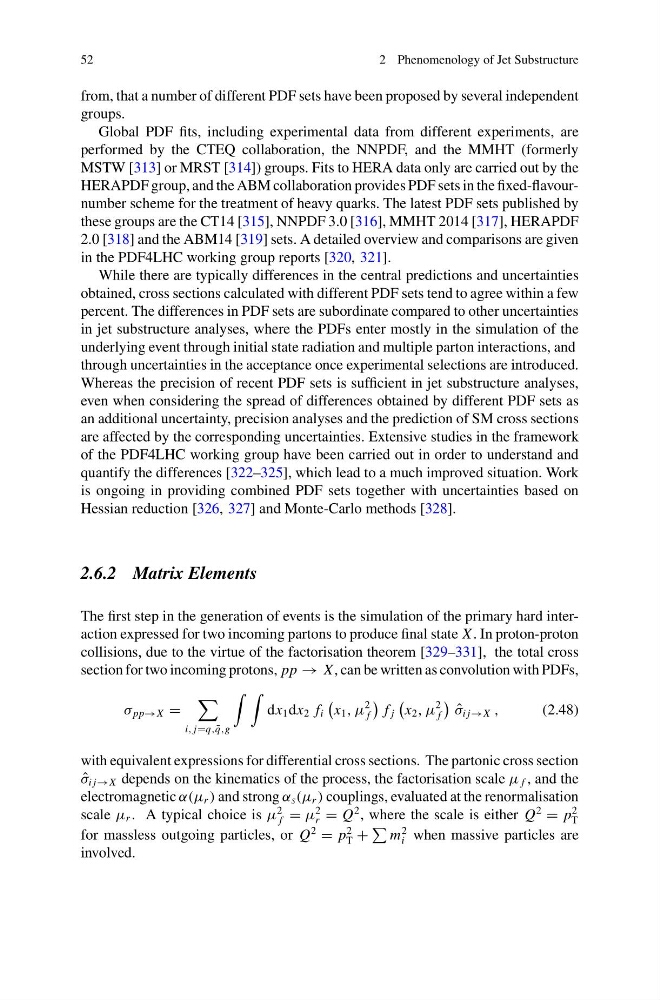
The first step in the generation of events is the simulation of the primary hard interaction expressed for two incoming partons to produce final state X . In proton-proton
collisions, due to the virtue of the factorisation theorem [329–331], the total cross
section for two incoming protons, pp → X , can be written as convolution with PDFs,
σ pp→X =
i, j=q, ¯
q,g
dx 1 dx 2 f i
x 1 , μ
2
f
f j
x 2 , μ
2
f
ˆ
σ i j→X ,
(2.48)
with equivalent expressions for differential cross sections. The partonic cross section
ˆ
σ i j→X depends on the kinematics of the process, the factorisation scale μ f , and the
electromagnetic α(μ r ) and strong α S (μ r ) couplings, evaluated at the renormalisation
scale μ r . A typical choice is μ
2
f = μ
2
r = Q
2 , where the scale is either Q
2
= p
2
T
for massless outgoing particles, or Q
2
= p
2
T +
m
2
i when massive particles are
involved.
2 Phenomenology of Jet Substructure
from, that a number of different PDF sets have been proposed by several independent
groups.
Global PDF fits, including experimental data from different experiments, are
performed by the CTEQ collaboration, the NNPDF, and the MMHT (formerly
MSTW [313] or MRST [314]) groups. Fits to HERA data only are carried out by the
HERAPDF group, and the ABM collaboration provides PDF sets in the fixed-flavournumber scheme for the treatment of heavy quarks. The latest PDF sets published by
these groups are the CT14 [315], NNPDF 3.0 [316], MMHT 2014 [317], HERAPDF
2.0 [318] and the ABM14 [319] sets. A detailed overview and comparisons are given
in the PDF4LHC working group reports [320, 321].
While there are typically differences in the central predictions and uncertainties
obtained, cross sections calculated with different PDF sets tend to agree within a few
percent. The differences in PDF sets are subordinate compared to other uncertainties
in jet substructure analyses, where the PDFs enter mostly in the simulation of the
underlying event through initial state radiation and multiple parton interactions, and
through uncertainties in the acceptance once experimental selections are introduced.
Whereas the precision of recent PDF sets is sufficient in jet substructure analyses,
even when considering the spread of differences obtained by different PDF sets as
an additional uncertainty, precision analyses and the prediction of SM cross sections
are affected by the corresponding uncertainties. Extensive studies in the framework
of the PDF4LHC working group have been carried out in order to understand and
quantify the differences [322–325], which lead to a much improved situation. Work
is ongoing in providing combined PDF sets together with uncertainties based on
Hessian reduction [326, 327] and Monte-Carlo methods [328].
2.6.2 Matrix Elements
The first step in the generation of events is the simulation of the primary hard interaction expressed for two incoming partons to produce final state X . In proton-proton
collisions, due to the virtue of the factorisation theorem [329–331], the total cross
section for two incoming protons, pp → X , can be written as convolution with PDFs,
σ pp→X =
i, j=q, ¯
q,g
dx 1 dx 2 f i
x 1 , μ
2
f
f j
x 2 , μ
2
f
ˆ
σ i j→X ,
(2.48)
with equivalent expressions for differential cross sections. The partonic cross section
ˆ
σ i j→X depends on the kinematics of the process, the factorisation scale μ f , and the
electromagnetic α(μ r ) and strong α S (μ r ) couplings, evaluated at the renormalisation
scale μ r . A typical choice is μ
2
f = μ
2
r = Q
2 , where the scale is either Q
2
= p
2
T
for massless outgoing particles, or Q
2
= p
2
T +
m
2
i when massive particles are
involved.