

50
2 Phenomenology of Jet Substructure
The scale UE receives contributions from the interactions of the proton remnants
and can not be calculated, but can be estimated from experimental studies or from
event generators. At the LHC, a rough estimate is UE ∼ 10 GeV. A more realistic
treatment needs to take into account the fact that jets are not exactly circular, and the
term R
2 in (2.45) is replaced by the active jet area [185].
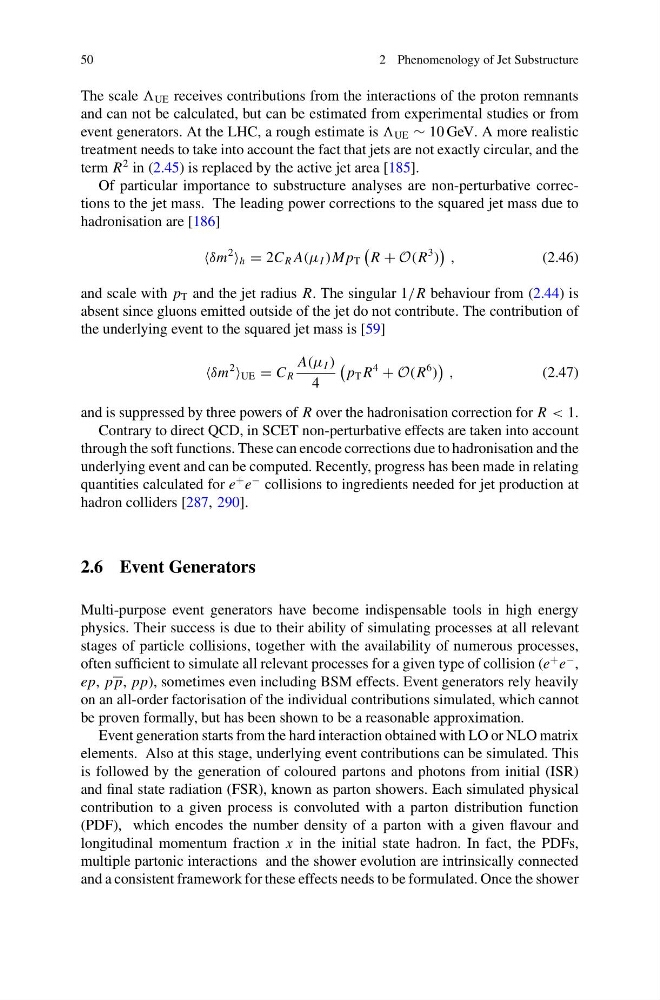
Of particular importance to substructure analyses are non-perturbative corrections to the jet mass. The leading power corrections to the squared jet mass due to
hadronisation are [186]
δm
2
h = 2C R A(μ I )Mp T
R + O(R
3
)
,
(2.46)
and scale with p T and the jet radius R. The singular 1/R behaviour from (2.44) is
absent since gluons emitted outside of the jet do not contribute. The contribution of
the underlying event to the squared jet mass is [59]
δm
2
UE = C R
A(μ I )
4
p T R
4
+ O(R
6
)
,
(2.47)
and is suppressed by three powers of R over the hadronisation correction for R < 1.
Contrary to direct QCD, in SCET non-perturbative effects are taken into account
through the soft functions. These can encode corrections due to hadronisation and the
underlying event and can be computed. Recently, progress has been made in relating
quantities calculated for e
+ e
− collisions to ingredients needed for jet production at
hadron colliders [287, 290].
2.6 Event Generators
Multi-purpose event generators have become indispensable tools in high energy
physics. Their success is due to their ability of simulating processes at all relevant
stages of particle collisions, together with the availability of numerous processes,
often sufficient to simulate all relevant processes for a given type of collision (e
+ e
− ,
ep, p p, pp), sometimes even including BSM effects. Event generators rely heavily
on an all-order factorisation of the individual contributions simulated, which cannot
be proven formally, but has been shown to be a reasonable approximation.
Event generation starts from the hard interaction obtained with LO or NLO matrix
elements. Also at this stage, underlying event contributions can be simulated. This
is followed by the generation of coloured partons and photons from initial (ISR)
and final state radiation (FSR), known as parton showers. Each simulated physical
contribution to a given process is convoluted with a parton distribution function
(PDF), which encodes the number density of a parton with a given flavour and
longitudinal momentum fraction x in the initial state hadron. In fact, the PDFs,
multiple partonic interactions and the shower evolution are intrinsically connected
and a consistent framework for these effects needs to be formulated. Once the shower
2 Phenomenology of Jet Substructure
The scale UE receives contributions from the interactions of the proton remnants
and can not be calculated, but can be estimated from experimental studies or from
event generators. At the LHC, a rough estimate is UE ∼ 10 GeV. A more realistic
treatment needs to take into account the fact that jets are not exactly circular, and the
term R
2 in (2.45) is replaced by the active jet area [185].
Of particular importance to substructure analyses are non-perturbative corrections to the jet mass. The leading power corrections to the squared jet mass due to
hadronisation are [186]
δm
2
h = 2C R A(μ I )Mp T
R + O(R
3
)
,
(2.46)
and scale with p T and the jet radius R. The singular 1/R behaviour from (2.44) is
absent since gluons emitted outside of the jet do not contribute. The contribution of
the underlying event to the squared jet mass is [59]
δm
2
UE = C R
A(μ I )
4
p T R
4
+ O(R
6
)
,
(2.47)
and is suppressed by three powers of R over the hadronisation correction for R < 1.
Contrary to direct QCD, in SCET non-perturbative effects are taken into account
through the soft functions. These can encode corrections due to hadronisation and the
underlying event and can be computed. Recently, progress has been made in relating
quantities calculated for e
+ e
− collisions to ingredients needed for jet production at
hadron colliders [287, 290].
2.6 Event Generators
Multi-purpose event generators have become indispensable tools in high energy
physics. Their success is due to their ability of simulating processes at all relevant
stages of particle collisions, together with the availability of numerous processes,
often sufficient to simulate all relevant processes for a given type of collision (e
+ e
− ,
ep, p p, pp), sometimes even including BSM effects. Event generators rely heavily
on an all-order factorisation of the individual contributions simulated, which cannot
be proven formally, but has been shown to be a reasonable approximation.
Event generation starts from the hard interaction obtained with LO or NLO matrix
elements. Also at this stage, underlying event contributions can be simulated. This
is followed by the generation of coloured partons and photons from initial (ISR)
and final state radiation (FSR), known as parton showers. Each simulated physical
contribution to a given process is convoluted with a parton distribution function
(PDF), which encodes the number density of a parton with a given flavour and
longitudinal momentum fraction x in the initial state hadron. In fact, the PDFs,
multiple partonic interactions and the shower evolution are intrinsically connected
and a consistent framework for these effects needs to be formulated. Once the shower