

32
2 Phenomenology of Jet Substructure
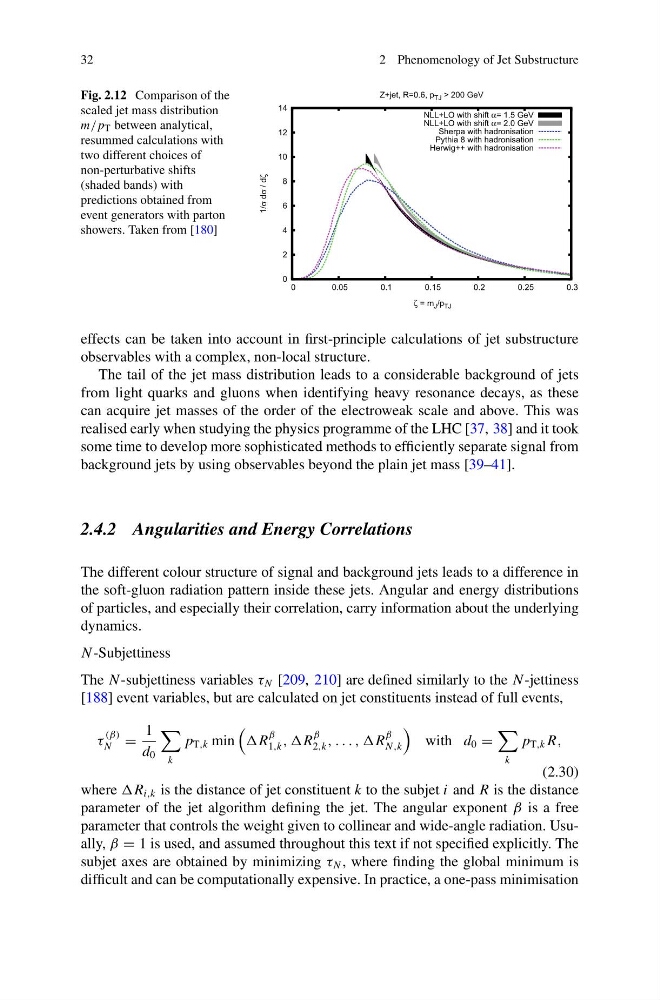
Fig. 2.12 Comparison of the
scaled jet mass distribution
m/ p T between analytical,
resummed calculations with
two different choices of
non-perturbative shifts
(shaded bands) with
predictions obtained from
event generators with parton
showers. Taken from [180]
0
2
4
6
8
10
12
14
0
0.05
0.1
0.15
0.2
0.25
0.3
1/σ dσ
/ dζ
ζ = m J /p TJ
Z+jet, R=0.6, p TJ > 200 GeV
NLL+LO with shift α= 1.5 GeV
NLL+LO with shift α= 2.0 GeV
Sherpa with hadronisation
Pythia 8 with hadronisation
Herwig++ with hadronisation
effects can be taken into account in first-principle calculations of jet substructure
observables with a complex, non-local structure.
The tail of the jet mass distribution leads to a considerable background of jets
from light quarks and gluons when identifying heavy resonance decays, as these
can acquire jet masses of the order of the electroweak scale and above. This was
realised early when studying the physics programme of the LHC [37, 38] and it took
some time to develop more sophisticated methods to efficiently separate signal from
background jets by using observables beyond the plain jet mass [39–41].
2.4.2 Angularities and Energy Correlations
The different colour structure of signal and background jets leads to a difference in
the soft-gluon radiation pattern inside these jets. Angular and energy distributions
of particles, and especially their correlation, carry information about the underlying
dynamics.
N -Subjettiness
The N -subjettiness variables τ N [209, 210] are defined similarly to the N -jettiness
[188] event variables, but are calculated on jet constituents instead of full events,
τ
(β)
N =
1
d 0
k
p T,k min
β
1,k , ,R
β
2,k , . . . , ,R
β
N ,k
with d 0 =
k
p T,k R,
(2.30)
where i,k is the distance of jet constituent k to the subjet i and R is the distance
parameter of the jet algorithm defining the jet. The angular exponent β is a free
parameter that controls the weight given to collinear and wide-angle radiation. Usually, β = 1 is used, and assumed throughout this text if not specified explicitly. The
subjet axes are obtained by minimizing τ N , where finding the global minimum is
difficult and can be computationally expensive. In practice, a one-pass minimisation
2 Phenomenology of Jet Substructure
Fig. 2.12 Comparison of the
scaled jet mass distribution
m/ p T between analytical,
resummed calculations with
two different choices of
non-perturbative shifts
(shaded bands) with
predictions obtained from
event generators with parton
showers. Taken from [180]
0
2
4
6
8
10
12
14
0
0.05
0.1
0.15
0.2
0.25
0.3
1/σ dσ
/ dζ
ζ = m J /p TJ
Z+jet, R=0.6, p TJ > 200 GeV
NLL+LO with shift α= 1.5 GeV
NLL+LO with shift α= 2.0 GeV
Sherpa with hadronisation
Pythia 8 with hadronisation
Herwig++ with hadronisation
effects can be taken into account in first-principle calculations of jet substructure
observables with a complex, non-local structure.
The tail of the jet mass distribution leads to a considerable background of jets
from light quarks and gluons when identifying heavy resonance decays, as these
can acquire jet masses of the order of the electroweak scale and above. This was
realised early when studying the physics programme of the LHC [37, 38] and it took
some time to develop more sophisticated methods to efficiently separate signal from
background jets by using observables beyond the plain jet mass [39–41].
2.4.2 Angularities and Energy Correlations
The different colour structure of signal and background jets leads to a difference in
the soft-gluon radiation pattern inside these jets. Angular and energy distributions
of particles, and especially their correlation, carry information about the underlying
dynamics.
N -Subjettiness
The N -subjettiness variables τ N [209, 210] are defined similarly to the N -jettiness
[188] event variables, but are calculated on jet constituents instead of full events,
τ
(β)
N =
1
d 0
k
p T,k min
β
1,k , ,R
β
2,k , . . . , ,R
β
N ,k
with d 0 =
k
p T,k R,
(2.30)
where i,k is the distance of jet constituent k to the subjet i and R is the distance
parameter of the jet algorithm defining the jet. The angular exponent β is a free
parameter that controls the weight given to collinear and wide-angle radiation. Usually, β = 1 is used, and assumed throughout this text if not specified explicitly. The
subjet axes are obtained by minimizing τ N , where finding the global minimum is
difficult and can be computationally expensive. In practice, a one-pass minimisation