

26
2 Phenomenology of Jet Substructure
Often new algorithmic developments are closely related to advances in calculations, which can also prompt the introduction of novel variables. Work is ongoing in
order to classify existing and novel methods and evaluate their usefulness, where the
largest scientific gain is obtained by methods well understood theoretically as well
as experimentally.
Methods for substructure analyses usually build up on existing jet algorithms. In
the following, sequential recombination algorithms are shortly reviewed because of
their importance for jet substructure. Traditional cone algorithms [175–178], where
the seedless infrared-safe cone (SISCone) [48] is an example of an IRC safe algorithm, play an insignificant role in this field and are not considered. Instead, two
recent developments, the XCone
5 [179, 180] and the Georgi [181–183] algorithms,
are described briefly.
2.3.1 Sequential Clustering Algorithms
All sequential recombination algorithms start with an input list of particles, also
denoted as pseudojets.
6 The clustering continues the processing until the input list
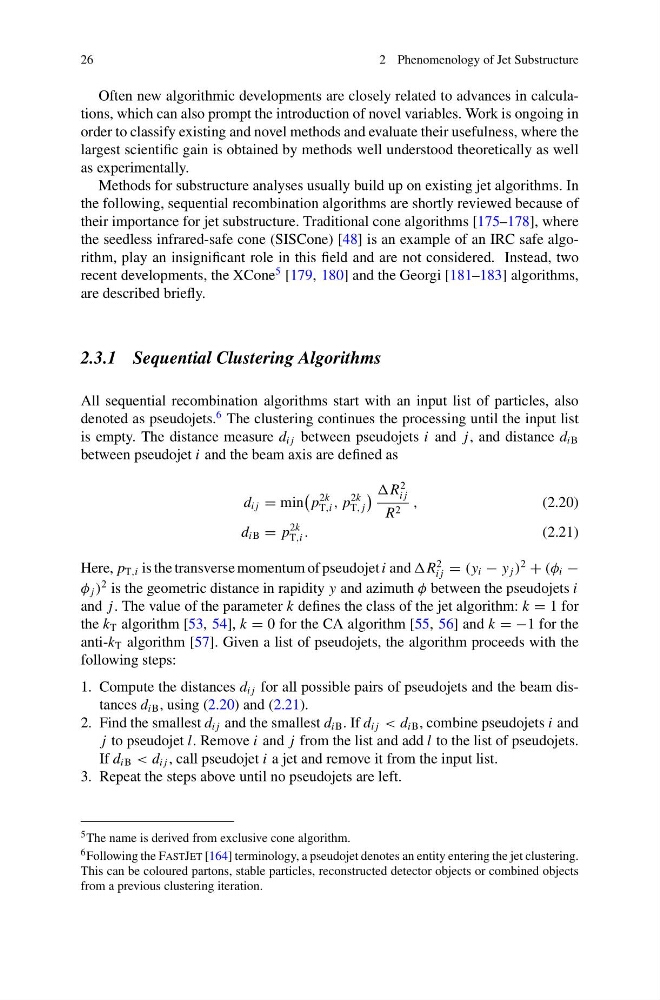
is empty. The distance measure d i j between pseudojets i and j, and distance d iB
between pseudojet i and the beam axis are defined as
d i j = min
p
2k
T,i , p
2k
T, j
R
2
i j
R 2 ,
(2.20)
d iB = p
2k
T,i .
(2.21)
Here, p T,i is the transverse momentum of pseudojet i and R
2
i j = (y i − y j )
2
+ (φ i −
φ j )
2 is the geometric distance in rapidity y and azimuth φ between the pseudojets i
and j. The value of the parameter k defines the class of the jet algorithm: k = 1 for
the k T algorithm [53, 54], k = 0 for the CA algorithm [55, 56] and k = −1 for the
anti-k T algorithm [57]. Given a list of pseudojets, the algorithm proceeds with the
following steps:
1. Compute the distances d i j for all possible pairs of pseudojets and the beam distances d iB , using (2.20) and (2.21).
2. Find the smallest d i j and the smallest d iB . If d i j < d iB , combine pseudojets i and
j to pseudojet l. Remove i and j from the list and add l to the list of pseudojets.
If d iB < d i j , call pseudojet i a jet and remove it from the input list.
3. Repeat the steps above until no pseudojets are left.
5 The name is derived from exclusive cone algorithm.
6 Following the FastJet [164] terminology, a pseudojet denotes an entity entering the jet clustering.
This can be coloured partons, stable particles, reconstructed detector objects or combined objects
from a previous clustering iteration.
2 Phenomenology of Jet Substructure
Often new algorithmic developments are closely related to advances in calculations, which can also prompt the introduction of novel variables. Work is ongoing in
order to classify existing and novel methods and evaluate their usefulness, where the
largest scientific gain is obtained by methods well understood theoretically as well
as experimentally.
Methods for substructure analyses usually build up on existing jet algorithms. In
the following, sequential recombination algorithms are shortly reviewed because of
their importance for jet substructure. Traditional cone algorithms [175–178], where
the seedless infrared-safe cone (SISCone) [48] is an example of an IRC safe algorithm, play an insignificant role in this field and are not considered. Instead, two
recent developments, the XCone
5 [179, 180] and the Georgi [181–183] algorithms,
are described briefly.
2.3.1 Sequential Clustering Algorithms
All sequential recombination algorithms start with an input list of particles, also
denoted as pseudojets.
6 The clustering continues the processing until the input list
is empty. The distance measure d i j between pseudojets i and j, and distance d iB
between pseudojet i and the beam axis are defined as
d i j = min
p
2k
T,i , p
2k
T, j
R
2
i j
R 2 ,
(2.20)
d iB = p
2k
T,i .
(2.21)
Here, p T,i is the transverse momentum of pseudojet i and R
2
i j = (y i − y j )
2
+ (φ i −
φ j )
2 is the geometric distance in rapidity y and azimuth φ between the pseudojets i
and j. The value of the parameter k defines the class of the jet algorithm: k = 1 for
the k T algorithm [53, 54], k = 0 for the CA algorithm [55, 56] and k = −1 for the
anti-k T algorithm [57]. Given a list of pseudojets, the algorithm proceeds with the
following steps:
1. Compute the distances d i j for all possible pairs of pseudojets and the beam distances d iB , using (2.20) and (2.21).
2. Find the smallest d i j and the smallest d iB . If d i j < d iB , combine pseudojets i and
j to pseudojet l. Remove i and j from the list and add l to the list of pseudojets.
If d iB < d i j , call pseudojet i a jet and remove it from the input list.
3. Repeat the steps above until no pseudojets are left.
5 The name is derived from exclusive cone algorithm.
6 Following the FastJet [164] terminology, a pseudojet denotes an entity entering the jet clustering.
This can be coloured partons, stable particles, reconstructed detector objects or combined objects
from a previous clustering iteration.