

5.5 Dark Matter and Mono-X
189
The best sensitivity to dark matter models is achieved by combining experimental
results from a number of different analyses, such as searches for dijet and dilepton resonances, tt resonances or mono-X signatures. The resonance searches cover
the mediator interactions with SM particles, while the mono-X searches constrain
the parameter space where the coupling to dark matter particles is larger. A recent
comprehensive combination has been performed by ATLAS [1092], considering a
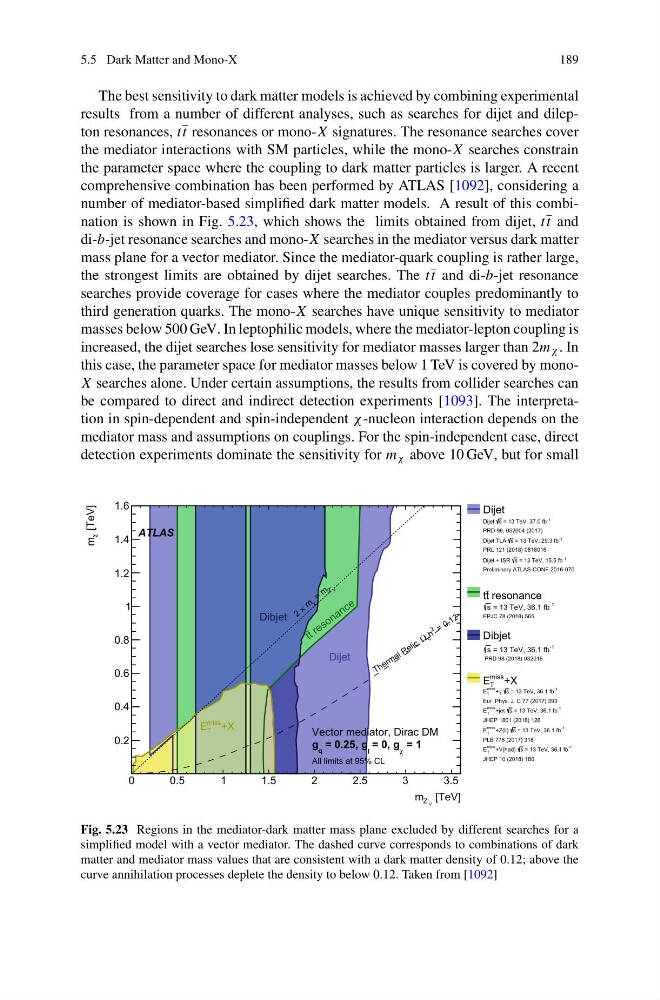
number of mediator-based simplified dark matter models. A result of this combination is shown in Fig. 5.23, which shows the limits obtained from dijet, tt and
di-b-jet resonance searches and mono-X searches in the mediator versus dark matter
mass plane for a vector mediator. Since the mediator-quark coupling is rather large,
the strongest limits are obtained by dijet searches. The tt and di-b-jet resonance
searches provide coverage for cases where the mediator couples predominantly to
third generation quarks. The mono-X searches have unique sensitivity to mediator
masses below 500 GeV. In leptophilic models, where the mediator-lepton coupling is
increased, the dijet searches lose sensitivity for mediator masses larger than 2m χ . In
this case, the parameter space for mediator masses below 1 TeV is covered by monoX searches alone. Under certain assumptions, the results from collider searches can
be compared to direct and indirect detection experiments [1093]. The interpretation in spin-dependent and spin-independent χ -nucleon interaction depends on the
mediator mass and assumptions on couplings. For the spin-independent case, direct
detection experiments dominate the sensitivity for m χ above 10 GeV, but for small
0
0.5
1
1.5
2
2.5
3
3.5
[TeV]
V
Z'
m
0.2
0.4
0.6
0.8
1
1.2
1.4
1.6
[TeV]
χ
m
ATLAS
= 1
χ
= 0, g
l
= 0.25, g
q
g
Vector mediator, Dirac DM
All limits at 95% CL
Dijet
Dijet
PRD 96, 052004 (2017)
-1
= 13 TeV, 37.0 fb
s
Dijet
PRL 121 (2018) 0818016
-1
= 13 TeV, 29.3 fb
s
Dijet TLA
Preliminary ATLAS-CONF-2016-070
-1
= 13 TeV, 15.5 fb
s
Dijet + ISR
r e s o n a n c e
t
t
EPJC 78 (2018) 565
-1
= 13 TeV, 36.1 fb
s
resonance
t
t
Dibjet
PRD 98 (2018) 032016
-1
= 13 TeV, 36.1 fb
s
Dibjet
+X
miss
T
E
+X
miss
T
E
Eur. Phys. J. C 77 (2017) 393
-1
= 13 TeV, 36.1 fb
s
γ
+
miss
T
E
JHEP 1801 (2018) 126
-1
= 13 TeV, 36.1 fb
s
+jet
miss
T
E
PLB 776 (2017) 318
-1
= 13 TeV, 36.1 fb
s
+Z(ll)
miss
T
E
JHEP 10 (2018) 180
-1
= 13 TeV, 36.1 fb
s
+V(had)
miss
T
E
V
Z '
=
m
χ
m
×
2
= 0 .1 2
2
h
c
Ω
T h e r m a l R e li c
Fig. 5.23 Regions in the mediator-dark matter mass plane excluded by different searches for a
simplified model with a vector mediator. The dashed curve corresponds to combinations of dark
matter and mediator mass values that are consistent with a dark matter density of 0.12; above the
curve annihilation processes deplete the density to below 0.12. Taken from [1092]
189
The best sensitivity to dark matter models is achieved by combining experimental
results from a number of different analyses, such as searches for dijet and dilepton resonances, tt resonances or mono-X signatures. The resonance searches cover
the mediator interactions with SM particles, while the mono-X searches constrain
the parameter space where the coupling to dark matter particles is larger. A recent
comprehensive combination has been performed by ATLAS [1092], considering a
number of mediator-based simplified dark matter models. A result of this combination is shown in Fig. 5.23, which shows the limits obtained from dijet, tt and
di-b-jet resonance searches and mono-X searches in the mediator versus dark matter
mass plane for a vector mediator. Since the mediator-quark coupling is rather large,
the strongest limits are obtained by dijet searches. The tt and di-b-jet resonance
searches provide coverage for cases where the mediator couples predominantly to
third generation quarks. The mono-X searches have unique sensitivity to mediator
masses below 500 GeV. In leptophilic models, where the mediator-lepton coupling is
increased, the dijet searches lose sensitivity for mediator masses larger than 2m χ . In
this case, the parameter space for mediator masses below 1 TeV is covered by monoX searches alone. Under certain assumptions, the results from collider searches can
be compared to direct and indirect detection experiments [1093]. The interpretation in spin-dependent and spin-independent χ -nucleon interaction depends on the
mediator mass and assumptions on couplings. For the spin-independent case, direct
detection experiments dominate the sensitivity for m χ above 10 GeV, but for small
0
0.5
1
1.5
2
2.5
3
3.5
[TeV]
V
Z'
m
0.2
0.4
0.6
0.8
1
1.2
1.4
1.6
[TeV]
χ
m
ATLAS
= 1
χ
= 0, g
l
= 0.25, g
q
g
Vector mediator, Dirac DM
All limits at 95% CL
Dijet
Dijet
PRD 96, 052004 (2017)
-1
= 13 TeV, 37.0 fb
s
Dijet
PRL 121 (2018) 0818016
-1
= 13 TeV, 29.3 fb
s
Dijet TLA
Preliminary ATLAS-CONF-2016-070
-1
= 13 TeV, 15.5 fb
s
Dijet + ISR
r e s o n a n c e
t
t
EPJC 78 (2018) 565
-1
= 13 TeV, 36.1 fb
s
resonance
t
t
Dibjet
PRD 98 (2018) 032016
-1
= 13 TeV, 36.1 fb
s
Dibjet
+X
miss
T
E
+X
miss
T
E
Eur. Phys. J. C 77 (2017) 393
-1
= 13 TeV, 36.1 fb
s
γ
+
miss
T
E
JHEP 1801 (2018) 126
-1
= 13 TeV, 36.1 fb
s
+jet
miss
T
E
PLB 776 (2017) 318
-1
= 13 TeV, 36.1 fb
s
+Z(ll)
miss
T
E
JHEP 10 (2018) 180
-1
= 13 TeV, 36.1 fb
s
+V(had)
miss
T
E
V
Z '
=
m
χ
m
×
2
= 0 .1 2
2
h
c
Ω
T h e r m a l R e li c
Fig. 5.23 Regions in the mediator-dark matter mass plane excluded by different searches for a
simplified model with a vector mediator. The dashed curve corresponds to combinations of dark
matter and mediator mass values that are consistent with a dark matter density of 0.12; above the
curve annihilation processes deplete the density to below 0.12. Taken from [1092]