

5.5 Dark Matter and Mono-X
185
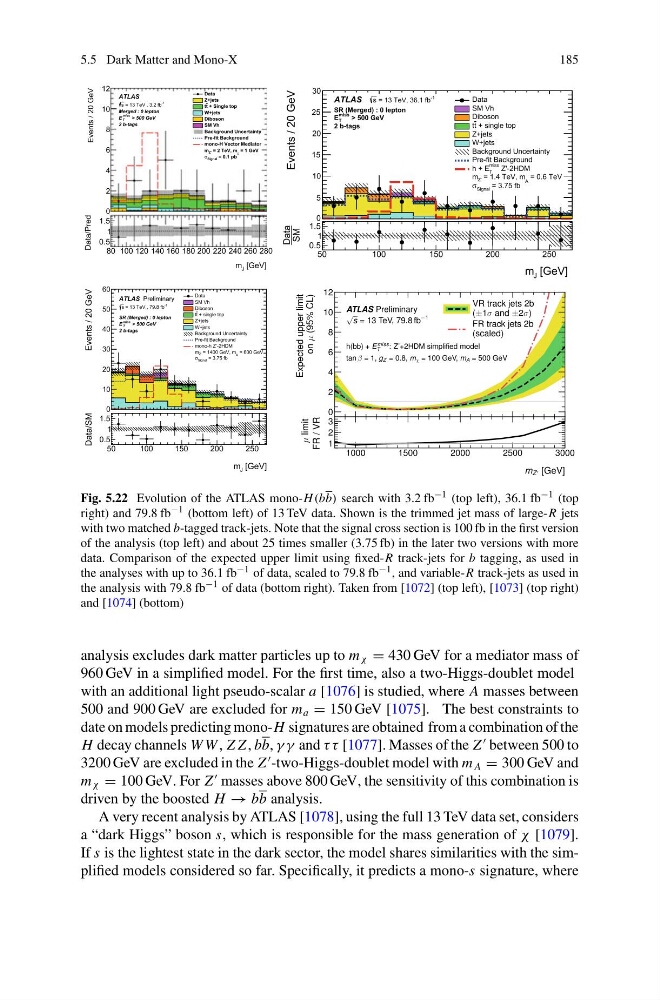
Fig. 5.22 Evolution of the ATLAS mono-H (bb) search with 3.2 fb −1 (top left), 36.1 fb −1 (top
right) and 79.8 fb −1 (bottom left) of 13 TeV data. Shown is the trimmed jet mass of large-R jets
with two matched b-tagged track-jets. Note that the signal cross section is 100 fb in the first version
of the analysis (top left) and about 25 times smaller (3.75 fb) in the later two versions with more
data. Comparison of the expected upper limit using fixed-R track-jets for b tagging, as used in
the analyses with up to 36.1 fb −1 of data, scaled to 79.8 fb −1 , and variable-R track-jets as used in
the analysis with 79.8 fb −1 of data (bottom right). Taken from [1072] (top left), [1073] (top right)
and [1074] (bottom)
analysis excludes dark matter particles up to m χ = 430 GeV for a mediator mass of
960 GeV in a simplified model. For the first time, also a two-Higgs-doublet model
with an additional light pseudo-scalar a [1076] is studied, where A masses between
500 and 900 GeV are excluded for m a = 150 GeV [1075]. The best constraints to
date on models predicting mono-H signatures are obtained from a combination of the
H decay channels W W , Z Z, bb, γ γ and τ τ [1077]. Masses of the Z
between 500 to
3200 GeV are excluded in the Z
-two-Higgs-doublet model with m A = 300 GeV and
m χ = 100 GeV. For Z
masses above 800 GeV, the sensitivity of this combination is
driven by the boosted H → bb analysis.
A very recent analysis by ATLAS [1078], using the full 13 TeV data set, considers
a “dark Higgs” boson s, which is responsible for the mass generation of χ [1079].
If s is the lightest state in the dark sector, the model shares similarities with the simplified models considered so far. Specifically, it predicts a mono-s signature, where
185
Fig. 5.22 Evolution of the ATLAS mono-H (bb) search with 3.2 fb −1 (top left), 36.1 fb −1 (top
right) and 79.8 fb −1 (bottom left) of 13 TeV data. Shown is the trimmed jet mass of large-R jets
with two matched b-tagged track-jets. Note that the signal cross section is 100 fb in the first version
of the analysis (top left) and about 25 times smaller (3.75 fb) in the later two versions with more
data. Comparison of the expected upper limit using fixed-R track-jets for b tagging, as used in
the analyses with up to 36.1 fb −1 of data, scaled to 79.8 fb −1 , and variable-R track-jets as used in
the analysis with 79.8 fb −1 of data (bottom right). Taken from [1072] (top left), [1073] (top right)
and [1074] (bottom)
analysis excludes dark matter particles up to m χ = 430 GeV for a mediator mass of
960 GeV in a simplified model. For the first time, also a two-Higgs-doublet model
with an additional light pseudo-scalar a [1076] is studied, where A masses between
500 and 900 GeV are excluded for m a = 150 GeV [1075]. The best constraints to
date on models predicting mono-H signatures are obtained from a combination of the
H decay channels W W , Z Z, bb, γ γ and τ τ [1077]. Masses of the Z
between 500 to
3200 GeV are excluded in the Z
-two-Higgs-doublet model with m A = 300 GeV and
m χ = 100 GeV. For Z
masses above 800 GeV, the sensitivity of this combination is
driven by the boosted H → bb analysis.
A very recent analysis by ATLAS [1078], using the full 13 TeV data set, considers
a “dark Higgs” boson s, which is responsible for the mass generation of χ [1079].
If s is the lightest state in the dark sector, the model shares similarities with the simplified models considered so far. Specifically, it predicts a mono-s signature, where