

182
5 Direct Searches for New Physics
Events / 10 GeV
0
50
100
150
200
250
Data
)+jet
ν ν
Z(
)+jet
τ
/
μ
W/Z(e/
Top
Diboson
uncertainty
D5(u=d) x100
D5(u=-d) x1
ATLAS
s
V
e
T
8
=
-1
20.3 fb
> 350 GeV
miss
T
SR: E
[GeV]
jet
m
50
60
70
80
90
100
110
120
Events / 10 GeV
0
5
10
15
20
25
30
35
D5(u=d) x20
D5(u=-d) x0.2
> 500 GeV
miss
T
SR: E
Events/GeV
-1
10
1
10
2
10
Data
)+jets
ν
ν
→
Z(
)+jets
ν
l
→
W(
Top quark
Dibosons
QCD multijet
)+jets
ll
→
Z(
=10 GeV
DM
m
=1 TeV,
MED
m
Vector mediator
CMS
V-boosted category
(8 TeV)
-1
19.7 fb
300
400
500
600
700
800
900
1000
Data/Pred.
0.5
1
1.5
[GeV]
miss
T
E
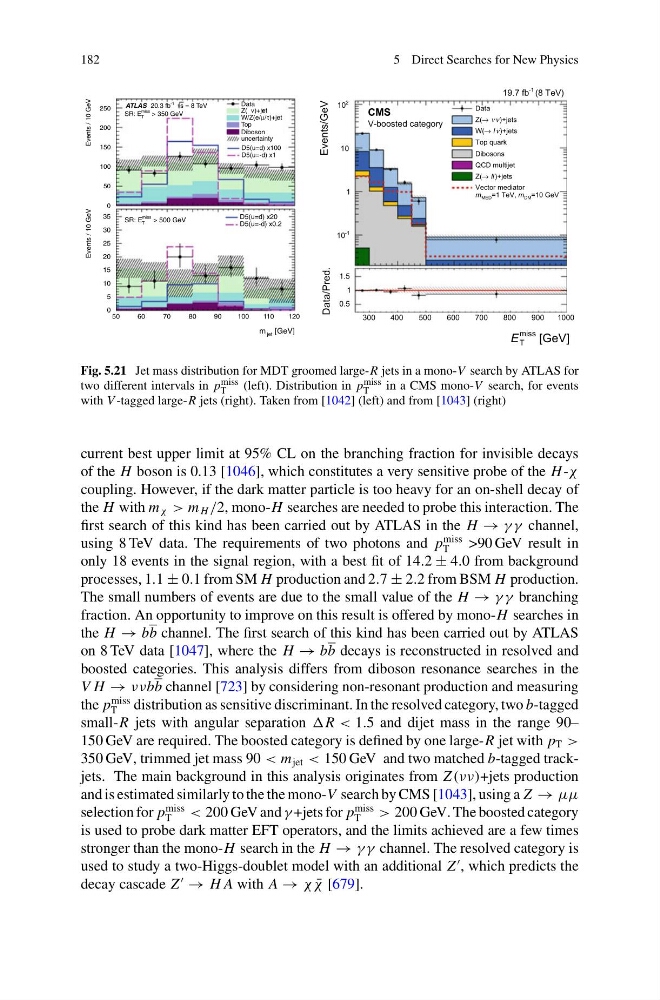
Fig. 5.21 Jet mass distribution for MDT groomed large-R jets in a mono-V search by ATLAS for
two different intervals in p miss
T
(left). Distribution in p miss
T
in a CMS mono-V search, for events
with V -tagged large-R jets (right). Taken from [1042] (left) and from [1043] (right)
current best upper limit at 95% CL on the branching fraction for invisible decays
of the H boson is 0.13 [1046], which constitutes a very sensitive probe of the H -χ
coupling. However, if the dark matter particle is too heavy for an on-shell decay of
the H with m χ > m H /2, mono-H searches are needed to probe this interaction. The
first search of this kind has been carried out by ATLAS in the H → γ γ channel,
using 8 TeV data. The requirements of two photons and p
miss
T
>90 GeV result in
only 18 events in the signal region, with a best fit of 14.2 ± 4.0 from background
processes, 1.1 ± 0.1 from SM H production and 2.7 ± 2.2 from BSM H production.
The small numbers of events are due to the small value of the H → γ γ branching
fraction. An opportunity to improve on this result is offered by mono-H searches in
the H → bb channel. The first search of this kind has been carried out by ATLAS
on 8 TeV data [1047], where the H → bb decays is reconstructed in resolved and
boosted categories. This analysis differs from diboson resonance searches in the
V H → ννbb channel [723] by considering non-resonant production and measuring
the p
miss
T
distribution as sensitive discriminant. In the resolved category, two b-tagged
small-R jets with angular separation < 1.5 and dijet mass in the range 90–
150 GeV are required. The boosted category is defined by one large-R jet with p T >
350 GeV, trimmed jet mass 90 < m jet < 150 GeV and two matched b-tagged trackjets. The main background in this analysis originates from Z (νν)+jets production
and is estimated similarly to the the mono-V search by CMS [1043], using a Z → μμ
selection for p
miss
T
< 200 GeV and γ +jets for p
miss
T
> 200 GeV. The boosted category
is used to probe dark matter EFT operators, and the limits achieved are a few times
stronger than the mono-H search in the H → γ γ channel. The resolved category is
used to study a two-Higgs-doublet model with an additional Z
, which predicts the
decay cascade Z
→ H A with A → χ ¯
χ [679].
5 Direct Searches for New Physics
Events / 10 GeV
0
50
100
150
200
250
Data
)+jet
ν ν
Z(
)+jet
τ
/
μ
W/Z(e/
Top
Diboson
uncertainty
D5(u=d) x100
D5(u=-d) x1
ATLAS
s
V
e
T
8
=
-1
20.3 fb
> 350 GeV
miss
T
SR: E
[GeV]
jet
m
50
60
70
80
90
100
110
120
Events / 10 GeV
0
5
10
15
20
25
30
35
D5(u=d) x20
D5(u=-d) x0.2
> 500 GeV
miss
T
SR: E
Events/GeV
-1
10
1
10
2
10
Data
)+jets
ν
ν
→
Z(
)+jets
ν
l
→
W(
Top quark
Dibosons
QCD multijet
)+jets
ll
→
Z(
=10 GeV
DM
m
=1 TeV,
MED
m
Vector mediator
CMS
V-boosted category
(8 TeV)
-1
19.7 fb
300
400
500
600
700
800
900
1000
Data/Pred.
0.5
1
1.5
[GeV]
miss
T
E
Fig. 5.21 Jet mass distribution for MDT groomed large-R jets in a mono-V search by ATLAS for
two different intervals in p miss
T
(left). Distribution in p miss
T
in a CMS mono-V search, for events
with V -tagged large-R jets (right). Taken from [1042] (left) and from [1043] (right)
current best upper limit at 95% CL on the branching fraction for invisible decays
of the H boson is 0.13 [1046], which constitutes a very sensitive probe of the H -χ
coupling. However, if the dark matter particle is too heavy for an on-shell decay of
the H with m χ > m H /2, mono-H searches are needed to probe this interaction. The
first search of this kind has been carried out by ATLAS in the H → γ γ channel,
using 8 TeV data. The requirements of two photons and p
miss
T
>90 GeV result in
only 18 events in the signal region, with a best fit of 14.2 ± 4.0 from background
processes, 1.1 ± 0.1 from SM H production and 2.7 ± 2.2 from BSM H production.
The small numbers of events are due to the small value of the H → γ γ branching
fraction. An opportunity to improve on this result is offered by mono-H searches in
the H → bb channel. The first search of this kind has been carried out by ATLAS
on 8 TeV data [1047], where the H → bb decays is reconstructed in resolved and
boosted categories. This analysis differs from diboson resonance searches in the
V H → ννbb channel [723] by considering non-resonant production and measuring
the p
miss
T
distribution as sensitive discriminant. In the resolved category, two b-tagged
small-R jets with angular separation < 1.5 and dijet mass in the range 90–
150 GeV are required. The boosted category is defined by one large-R jet with p T >
350 GeV, trimmed jet mass 90 < m jet < 150 GeV and two matched b-tagged trackjets. The main background in this analysis originates from Z (νν)+jets production
and is estimated similarly to the the mono-V search by CMS [1043], using a Z → μμ
selection for p
miss
T
< 200 GeV and γ +jets for p
miss
T
> 200 GeV. The boosted category
is used to probe dark matter EFT operators, and the limits achieved are a few times
stronger than the mono-H search in the H → γ γ channel. The resolved category is
used to study a two-Higgs-doublet model with an additional Z
, which predicts the
decay cascade Z
→ H A with A → χ ¯
χ [679].