

5.5 Dark Matter and Mono-X
179
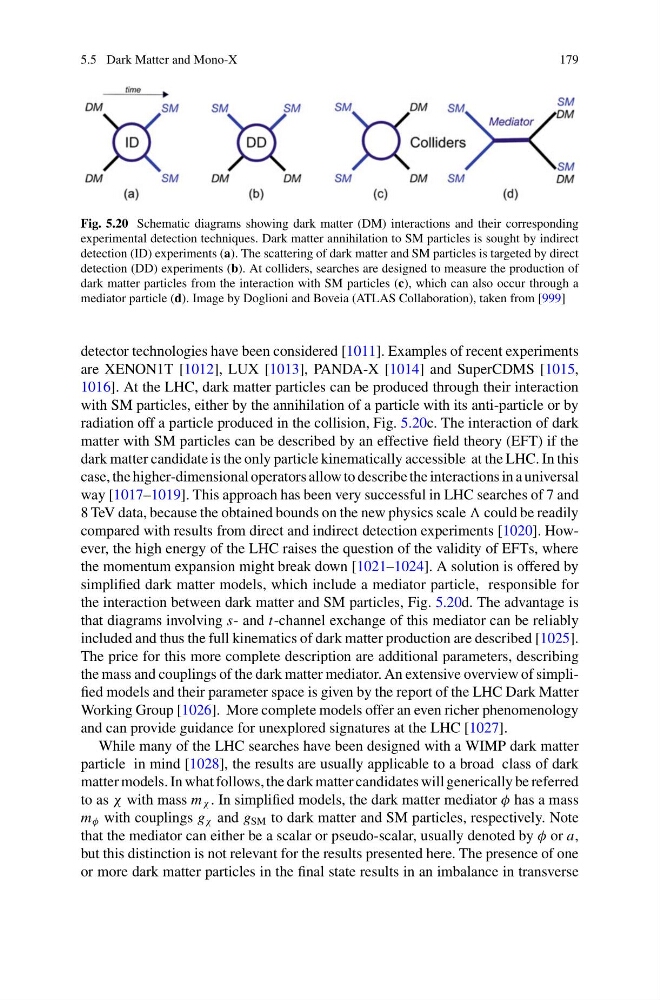
Fig. 5.20 Schematic diagrams showing dark matter (DM) interactions and their corresponding
experimental detection techniques. Dark matter annihilation to SM particles is sought by indirect
detection (ID) experiments (a). The scattering of dark matter and SM particles is targeted by direct
detection (DD) experiments (b). At colliders, searches are designed to measure the production of
dark matter particles from the interaction with SM particles (c), which can also occur through a
mediator particle (d). Image by Doglioni and Boveia (ATLAS Collaboration), taken from [999]
detector technologies have been considered [1011]. Examples of recent experiments
are XENON1T [1012], LUX [1013], PANDA-X [1014] and SuperCDMS [1015,
1016]. At the LHC, dark matter particles can be produced through their interaction
with SM particles, either by the annihilation of a particle with its anti-particle or by
radiation off a particle produced in the collision, Fig. 5.20c. The interaction of dark
matter with SM particles can be described by an effective field theory (EFT) if the
dark matter candidate is the only particle kinematically accessible at the LHC. In this
case, the higher-dimensional operators allow to describe the interactions in a universal
way [1017–1019]. This approach has been very successful in LHC searches of 7 and
8 TeV data, because the obtained bounds on the new physics scale could be readily
compared with results from direct and indirect detection experiments [1020]. However, the high energy of the LHC raises the question of the validity of EFTs, where
the momentum expansion might break down [1021–1024]. A solution is offered by
simplified dark matter models, which include a mediator particle, responsible for
the interaction between dark matter and SM particles, Fig. 5.20d. The advantage is
that diagrams involving s- and t-channel exchange of this mediator can be reliably
included and thus the full kinematics of dark matter production are described [1025].
The price for this more complete description are additional parameters, describing
the mass and couplings of the dark matter mediator. An extensive overview of simplified models and their parameter space is given by the report of the LHC Dark Matter
Working Group [1026]. More complete models offer an even richer phenomenology
and can provide guidance for unexplored signatures at the LHC [1027].
While many of the LHC searches have been designed with a WIMP dark matter
particle in mind [1028], the results are usually applicable to a broad class of dark
matter models. In what follows, the dark matter candidates will generically be referred
to as χ with mass m χ . In simplified models, the dark matter mediator φ has a mass
m φ with couplings g χ and g SM to dark matter and SM particles, respectively. Note
that the mediator can either be a scalar or pseudo-scalar, usually denoted by φ or a,
but this distinction is not relevant for the results presented here. The presence of one
or more dark matter particles in the final state results in an imbalance in transverse
179
Fig. 5.20 Schematic diagrams showing dark matter (DM) interactions and their corresponding
experimental detection techniques. Dark matter annihilation to SM particles is sought by indirect
detection (ID) experiments (a). The scattering of dark matter and SM particles is targeted by direct
detection (DD) experiments (b). At colliders, searches are designed to measure the production of
dark matter particles from the interaction with SM particles (c), which can also occur through a
mediator particle (d). Image by Doglioni and Boveia (ATLAS Collaboration), taken from [999]
detector technologies have been considered [1011]. Examples of recent experiments
are XENON1T [1012], LUX [1013], PANDA-X [1014] and SuperCDMS [1015,
1016]. At the LHC, dark matter particles can be produced through their interaction
with SM particles, either by the annihilation of a particle with its anti-particle or by
radiation off a particle produced in the collision, Fig. 5.20c. The interaction of dark
matter with SM particles can be described by an effective field theory (EFT) if the
dark matter candidate is the only particle kinematically accessible at the LHC. In this
case, the higher-dimensional operators allow to describe the interactions in a universal
way [1017–1019]. This approach has been very successful in LHC searches of 7 and
8 TeV data, because the obtained bounds on the new physics scale could be readily
compared with results from direct and indirect detection experiments [1020]. However, the high energy of the LHC raises the question of the validity of EFTs, where
the momentum expansion might break down [1021–1024]. A solution is offered by
simplified dark matter models, which include a mediator particle, responsible for
the interaction between dark matter and SM particles, Fig. 5.20d. The advantage is
that diagrams involving s- and t-channel exchange of this mediator can be reliably
included and thus the full kinematics of dark matter production are described [1025].
The price for this more complete description are additional parameters, describing
the mass and couplings of the dark matter mediator. An extensive overview of simplified models and their parameter space is given by the report of the LHC Dark Matter
Working Group [1026]. More complete models offer an even richer phenomenology
and can provide guidance for unexplored signatures at the LHC [1027].
While many of the LHC searches have been designed with a WIMP dark matter
particle in mind [1028], the results are usually applicable to a broad class of dark
matter models. In what follows, the dark matter candidates will generically be referred
to as χ with mass m χ . In simplified models, the dark matter mediator φ has a mass
m φ with couplings g χ and g SM to dark matter and SM particles, respectively. Note
that the mediator can either be a scalar or pseudo-scalar, usually denoted by φ or a,
but this distinction is not relevant for the results presented here. The presence of one
or more dark matter particles in the final state results in an imbalance in transverse