

5.3 Vector-Like Quarks
163
[GeV]
tZ
m
600 800 1000 1200 1400 1600 1800 2000
Data/Bkg.
0
0.5
1
1.5
2
Events / bin
0
5
10
15
20
25
30
35
40
45
Data
*+jets
γ
Z/
ttV and tZq (V = Z or W)
and single-top
t
t
VV (V = Z or W)
Background uncertainty
tZb (M=1TeV, LH)
→
Tb
(13 TeV)
-1
35.9 fb
CMS
+ 1 t jet
μ
T in 2
[GeV]
Zt
m
400 600 800 1000 1200 1400 1600 1800 2000
Data / Bkg.
0.5
1
1.5
Events / 200 GeV
0
10
20
30
40
50
60
70
80
90
ATLAS
-1
13 TeV, 36.1 fb
l
SP 2
SR
Post-Fit
Data
= 0.5)
T
κ
(900 GeV,
Single-T x 3
Z+jets
t
t
Diboson
+X
t
t
Other
Uncertainty
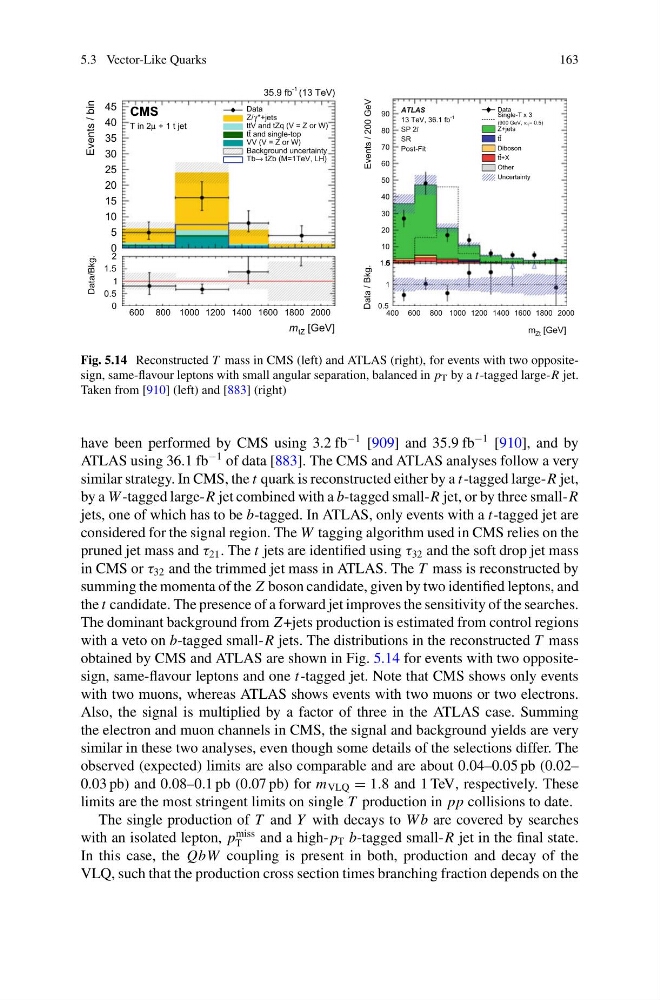
Fig. 5.14 Reconstructed T mass in CMS (left) and ATLAS (right), for events with two oppositesign, same-flavour leptons with small angular separation, balanced in p T by a t-tagged large-R jet.
Taken from [910] (left) and [883] (right)
have been performed by CMS using 3.2 fb
−1 [909] and 35.9 fb
−1 [910], and by
ATLAS using 36.1 fb
−1 of data [883]. The CMS and ATLAS analyses follow a very
similar strategy. In CMS, the t quark is reconstructed either by a t-tagged large-R jet,
by a W -tagged large-R jet combined with a b-tagged small-R jet, or by three small-R
jets, one of which has to be b-tagged. In ATLAS, only events with a t-tagged jet are
considered for the signal region. The W tagging algorithm used in CMS relies on the
pruned jet mass and τ 21 . The t jets are identified using τ 32 and the soft drop jet mass
in CMS or τ 32 and the trimmed jet mass in ATLAS. The T mass is reconstructed by
summing the momenta of the Z boson candidate, given by two identified leptons, and
the t candidate. The presence of a forward jet improves the sensitivity of the searches.
The dominant background from Z +jets production is estimated from control regions
with a veto on b-tagged small-R jets. The distributions in the reconstructed T mass
obtained by CMS and ATLAS are shown in Fig. 5.14 for events with two oppositesign, same-flavour leptons and one t-tagged jet. Note that CMS shows only events
with two muons, whereas ATLAS shows events with two muons or two electrons.
Also, the signal is multiplied by a factor of three in the ATLAS case. Summing
the electron and muon channels in CMS, the signal and background yields are very
similar in these two analyses, even though some details of the selections differ. The
observed (expected) limits are also comparable and are about 0.04–0.05 pb (0.02–
0.03 pb) and 0.08–0.1 pb (0.07 pb) for m VLQ = 1.8 and 1 TeV, respectively. These
limits are the most stringent limits on single T production in pp collisions to date.
The single production of T and Y with decays to W b are covered by searches
with an isolated lepton, p
miss
T
and a high- p T b-tagged small-R jet in the final state.
In this case, the QbW coupling is present in both, production and decay of the
VLQ, such that the production cross section times branching fraction depends on the
163
[GeV]
tZ
m
600 800 1000 1200 1400 1600 1800 2000
Data/Bkg.
0
0.5
1
1.5
2
Events / bin
0
5
10
15
20
25
30
35
40
45
Data
*+jets
γ
Z/
ttV and tZq (V = Z or W)
and single-top
t
t
VV (V = Z or W)
Background uncertainty
tZb (M=1TeV, LH)
→
Tb
(13 TeV)
-1
35.9 fb
CMS
+ 1 t jet
μ
T in 2
[GeV]
Zt
m
400 600 800 1000 1200 1400 1600 1800 2000
Data / Bkg.
0.5
1
1.5
Events / 200 GeV
0
10
20
30
40
50
60
70
80
90
ATLAS
-1
13 TeV, 36.1 fb
l
SP 2
SR
Post-Fit
Data
= 0.5)
T
κ
(900 GeV,
Single-T x 3
Z+jets
t
t
Diboson
+X
t
t
Other
Uncertainty
Fig. 5.14 Reconstructed T mass in CMS (left) and ATLAS (right), for events with two oppositesign, same-flavour leptons with small angular separation, balanced in p T by a t-tagged large-R jet.
Taken from [910] (left) and [883] (right)
have been performed by CMS using 3.2 fb
−1 [909] and 35.9 fb
−1 [910], and by
ATLAS using 36.1 fb
−1 of data [883]. The CMS and ATLAS analyses follow a very
similar strategy. In CMS, the t quark is reconstructed either by a t-tagged large-R jet,
by a W -tagged large-R jet combined with a b-tagged small-R jet, or by three small-R
jets, one of which has to be b-tagged. In ATLAS, only events with a t-tagged jet are
considered for the signal region. The W tagging algorithm used in CMS relies on the
pruned jet mass and τ 21 . The t jets are identified using τ 32 and the soft drop jet mass
in CMS or τ 32 and the trimmed jet mass in ATLAS. The T mass is reconstructed by
summing the momenta of the Z boson candidate, given by two identified leptons, and
the t candidate. The presence of a forward jet improves the sensitivity of the searches.
The dominant background from Z +jets production is estimated from control regions
with a veto on b-tagged small-R jets. The distributions in the reconstructed T mass
obtained by CMS and ATLAS are shown in Fig. 5.14 for events with two oppositesign, same-flavour leptons and one t-tagged jet. Note that CMS shows only events
with two muons, whereas ATLAS shows events with two muons or two electrons.
Also, the signal is multiplied by a factor of three in the ATLAS case. Summing
the electron and muon channels in CMS, the signal and background yields are very
similar in these two analyses, even though some details of the selections differ. The
observed (expected) limits are also comparable and are about 0.04–0.05 pb (0.02–
0.03 pb) and 0.08–0.1 pb (0.07 pb) for m VLQ = 1.8 and 1 TeV, respectively. These
limits are the most stringent limits on single T production in pp collisions to date.
The single production of T and Y with decays to W b are covered by searches
with an isolated lepton, p
miss
T
and a high- p T b-tagged small-R jet in the final state.
In this case, the QbW coupling is present in both, production and decay of the
VLQ, such that the production cross section times branching fraction depends on the