

154
5 Direct Searches for New Physics
6j, 3b
≥
0t, 0H,
6j, 3b
≥
1t, 0H,
6j, 3b
≥
0t, 1H,
6j, 3b
≥
1t, 1H,
6j, 3b
≥
2t, 0-1H,
≥
6j, 3b
≥
2H,
≥
0t,
≥
4b
≥
6j,
≥
0t, 0H,
4b
≥
6j,
≥
1t, 0H,
4b
≥
6j,
≥
0t, 1H,
4b
≥
6j,
≥
1t, 1H,
4b
≥
6j,
≥
2t, 0-1H,
≥
4b
≥
6j,
≥
2H,
≥
0t,
≥
7j, 2b, HM
≥
0t, 0H,
7j, 2b, HM
≥
1t, 0H,
7j, 2b, HM
≥
0t, 1H,
7j, 2b, HM
≥
2tH,
≥
7j, 3b, LM
≥
0t, 0H,
7j, 3b, LM
≥
1t, 0H,
7j, 3b, LM
≥
0t, 1H,
7j, 3b, LM
≥
1t, 1H,
7j, 3b, LM
≥
2t, 0-1H,
≥
7j, 3b, HM
≥
0t, 0H,
7j, 3b, HM
≥
1t, 0H,
7j, 3b, HM
≥
0t, 1H,
7j, 3b, HM
≥
1t, 1H,
7j, 3b, HM
≥
2t, 0-1H,
≥
7j, 3b
≥
2H,
≥
0t,
≥
4b, LM
≥
7j,
≥
0t, 0H,
4b, LM
≥
7j,
≥
1t, 0H,
4b, LM
≥
7j,
≥
0t, 1H,
4b, HM
≥
7j,
≥
0t, 0H,
4b, HM
≥
7j,
≥
1t, 0H,
4b, HM
≥
7j,
≥
0t, 1H,
4b
≥
7j,
≥
2tH,
≥
Data / Bkg
0
0.5
1
1.5
2
Events
1
10
2
10
3
10
4
10
5
10
ATLAS
-1
= 13 TeV, 36.1 fb
s
Search regions
Pre-Fit
Data
doublet (1 TeV)
T
T
+ light-jets
t
t
1c
≥
+
t
t
1b
≥
+
t
t
t
Non-t
Total Bkg unc.
1-lepton 0-lepton
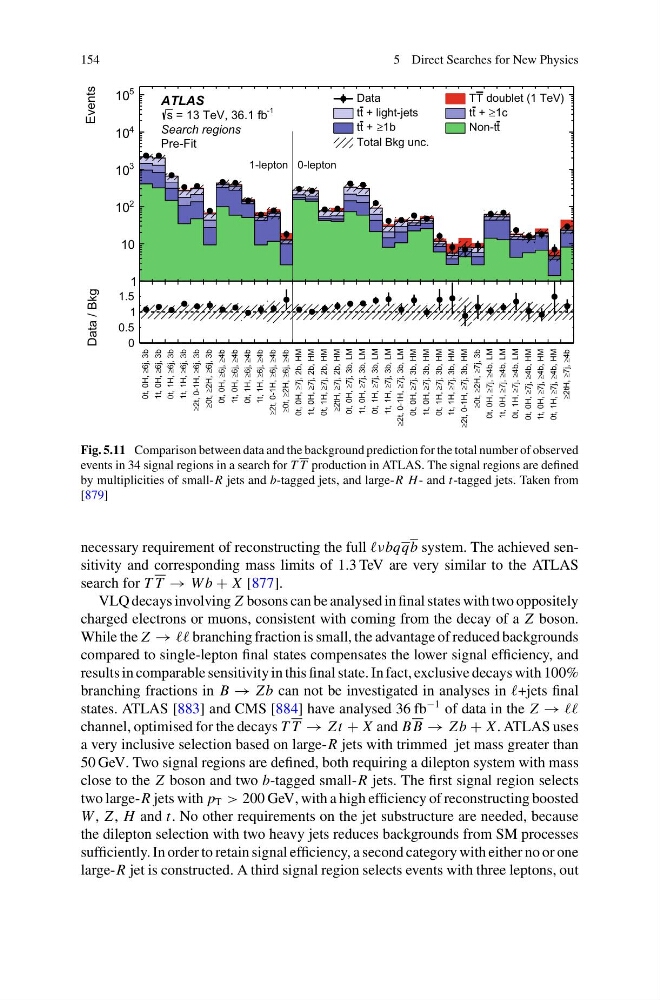
Fig. 5.11 Comparison between data and the background prediction for the total number of observed
events in 34 signal regions in a search for T T production in ATLAS. The signal regions are defined
by multiplicities of small-R jets and b-tagged jets, and large-R H- and t-tagged jets. Taken from
[879]
necessary requirement of reconstructing the full νbqqb system. The achieved sensitivity and corresponding mass limits of 1.3 TeV are very similar to the ATLAS
search for T T → W b + X [877].
VLQ decays involving Z bosons can be analysed in final states with two oppositely
charged electrons or muons, consistent with coming from the decay of a Z boson.
While the Z → branching fraction is small, the advantage of reduced backgrounds
compared to single-lepton final states compensates the lower signal efficiency, and
results in comparable sensitivity in this final state. In fact, exclusive decays with 100%
branching fractions in B → Zb can not be investigated in analyses in +jets final
states. ATLAS [883] and CMS [884] have analysed 36 fb
−1 of data in the Z →
channel, optimised for the decays T T → Zt + X and B B → Zb + X . ATLAS uses
a very inclusive selection based on large-R jets with trimmed jet mass greater than
50 GeV. Two signal regions are defined, both requiring a dilepton system with mass
close to the Z boson and two b-tagged small-R jets. The first signal region selects
two large-R jets with p T > 200 GeV, with a high efficiency of reconstructing boosted
W , Z , H and t. No other requirements on the jet substructure are needed, because
the dilepton selection with two heavy jets reduces backgrounds from SM processes
sufficiently. In order to retain signal efficiency, a second category with either no or one
large-R jet is constructed. A third signal region selects events with three leptons, out
5 Direct Searches for New Physics
6j, 3b
≥
0t, 0H,
6j, 3b
≥
1t, 0H,
6j, 3b
≥
0t, 1H,
6j, 3b
≥
1t, 1H,
6j, 3b
≥
2t, 0-1H,
≥
6j, 3b
≥
2H,
≥
0t,
≥
4b
≥
6j,
≥
0t, 0H,
4b
≥
6j,
≥
1t, 0H,
4b
≥
6j,
≥
0t, 1H,
4b
≥
6j,
≥
1t, 1H,
4b
≥
6j,
≥
2t, 0-1H,
≥
4b
≥
6j,
≥
2H,
≥
0t,
≥
7j, 2b, HM
≥
0t, 0H,
7j, 2b, HM
≥
1t, 0H,
7j, 2b, HM
≥
0t, 1H,
7j, 2b, HM
≥
2tH,
≥
7j, 3b, LM
≥
0t, 0H,
7j, 3b, LM
≥
1t, 0H,
7j, 3b, LM
≥
0t, 1H,
7j, 3b, LM
≥
1t, 1H,
7j, 3b, LM
≥
2t, 0-1H,
≥
7j, 3b, HM
≥
0t, 0H,
7j, 3b, HM
≥
1t, 0H,
7j, 3b, HM
≥
0t, 1H,
7j, 3b, HM
≥
1t, 1H,
7j, 3b, HM
≥
2t, 0-1H,
≥
7j, 3b
≥
2H,
≥
0t,
≥
4b, LM
≥
7j,
≥
0t, 0H,
4b, LM
≥
7j,
≥
1t, 0H,
4b, LM
≥
7j,
≥
0t, 1H,
4b, HM
≥
7j,
≥
0t, 0H,
4b, HM
≥
7j,
≥
1t, 0H,
4b, HM
≥
7j,
≥
0t, 1H,
4b
≥
7j,
≥
2tH,
≥
Data / Bkg
0
0.5
1
1.5
2
Events
1
10
2
10
3
10
4
10
5
10
ATLAS
-1
= 13 TeV, 36.1 fb
s
Search regions
Pre-Fit
Data
doublet (1 TeV)
T
T
+ light-jets
t
t
1c
≥
+
t
t
1b
≥
+
t
t
t
Non-t
Total Bkg unc.
1-lepton 0-lepton
Fig. 5.11 Comparison between data and the background prediction for the total number of observed
events in 34 signal regions in a search for T T production in ATLAS. The signal regions are defined
by multiplicities of small-R jets and b-tagged jets, and large-R H- and t-tagged jets. Taken from
[879]
necessary requirement of reconstructing the full νbqqb system. The achieved sensitivity and corresponding mass limits of 1.3 TeV are very similar to the ATLAS
search for T T → W b + X [877].
VLQ decays involving Z bosons can be analysed in final states with two oppositely
charged electrons or muons, consistent with coming from the decay of a Z boson.
While the Z → branching fraction is small, the advantage of reduced backgrounds
compared to single-lepton final states compensates the lower signal efficiency, and
results in comparable sensitivity in this final state. In fact, exclusive decays with 100%
branching fractions in B → Zb can not be investigated in analyses in +jets final
states. ATLAS [883] and CMS [884] have analysed 36 fb
−1 of data in the Z →
channel, optimised for the decays T T → Zt + X and B B → Zb + X . ATLAS uses
a very inclusive selection based on large-R jets with trimmed jet mass greater than
50 GeV. Two signal regions are defined, both requiring a dilepton system with mass
close to the Z boson and two b-tagged small-R jets. The first signal region selects
two large-R jets with p T > 200 GeV, with a high efficiency of reconstructing boosted
W , Z , H and t. No other requirements on the jet substructure are needed, because
the dilepton selection with two heavy jets reduces backgrounds from SM processes
sufficiently. In order to retain signal efficiency, a second category with either no or one
large-R jet is constructed. A third signal region selects events with three leptons, out