

5.3 Vector-Like Quarks
151
T 2/3
T 2/3
p
p
b, t, t
W
+ , Z, H
W
− , Z, H
¯
b, ¯ t, ¯ t
B −1/3
B −1/3
p
p
t, b, b
W
− , Z, H
W
+ , Z, H
¯ t, ¯
b, ¯
b
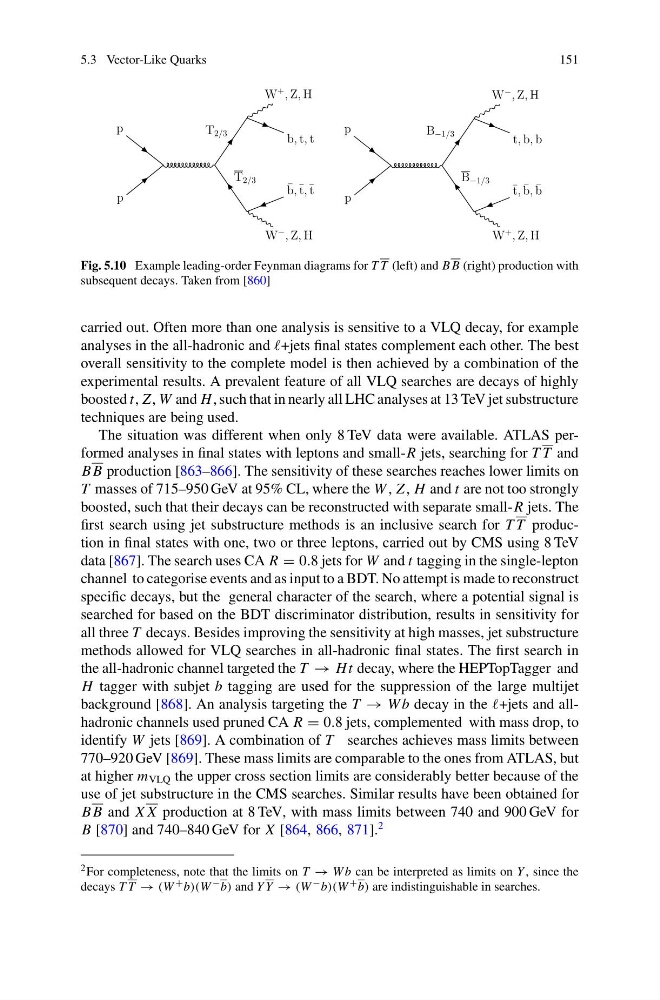
Fig. 5.10 Example leading-order Feynman diagrams for T T (left) and B B (right) production with
subsequent decays. Taken from [860]
carried out. Often more than one analysis is sensitive to a VLQ decay, for example
analyses in the all-hadronic and +jets final states complement each other. The best
overall sensitivity to the complete model is then achieved by a combination of the
experimental results. A prevalent feature of all VLQ searches are decays of highly
boosted t, Z , W and H , such that in nearly all LHC analyses at 13 TeV jet substructure
techniques are being used.
The situation was different when only 8 TeV data were available. ATLAS performed analyses in final states with leptons and small-R jets, searching for T T and
B B production [863–866]. The sensitivity of these searches reaches lower limits on
T masses of 715–950 GeV at 95% CL, where the W , Z , H and t are not too strongly
boosted, such that their decays can be reconstructed with separate small-R jets. The
first search using jet substructure methods is an inclusive search for T T production in final states with one, two or three leptons, carried out by CMS using 8 TeV
data [867]. The search uses CA R = 0.8 jets for W and t tagging in the single-lepton
channel to categorise events and as input to a BDT. No attempt is made to reconstruct
specific decays, but the general character of the search, where a potential signal is
searched for based on the BDT discriminator distribution, results in sensitivity for
all three T decays. Besides improving the sensitivity at high masses, jet substructure
methods allowed for VLQ searches in all-hadronic final states. The first search in
the all-hadronic channel targeted the T → Ht decay, where the HEPTopTagger and
H tagger with subjet b tagging are used for the suppression of the large multijet
background [868]. An analysis targeting the T → W b decay in the +jets and allhadronic channels used pruned CA R = 0.8 jets, complemented with mass drop, to
identify W jets [869]. A combination of T searches achieves mass limits between
770–920 GeV [869]. These mass limits are comparable to the ones from ATLAS, but
at higher m VLQ the upper cross section limits are considerably better because of the
use of jet substructure in the CMS searches. Similar results have been obtained for
B B and X X production at 8 TeV, with mass limits between 740 and 900 GeV for
B [870] and 740–840 GeV for X [864, 866, 871].
2
2 For completeness, note that the limits on T → W b can be interpreted as limits on Y , since the
decays T T → (W + b)(W − b) and Y Y → (W − b)(W + b) are indistinguishable in searches.
151
T 2/3
T 2/3
p
p
b, t, t
W
+ , Z, H
W
− , Z, H
¯
b, ¯ t, ¯ t
B −1/3
B −1/3
p
p
t, b, b
W
− , Z, H
W
+ , Z, H
¯ t, ¯
b, ¯
b
Fig. 5.10 Example leading-order Feynman diagrams for T T (left) and B B (right) production with
subsequent decays. Taken from [860]
carried out. Often more than one analysis is sensitive to a VLQ decay, for example
analyses in the all-hadronic and +jets final states complement each other. The best
overall sensitivity to the complete model is then achieved by a combination of the
experimental results. A prevalent feature of all VLQ searches are decays of highly
boosted t, Z , W and H , such that in nearly all LHC analyses at 13 TeV jet substructure
techniques are being used.
The situation was different when only 8 TeV data were available. ATLAS performed analyses in final states with leptons and small-R jets, searching for T T and
B B production [863–866]. The sensitivity of these searches reaches lower limits on
T masses of 715–950 GeV at 95% CL, where the W , Z , H and t are not too strongly
boosted, such that their decays can be reconstructed with separate small-R jets. The
first search using jet substructure methods is an inclusive search for T T production in final states with one, two or three leptons, carried out by CMS using 8 TeV
data [867]. The search uses CA R = 0.8 jets for W and t tagging in the single-lepton
channel to categorise events and as input to a BDT. No attempt is made to reconstruct
specific decays, but the general character of the search, where a potential signal is
searched for based on the BDT discriminator distribution, results in sensitivity for
all three T decays. Besides improving the sensitivity at high masses, jet substructure
methods allowed for VLQ searches in all-hadronic final states. The first search in
the all-hadronic channel targeted the T → Ht decay, where the HEPTopTagger and
H tagger with subjet b tagging are used for the suppression of the large multijet
background [868]. An analysis targeting the T → W b decay in the +jets and allhadronic channels used pruned CA R = 0.8 jets, complemented with mass drop, to
identify W jets [869]. A combination of T searches achieves mass limits between
770–920 GeV [869]. These mass limits are comparable to the ones from ATLAS, but
at higher m VLQ the upper cross section limits are considerably better because of the
use of jet substructure in the CMS searches. Similar results have been obtained for
B B and X X production at 8 TeV, with mass limits between 740 and 900 GeV for
B [870] and 740–840 GeV for X [864, 866, 871].
2
2 For completeness, note that the limits on T → W b can be interpreted as limits on Y , since the
decays T T → (W + b)(W − b) and Y Y → (W − b)(W + b) are indistinguishable in searches.