

134
5 Direct Searches for New Physics
0
200
400
600
800
1000
Events / 6 GeV
(13 TeV)
-1
35.9 fb
CMS
CR
t
t
All categories
Data
Fit unc.
bkg.
t
m
bkg.
W
m
Lost t/W bkg.
q/g bkg.
40 60 80 100 120 140 160 180 200
[GeV]
b
b
m
0.5
1
1.5
Data / fit
0
500
1000
1500
2000
Events / 6 GeV
(13 TeV)
-1
35.9 fb
CMS
q/g CR
All categories
Data
Fit unc.
bkg.
t
m
bkg.
W
m
Lost t/W bkg.
q/g bkg.
40 60 80 100 120 140 160 180 200
[GeV]
b
b
m
0.5
1
1.5
Data / fit
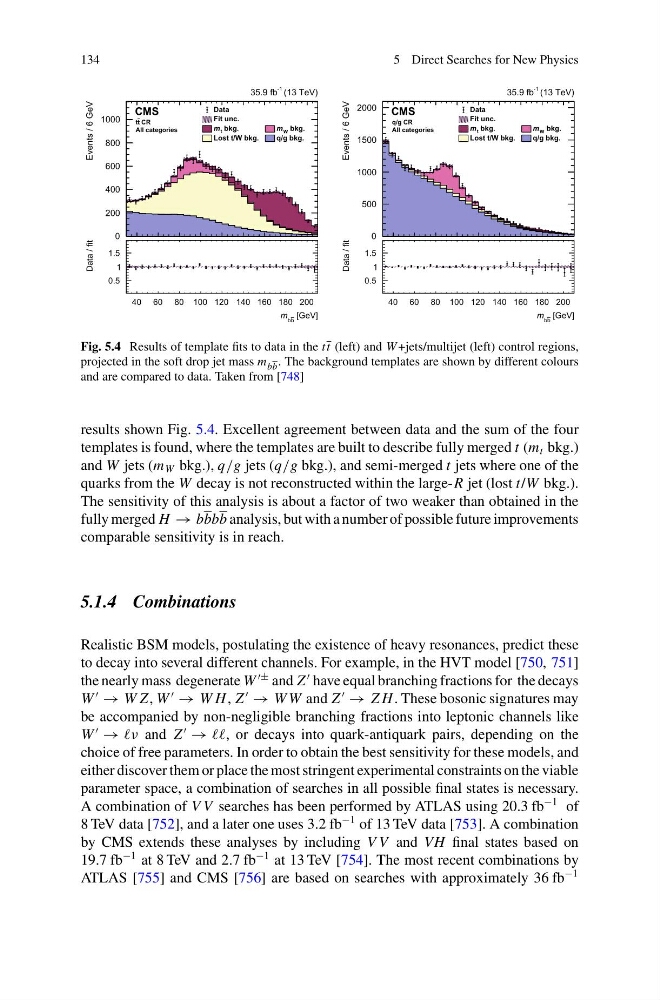
Fig. 5.4 Results of template fits to data in the tt (left) and W +jets/multijet (left) control regions,
projected in the soft drop jet mass m bb . The background templates are shown by different colours
and are compared to data. Taken from [748]
results shown Fig. 5.4. Excellent agreement between data and the sum of the four
templates is found, where the templates are built to describe fully merged t (m t bkg.)
and W jets (m W bkg.), q/g jets (q/g bkg.), and semi-merged t jets where one of the
quarks from the W decay is not reconstructed within the large-R jet (lost t/W bkg.).
The sensitivity of this analysis is about a factor of two weaker than obtained in the
fully merged H → bbbb analysis, but with a number of possible future improvements
comparable sensitivity is in reach.
5.1.4 Combinations
Realistic BSM models, postulating the existence of heavy resonances, predict these
to decay into several different channels. For example, in the HVT model [750, 751]
the nearly mass degenerate W
and Z
have equal branching fractions for the decays
W
→ W Z, W
→ W H, Z
→ W W and Z
→ Z H. These bosonic signatures may
be accompanied by non-negligible branching fractions into leptonic channels like
W
→ ν and Z
→ , or decays into quark-antiquark pairs, depending on the
choice of free parameters. In order to obtain the best sensitivity for these models, and
either discover them or place the most stringent experimental constraints on the viable
parameter space, a combination of searches in all possible final states is necessary.
A combination of V V searches has been performed by ATLAS using 20.3 fb
−1 of
8 TeV data [752], and a later one uses 3.2 fb
−1 of 13 TeV data [753]. A combination
by CMS extends these analyses by including V V and VH final states based on
19.7 fb
−1 at 8 TeV and 2.7 fb
−1 at 13 TeV [754]. The most recent combinations by
ATLAS [755] and CMS [756] are based on searches with approximately 36 fb
−1
5 Direct Searches for New Physics
0
200
400
600
800
1000
Events / 6 GeV
(13 TeV)
-1
35.9 fb
CMS
CR
t
t
All categories
Data
Fit unc.
bkg.
t
m
bkg.
W
m
Lost t/W bkg.
q/g bkg.
40 60 80 100 120 140 160 180 200
[GeV]
b
b
m
0.5
1
1.5
Data / fit
0
500
1000
1500
2000
Events / 6 GeV
(13 TeV)
-1
35.9 fb
CMS
q/g CR
All categories
Data
Fit unc.
bkg.
t
m
bkg.
W
m
Lost t/W bkg.
q/g bkg.
40 60 80 100 120 140 160 180 200
[GeV]
b
b
m
0.5
1
1.5
Data / fit
Fig. 5.4 Results of template fits to data in the tt (left) and W +jets/multijet (left) control regions,
projected in the soft drop jet mass m bb . The background templates are shown by different colours
and are compared to data. Taken from [748]
results shown Fig. 5.4. Excellent agreement between data and the sum of the four
templates is found, where the templates are built to describe fully merged t (m t bkg.)
and W jets (m W bkg.), q/g jets (q/g bkg.), and semi-merged t jets where one of the
quarks from the W decay is not reconstructed within the large-R jet (lost t/W bkg.).
The sensitivity of this analysis is about a factor of two weaker than obtained in the
fully merged H → bbbb analysis, but with a number of possible future improvements
comparable sensitivity is in reach.
5.1.4 Combinations
Realistic BSM models, postulating the existence of heavy resonances, predict these
to decay into several different channels. For example, in the HVT model [750, 751]
the nearly mass degenerate W
and Z
have equal branching fractions for the decays
W
→ W Z, W
→ W H, Z
→ W W and Z
→ Z H. These bosonic signatures may
be accompanied by non-negligible branching fractions into leptonic channels like
W
→ ν and Z
→ , or decays into quark-antiquark pairs, depending on the
choice of free parameters. In order to obtain the best sensitivity for these models, and
either discover them or place the most stringent experimental constraints on the viable
parameter space, a combination of searches in all possible final states is necessary.
A combination of V V searches has been performed by ATLAS using 20.3 fb
−1 of
8 TeV data [752], and a later one uses 3.2 fb
−1 of 13 TeV data [753]. A combination
by CMS extends these analyses by including V V and VH final states based on
19.7 fb
−1 at 8 TeV and 2.7 fb
−1 at 13 TeV [754]. The most recent combinations by
ATLAS [755] and CMS [756] are based on searches with approximately 36 fb
−1