

118
4 Standard Model Measurements
[GeV]
t
T
p
0
200 400 600 800 1000 1200 1400 1600 1800 2000
NNLO
Data
0.2
0.4
0.6
0.8
1
1.2
1.4
1.6
1.8
2
ATLAS
-1
= 13 TeV, 36.1 fb
s
Full phase-space
Absolute cross-section
Resolved
Stat. unc.
Stat.+Syst. unc.
Boosted
Stat. unc.
Stat.+Syst. unc.
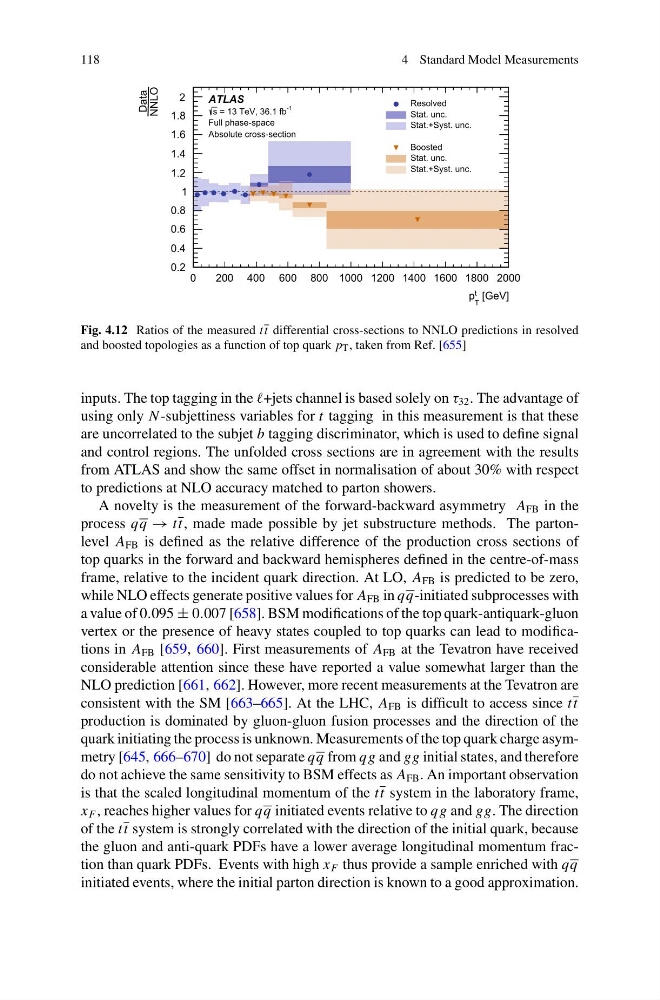
Fig. 4.12 Ratios of the measured tt differential cross-sections to NNLO predictions in resolved
and boosted topologies as a function of top quark p T , taken from Ref. [655]
inputs. The top tagging in the +jets channel is based solely on τ 32 . The advantage of
using only N -subjettiness variables for t tagging in this measurement is that these
are uncorrelated to the subjet b tagging discriminator, which is used to define signal
and control regions. The unfolded cross sections are in agreement with the results
from ATLAS and show the same offset in normalisation of about 30% with respect
to predictions at NLO accuracy matched to parton showers.
A novelty is the measurement of the forward-backward asymmetry A FB in the
process qq → tt, made made possible by jet substructure methods. The partonlevel A FB is defined as the relative difference of the production cross sections of
top quarks in the forward and backward hemispheres defined in the centre-of-mass
frame, relative to the incident quark direction. At LO, A FB is predicted to be zero,
while NLO effects generate positive values for A FB in qq-initiated subprocesses with
a value of 0.095 ± 0.007 [658]. BSM modifications of the top quark-antiquark-gluon
vertex or the presence of heavy states coupled to top quarks can lead to modifications in A FB [659, 660]. First measurements of A FB at the Tevatron have received
considerable attention since these have reported a value somewhat larger than the
NLO prediction [661, 662]. However, more recent measurements at the Tevatron are
consistent with the SM [663–665]. At the LHC, A FB is difficult to access since tt
production is dominated by gluon-gluon fusion processes and the direction of the
quark initiating the process is unknown. Measurements of the top quark charge asymmetry [645, 666–670] do not separate qq from qg and gg initial states, and therefore
do not achieve the same sensitivity to BSM effects as A FB . An important observation
is that the scaled longitudinal momentum of the tt system in the laboratory frame,
x F , reaches higher values for qq initiated events relative to qg and gg. The direction
of the tt system is strongly correlated with the direction of the initial quark, because
the gluon and anti-quark PDFs have a lower average longitudinal momentum fraction than quark PDFs. Events with high x F thus provide a sample enriched with qq
initiated events, where the initial parton direction is known to a good approximation.
4 Standard Model Measurements
[GeV]
t
T
p
0
200 400 600 800 1000 1200 1400 1600 1800 2000
NNLO
Data
0.2
0.4
0.6
0.8
1
1.2
1.4
1.6
1.8
2
ATLAS
-1
= 13 TeV, 36.1 fb
s
Full phase-space
Absolute cross-section
Resolved
Stat. unc.
Stat.+Syst. unc.
Boosted
Stat. unc.
Stat.+Syst. unc.
Fig. 4.12 Ratios of the measured tt differential cross-sections to NNLO predictions in resolved
and boosted topologies as a function of top quark p T , taken from Ref. [655]
inputs. The top tagging in the +jets channel is based solely on τ 32 . The advantage of
using only N -subjettiness variables for t tagging in this measurement is that these
are uncorrelated to the subjet b tagging discriminator, which is used to define signal
and control regions. The unfolded cross sections are in agreement with the results
from ATLAS and show the same offset in normalisation of about 30% with respect
to predictions at NLO accuracy matched to parton showers.
A novelty is the measurement of the forward-backward asymmetry A FB in the
process qq → tt, made made possible by jet substructure methods. The partonlevel A FB is defined as the relative difference of the production cross sections of
top quarks in the forward and backward hemispheres defined in the centre-of-mass
frame, relative to the incident quark direction. At LO, A FB is predicted to be zero,
while NLO effects generate positive values for A FB in qq-initiated subprocesses with
a value of 0.095 ± 0.007 [658]. BSM modifications of the top quark-antiquark-gluon
vertex or the presence of heavy states coupled to top quarks can lead to modifications in A FB [659, 660]. First measurements of A FB at the Tevatron have received
considerable attention since these have reported a value somewhat larger than the
NLO prediction [661, 662]. However, more recent measurements at the Tevatron are
consistent with the SM [663–665]. At the LHC, A FB is difficult to access since tt
production is dominated by gluon-gluon fusion processes and the direction of the
quark initiating the process is unknown. Measurements of the top quark charge asymmetry [645, 666–670] do not separate qq from qg and gg initial states, and therefore
do not achieve the same sensitivity to BSM effects as A FB . An important observation
is that the scaled longitudinal momentum of the tt system in the laboratory frame,
x F , reaches higher values for qq initiated events relative to qg and gg. The direction
of the tt system is strongly correlated with the direction of the initial quark, because
the gluon and anti-quark PDFs have a lower average longitudinal momentum fraction than quark PDFs. Events with high x F thus provide a sample enriched with qq
initiated events, where the initial parton direction is known to a good approximation.