

4.2 Measurements Using Jet Substructure
115
300
400
500
600
700
800
900
1000
1100
1200
[fb/GeV]
t
T
/dp
t
t
σ
d
-2
10
-1
10
1
10
Fiducial phase-space
Data
POWHEG+PYTHIA
ALPGEN+HERWIG
MC@NLO+HERWIG
POWHEG+HERWIG
ATLAS
-1
= 8 TeV, 20.3 fb
s
300
400
500
600
700
800
900
1000
1100
1200
0.5
1
1.5
2
[GeV]
T
Particle top-jet candidate p
Pred. / Data
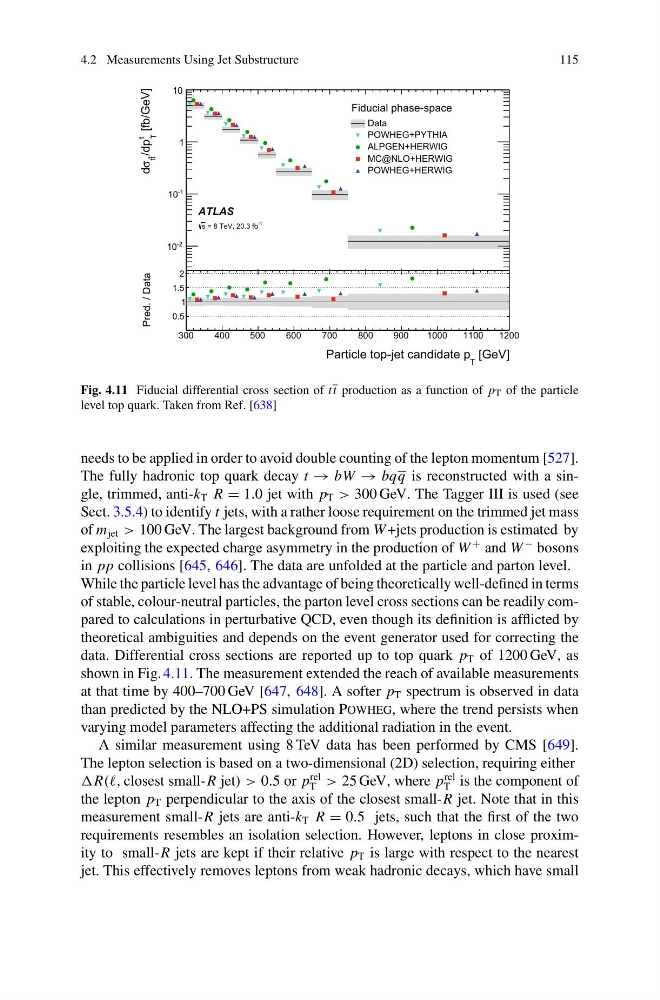
Fig. 4.11 Fiducial differential cross section of tt production as a function of p T of the particle
level top quark. Taken from Ref. [638]
needs to be applied in order to avoid double counting of the lepton momentum [527].
The fully hadronic top quark decay t → bW → bqq is reconstructed with a single, trimmed, anti-k T R = 1.0 jet with p T > 300 GeV. The Tagger III is used (see
Sect. 3.5.4) to identify t jets, with a rather loose requirement on the trimmed jet mass
of m jet > 100 GeV. The largest background from W +jets production is estimated by
exploiting the expected charge asymmetry in the production of W
+ and W
− bosons
in pp collisions [645, 646]. The data are unfolded at the particle and parton level.
While the particle level has the advantage of being theoretically well-defined in terms
of stable, colour-neutral particles, the parton level cross sections can be readily compared to calculations in perturbative QCD, even though its definition is afflicted by
theoretical ambiguities and depends on the event generator used for correcting the
data. Differential cross sections are reported up to top quark p T of 1200 GeV, as
shown in Fig. 4.11. The measurement extended the reach of available measurements
at that time by 400–700 GeV [647, 648]. A softer p T spectrum is observed in data
than predicted by the NLO+PS simulation Powheg, where the trend persists when
varying model parameters affecting the additional radiation in the event.
A similar measurement using 8 TeV data has been performed by CMS [649].
The lepton selection is based on a two-dimensional (2D) selection, requiring either
closest small-R jet) > 0.5 or p
rel
T > 25 GeV, where p
rel
T is the component of
the lepton p T perpendicular to the axis of the closest small-R jet. Note that in this
measurement small-R jets are anti-k T R = 0.5 jets, such that the first of the two
requirements resembles an isolation selection. However, leptons in close proximity to small-R jets are kept if their relative p T is large with respect to the nearest
jet. This effectively removes leptons from weak hadronic decays, which have small
115
300
400
500
600
700
800
900
1000
1100
1200
[fb/GeV]
t
T
/dp
t
t
σ
d
-2
10
-1
10
1
10
Fiducial phase-space
Data
POWHEG+PYTHIA
ALPGEN+HERWIG
MC@NLO+HERWIG
POWHEG+HERWIG
ATLAS
-1
= 8 TeV, 20.3 fb
s
300
400
500
600
700
800
900
1000
1100
1200
0.5
1
1.5
2
[GeV]
T
Particle top-jet candidate p
Pred. / Data
Fig. 4.11 Fiducial differential cross section of tt production as a function of p T of the particle
level top quark. Taken from Ref. [638]
needs to be applied in order to avoid double counting of the lepton momentum [527].
The fully hadronic top quark decay t → bW → bqq is reconstructed with a single, trimmed, anti-k T R = 1.0 jet with p T > 300 GeV. The Tagger III is used (see
Sect. 3.5.4) to identify t jets, with a rather loose requirement on the trimmed jet mass
of m jet > 100 GeV. The largest background from W +jets production is estimated by
exploiting the expected charge asymmetry in the production of W
+ and W
− bosons
in pp collisions [645, 646]. The data are unfolded at the particle and parton level.
While the particle level has the advantage of being theoretically well-defined in terms
of stable, colour-neutral particles, the parton level cross sections can be readily compared to calculations in perturbative QCD, even though its definition is afflicted by
theoretical ambiguities and depends on the event generator used for correcting the
data. Differential cross sections are reported up to top quark p T of 1200 GeV, as
shown in Fig. 4.11. The measurement extended the reach of available measurements
at that time by 400–700 GeV [647, 648]. A softer p T spectrum is observed in data
than predicted by the NLO+PS simulation Powheg, where the trend persists when
varying model parameters affecting the additional radiation in the event.
A similar measurement using 8 TeV data has been performed by CMS [649].
The lepton selection is based on a two-dimensional (2D) selection, requiring either
closest small-R jet) > 0.5 or p
rel
T > 25 GeV, where p
rel
T is the component of
the lepton p T perpendicular to the axis of the closest small-R jet. Note that in this
measurement small-R jets are anti-k T R = 0.5 jets, such that the first of the two
requirements resembles an isolation selection. However, leptons in close proximity to small-R jets are kept if their relative p T is large with respect to the nearest
jet. This effectively removes leptons from weak hadronic decays, which have small